

William Slatter (1759–1837)
Mayor of Oxford 1824/5 [and 1825]
William Slatter (or Slater) was born in Oxford and baptised at St Peter-in-the-East Church on 7 March 1759, the fourth of the seven children of John and Catherine Slatter.
His father was a freeman of Oxford and was probably the John Slatter of St Thomas parish who married Catherine Weston of St Michael’s parish at St Mary Magdalen Church on 9 February 1753. His siblings were also baptised at St Peter-in-the-East Church on the following dates: Mary Slatter (12 February 1755); Jane Slatter (2 February 1756); John Slatter (16 March 1757); Ann Slatter (17 May 1761); and Sarah Slatter (16 March 1766).
In 1772 a survey of every house in the city was taken in consequence of the Mileways Act of 1771. According to H. E. Salter, Mr Slatter (William's father John) had a house at the east end of the High Street on the site of the present Examination Schools which had a frontage of 4 yards, 2 ft. and 7 in. and was in St Peter-in-the-East parish. The John Slatter buried at St Peter-in-the-East Church five years later on 30 December 1779 was probably William’s father.
On 7 November 1782 at St James's Church in Westminster, William Slatter married Lucy Gerard, and they had two sons:
- William Slatter junior (baptised at St Peter-in-the-East Church on 3 July 1784)
- Phipps Gerard Slatter (baptised at St Peter-in-the-East Church on 30 Apr 1789).
On 26 April 1784, in order to set up business as a baker in Oxford’s High Street), William Slatter, aged 25, took up his freedom of the city by virtue of being the second son of John Slatter.
In 1786 William Slatter, described as a baker of St Peter-in-the-East parish, took on as his first apprentices Thomas Verey of Langford in Berkshire and Jave Lock of Oxford.
William Slatter was elected to the Common Council on 1 October 1787, and was chosen as City Chamberlain in 1790, Junior Bailiff in 1795, and Viewer of Nuisances in 1801.
The Catherine Slater who was buried at St Peter-in-the-East Church on 18 March 1794 was probably William's mother.
William Slatter was listed as a baker in the Universal Directory of Britain for 1794. in 1795 he took on another apprentice, William Farrell of St Clement’s, and on 29 September 1799 he took on Robert Slatter, son of the Oxford plumber and glazier John Slatter, who is likely to have been a relation.
In March 1801 the council agreed to let the city estate at Eynsham to a Mr William Slatter (presumably the future Mayor) for an annual rent of £180 and a payment of 4% p.a. for all money laid out by the city in buildings on the farm, and he extended it in 1813.
Both of Slatter's sons were matriculated at the University of Oxford from Christ Church, each described in Alumni Oxonienses as “s. William of St. Peter's, Oxford (city), pleb.”:
- On 28 January 1801 his elder son William Slatter junior was matriculated at the age of 16,
obtaining his BA in 1805 and his MA in 1808. - On 11 March 1806 his younger son Phipps Gerard Slatter was also matriculated at the age of 16,
obtaining his BA in 1809 and his MA in 1812.
The Cartulary of St John the Baptist shows that on 6 December 1807 the lease of half of Chapel Hall, alias Link Lodging, was granted to Charles Wheeler Fidler, and that one of its two occupants was William Slatter, baker. (Link Lodging was at the north-east end of the High Street, near Longwall Street.)
Both of Slatter’s sons were admitted free on 13 October 1812.
His younger son, the Revd Phipps Gerard Slatter, died at the age of 25 at Kirkham in Lancashire on 24 March 1815, just after being appointed Headmaster of Kirkham Grammar School.
His wife Lucy Slatter died at the age of 54. She was buried at Cumnor on 4 November 1818, with the parish register stating that her abode was the High Street, Oxford. .
In about 1817 William Slatter took on a business partner, Alexander Bayne, and on 25 November 1820 the following notice appeared in Jackson’s Oxford Journal, indicating that Slatter was handing the whole business over to Bayne:
HIGH STREET, OXFORD
Mr. William Slatter having declined the baking business in favour of his late partner, Mr. Alexander Bayne, requests that all persons who have demands on the partnership, or on his private account, will present the same, that it may be immediately discharged.
ALEXANDER BAYNE
begs leave to extend thanks to his friends and the public for their support during his late Partnership, and hopes, by an unremitting attention, to merit their future favours.
Pigot’s Directory for 1823, however, still listed “Slatter & Bayne” as bakers in the High, so Slatter’s name must have remained on the shop.
Slatter was for many years one of the Commissioners under the Paving and Lighting Act.
On 17 June 1824 he was elected one of the eight assistants, and then just a few months later on 20 September he was elected Mayor of Oxford for the first time (for 1824/5).
On 11 November 1824 the council minutes state that Slatter had said that he could not take part in the St Scholastica's Day humiliation the following February“without a painful sacrifice of personal feeling” and as a result the council debated the continuance of the practice and it was abolished.
On 21 July 1825 he perambulated the city boundary.
Slatter was elected to serve again as Mayor for the following year, 1825/6, but it was discovered that it was now illegal for a Mayor to serve for two years running, and Thomas Ensworth took over from him at the end of November 1825.
In January 1826 Slatter was appointed a Justice of the Peace, and on 2 December 1825 Slatter was elected on to the Market Committee.
In the case of The Mayor and Corporation v. Farriday/Faraday in 1827 (regarding the illegal selling of china by Samuel Bayliss Faraday, who was not a freeman), it was necessary to ascertain whether William Slatter was disqualified from giving evidence. This extract from his statement reported in Jackson's Oxford Journal of 4 August 1827 neatly sums up Slatter's early life as a baker in Oxford:
I am near 70 years of age; about three and forty years ago I attempted to settle myself in Oxford as a baker. At that time I was not a freeman of the City; and application was then made to me by the Corporation to take up my freedom, as they would not suffer me to trade until I had done so. In consequence I came to the Town Hall and took my freedom up, and paid about twenty-three shillings for it. As I was entitled to it by my father’s copy, I only paid the ordinary fees. I then carried on business in the city for three or four and twenty years. For the last ten years I have retired from business altogether. I have also been an Assistant and have served the office of Mayor of the city. I have also been a Member of a Committee of the Council called the Committee of Trade. The principal duty of that Committee is to receive reports from the officers of the City respecting persons carrying on trade, who are not free.
In the event Slatter was one of a group of councillors who on 23 July 1827 had to resign their freedom and their place on the Council to give evidence, but a week later on 30 July he was reinstated thus at a Council meeting:
Also at this Council it is unanimously ordered and agreed that William Slatter Esquire who has this day been readmitted to the Freedom of this City pursuant to the above Act of Council have a Bailiffs Place in this House And that he be reinstated to his rank in the Chamber immediately preceding his resignation.
Then on 2 August 1827 he was elected one of the Assistants:
At this Council William Slatter Esquire was by Scrutiny in the House elected one of the eight assistants or associates of this City which became vacant by his resignation and removal at the Council holden by adjournment the twenty seventh day of July ultimo: And the said William Slatter Esquire being present came and took the several oaths appointed by Act of Parliament And also the oath of an assistant and paid to the Treasurer one of the Keykeepers Five pounds according to custom.
William Slatter was still living in St Peter-in-the-East parish in Oxford at the time of his death on 11 February 1837 at the age of 77. He was described as living in Oxford when he buried with his wife in Cumnor at St Michael's Church on 17 February 1837.
His death notice and obituary in Jackson's Oxford Journal on 18 February 1837 read:
On the 11th inst. in the 78th year of his age, William Slatter, Esq. of the High-street, in this city. Mr. Slatter was elected a Member of the Council Chamber in the year 1787, and served the office of Bailiff with Mr. Adams in 1795. In the year 1824 he was elected Mayor of the City and discharged the duties of the office with the strictest integrity; and so highly was he respected by all classes, that at the expiration of his Mayoralty he was re-chosen, a circumstance which had not happened before in the city for the space of 140 years. Soon after this re-election, however, it was discovered that by a clause in an Act of Queen Anne, the re-election was illegal, and Mr Slatter held the office until a mandamus could be obtained, when Mr Ensworth was elected Mayor. Mr. Slatter was for many years one of the Commissioners under the Paving and Lighting Act, in the discharge of the duties of which office he was indefatigable, and rendered extensive service to the inhabitants of Oxford generally.
Will of William Slatter
William Slatter (now described as “Esquire”) wrote a very short will on 13 June 1828 leaving all his property to his only surviving son and sole executor the Revd William Slatter and his heirs.
A Codicil to that Will that he signed on 24 December 1828 was confirmed as genuine by the bakers William and Alexander Bayne who now ran his former business. This added the words:
I also give and bequeath to the Mayor and Aldermen of the City of Oxford in Bond for one hundred pounds on the Hincksey trust in trust that the interest on the same be applied one half for the benefit of the Blue Coat Charity School in Oxford and the other half to the Minister and Church Wardens of the parish of Cumnor in the County of Berks to be applied towards defraying the Expense of educating the Children of the poor of the parish.
(Alexander Bayne was still listed as a baker in the High Street in Pigot’s Directory of 1842 and died there at the age of 80 on 24 July 1847.)
The Revd William Slatter junior (1784–1846) (Christ Church)
Only surviving son of the Mayor William Slatter
The Revd William Slatter (born 1784), graduate of Christ Church, was awarded his B.A. in 1805 and his M.A. in 1808, and was ordained Priest on 24 December 1813. He was one of the two chaplains of Christ Church from 1808 to 1813 and was confusingly succeeded by his cousin of the same name. He appears to have been the William Slatter who ran a school at Denton House, Rose Hill, Iffley referred to as “The Gentlemen's Academy”. He died at Iffley and was buried there on 11 June 1846, with his age very precisely recorded as 56 years and 10 months (which does not match his 1784 baptism).
The Revd John Slatter (1757–1810), brother of the Mayor
Vicar of Cumnor 1798–1810
The Mayor's brother, John Slatter (born near the beginning of 1757), was described as “s. John, of Oxford (city), pleb.” when he was matriculated at the University of Oxford from St Alban Hall at the age of 27 on 16 December 1784. He served as Usher of Magdalen College School from 1788 to 1791 and was Master of New College School from 1781 to 1806. He was Vicar of Cumnor from December 1798 until his death (and also of Stanton Harcourt from 10 August 1803). He died in Cumnor at the age of 53 and was buried there on 13 July 1810 according to their parish register. (His will mentions his his brother William and his sisters Mary, Sarah, and Jane, and Elizabeth alias Catherine, which matches the siblings of the Mayor.) His widow, Lydia Slatter died at Rose Hill, Oxford and was buried inside Cumnor Church with him on 19 May 1817.
Another William Slatter
(1789–1849) John Slatter's son and nephew of the Mayor
Vicar of Cumnor
1810–1849
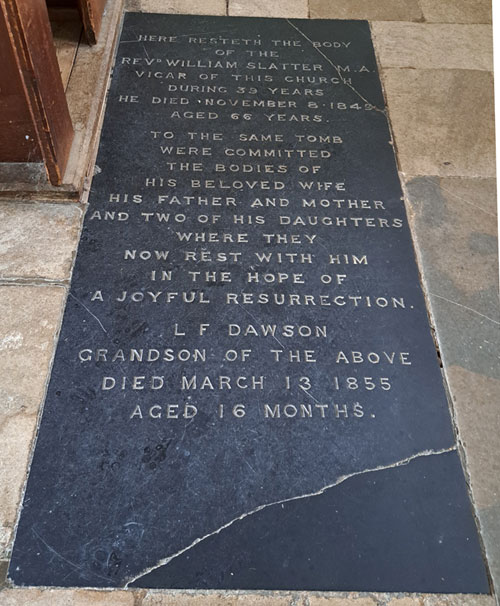
Slate memorial slab in the floor of St Michael's Church in Cumnor
remembering the Revd William Slatter and his wife, two of their daughters,
his father and mother, and his grandson Leonard Frederick Dawson
The Mayor's nephew, another William Slatter (born in Oxford in 1789 and baptised at St Aldate's Church on 22 August) was the son of John Slatter above.
He was matriculated at the University of Oxford from Merton College on 26 October 1803 at the age of 14 and was already described as the Revd William Slatter when he was awarded his M.A. on 30 June 1810. He succeeded his father as Vicar of Cumnor in July 1810 and was also Rector of Hethe. Confusingly he also succeeded his cousin of the same name in 1813 as Chaplain of Christ Church. On 25 August 1814 at St George's Church, Hanover Square, London the Revd William Slatter, described as the Vicar of Cumnor, married Lucy Butler of Oxford, and they had five daughters baptised at Cumnor: Lucy, later Mrs Burford (1815), Emily (1816, died 1828), Jane (1819, died 1841), Fanny, later Mrs Dawson (1822), and Caroline, later Mrs Green (1826).
The Revd William Slatter's wife Lucy Slatter died at the age of 40 and was buried inside Cumnor Church with her father-in-law on 28 August 1832.
He himself died at Cumnor vicarage at the age of 66 on 8 November 1849 and was buried in the same vault in St Michael's Church there as the rest of his family on 14 November.
The sisters of the Mayor William Slatter
- Mary Slatter (born c. 1755) married Deodatus Eaton of St Aldate’s at St Peter-in-the-East Church on 27 July 1776.
- Jane Slatter (born c.1756) married James Butler at St Martin-in-the-Fields Church, Westminster on 1 October 1776.
- Sarah Slatter (born c.1766) of All Saints Parish married Thomas Langston of Christ Church at All Saints’ Church, Oxford on 10 July 1787.
See also:
- Jackson’s Oxford Journal, 18 February 1837, p. 3c (obituary)
- PCC Will of William Slatter of Oxford, proved on 18 April 1837: PROB 11/1877
- Malcolm Graham, Oxford City Apprentices, Nos. 2800, 2803, 3060, 3179
