

88–89: Durham Building

The Durham Building of University College was erected in 1902, and the architect was Harry Wilkinson Moore. It is named after William of Durham, who endowed the college in 1249.
It is a Grade II listed building (List Entry No. 1299972). It was at the west end of St Peter-in-the East parish until that parish was united with St Cross parish in 1957.
In 1904 a controversial small bridge (on right of photograph above) was built across Logic Lane, linking this section to the main body of the college to the west.
During the First World War the Durham Building was used as a military hospital.
An earlier and different 89 High Street ...
The buildings on this site were first numbered just 88 High Street and No. 89 was to the west of the University College. When the College expanded and demolished No. 89, the “lost” number was used by this building until it too was demolished in 1902.
For the former Staunton Hall that was originally allocated this number, see separate page
The former building on this site (the Alfred's Head Inn, later University Hall)
John Browne, the Master of University College from 1745 to 1764, left a house on this site to University College when he died in 1764 (more details here).
By 1786 the building was the Alfred's Head Inn (named after King Alfred, who was the alleged founder of University College), and was licensed by the Vice-Chancellor of the University (to sell wines and spirits). On 25 February 1786 Joseph Hart advertised that he would continue to set out from the coach office at the Alfred's Head opposite The Queen's College at seven o'clock every morning to the New Inn in the Old Bailey London and that another coach returned to Oxford from London at the same time. The cost was inside passengers 13s, and outside passengers and children on laps seven shillings.
In 1791 the innkeeper was Robert Smith: he left near the end of 1796 to go into partnership with Joseph Walker at a distillery warehouse in Cornmarket. The Universal British Directory of 1794/5 announced:
From the Alfred's Head, High-street:—Thomas Bowbert's [sic] coach sets out every morning at half past seven, Sunday excepted, to the New Inn, Old Bailey, London; inside fare 14s. outside 8s.
On 2 April 1795 Robert Smith announced that he had taken over the Alfred's Head Inn, where he provided wines of the best quality and from which a coach to London left every day except Sunday. The following advertisement that appeared in Jackson's Oxford Journal on 25 August 1798 describes the coach service, which took eight hours, in more detail:
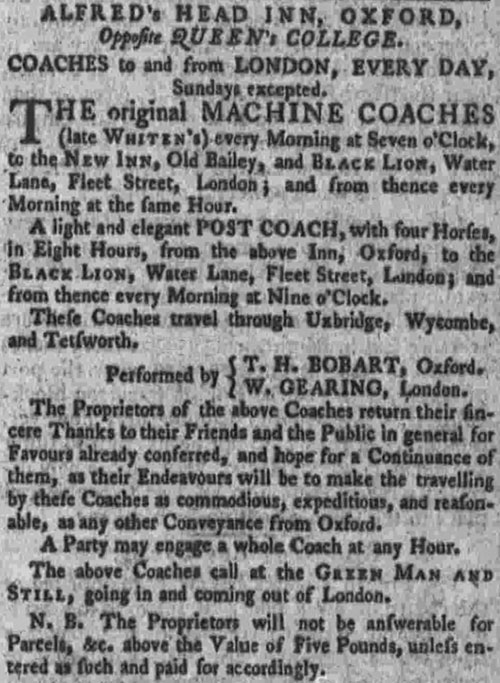
When the Alfred's Head Inn was advertised to let In Jackson's Oxford Journal of of 7 July 1804, particulars were available from T. H. Bobart at the inn. Then on 15 September 1804 Christopher Graham announced that he had taken it over and had newly fitted it up, that it had good beds and reasonable charges, and that Bobart's Coaches to and from London stopped here every day.
The Alfred's Head Inn was still going strong on 25 October 1809, when the Loyal and Independent Lodge of Odd Fellows feasted on roast beef and plum pudding to celebrate the start of the 50th year of the reign of King George III.
On 6 January 1810 Jackson's Oxford Journal contained an advertisement from T. H. Bobart, coachmaster, that the inn was to be let with immediate possession, and a week later the reason for the vacancy was announced: the current landlords, Mr & Mrs Graham, had been elected as Master and Mistress of the House of Industry in Oxford.
It appears that the inn was not let, as on 17 February 1810 the Loyal Independent Lodge of Odd Fellows announced that they had resolved to move their Lodge from the Alfred's Head Inn to the Chequers pub, and by 1 June 1811 it had closed, as it was described as “late the King's Head Inn” in an advertisement for an auction of its contents to be held at the back of the premises, “Mr. Bobart having declined the public business, and occupying only part of the house". Items for sale included the sign of King Alfred on a mahogany board, a three-motion beer engine with sinking front, pewter and plated cups, spirit casks, and furniture.
From 1811 University College let out the building as three private properties.
After the original No. 89 on at the western end of University College was demolished in 1842, that number seems to have been picked up by these premises, which were henceforth numbered 88 and 89.
The 1851 census appears to show five students living at No. 88 and a college servant called James Lawson and his wife and children living at No. 89 with their servant girl and two more student lodgers, but it is not clear.
At the time of the 1861 census this building was two properties, with No. 88 on the left occupied by William Cattle (77) and his wife Dinah plus their lodger and three servants and No. 89 on the right by the French milliner and dressmaker, Mlle Florentine Duprez (24), and her apprentice and two “improvers”, plus an undergraduate lodger and two servants. Halford’s Livery Stables appear to have operated from Tarry’s Court behind.
In 1867 University College took over this building at Nos. 88 & 89 for its own use, renaming it University Hall, and henceforth it is described in directories as being part of University College.
At the time of the 1871 census University Hall was occupied by the college porter William Tomlins (38) and his wife Ann and their two children.
In 1881 No. 88 was uninhabited, and No. 89 was occupied by the college porter, John Wheeler (35) and his wife Sarah and their two young children. He was described as the head of the household, and living with him as “boarders” were an undergraduate, a second college porter, and the lecturer in classics at University College, plus a number of servants of the college.
In the 1891 census it is probably the “University College House” occupied by a parlourmaid and a kitchenmaid. In 1901 it was occupied by the college servant Percy F. Bickerton (21) and the porter Frederick Smith (43).
The photograph below (Historic England CC50/00767) was taken in 1901 and shows University Hall shortly before it was demolished, with Walford's antique shop at No. 87 on the left and Logic Lane and then the start of University College proper on on the right:
There is a glimpse of the Alfred's Head Inn on the left in this engraving of 1755 and in this painting of 1798/9.
The following photograph (Historic England HT08650) was also taken just before demolition and shows a carved sixteenth-century fireplace in the hall:
This photograph (Historic England CC50/00769) shows more of the same room:
In 1902 University Hall was replaced by University College's Durham Building.
