

An earlier 89 High Street
The original 89 High Street was further to the west, opposite All Souls College, and attached to No. 90.
It was demolished in 1842 to make way for University College's New Buildings,
and the lost number 89 was then used for part of No. 88 to the east
This is a drawing by William Turner of Oxford of the building that originally had this number, made not long before its demolition in 1842 (Historic England HT00106):
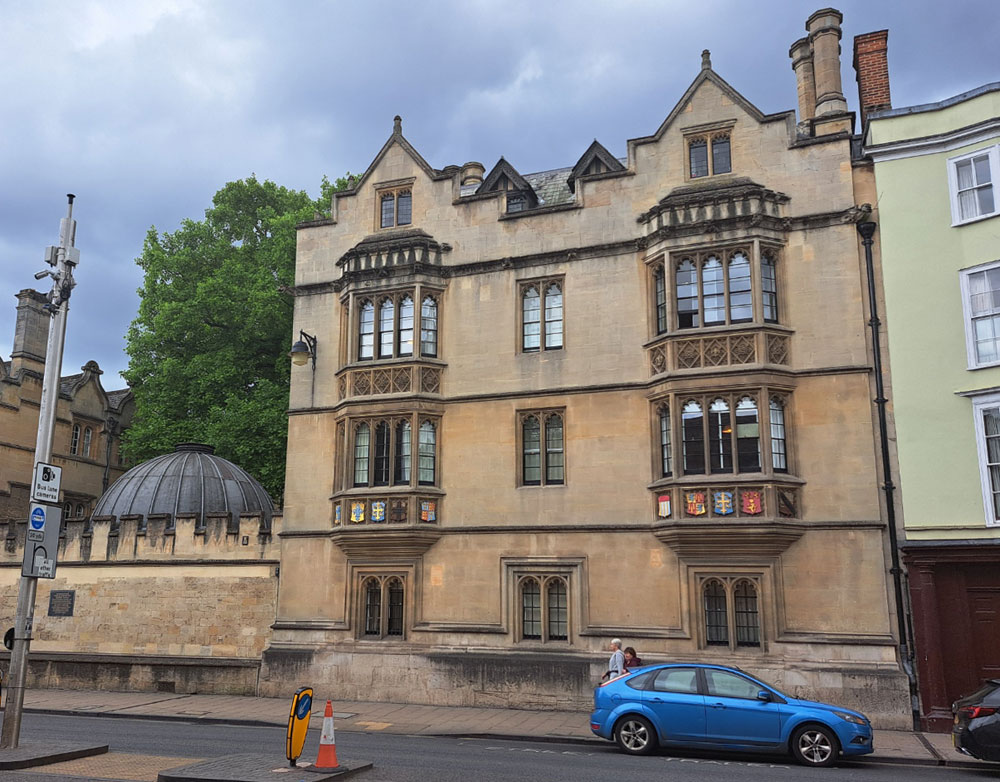
A new part of University College was built on this site in 1842 in Bath (Box ground) stone to Tudor Gothic designs of Sir Charles Barry, and is Grade II listed (list entry number 1046634). It is shown here in 1853 (with a glimpse of the present No. 90 and its pillar to the right) and below in 2025:
Staunton Hall
The building that stood on this site in St Mary-the-Virgin parish was originally an academic hall of University College known as Staunton Hall. Anthony Wood wrote:
Next tenement to the aforementioned hall called Deep Hall, where now a tavern is, was sometimes a very ancient hall called Staunton Hall. It was one of those ten<ements> purchased with the money of William of Durham by the name of Staunton Hall, 4 Henry III <1220> for the endowment of his fellowships in University College; and, according to the charter of dotation, situated in the street leading from S. Marie's Church to East Gate between the tenements of the Abbey of Osney on the east and west sides, with a garden behind it of ten perches in length and two and an half in breadth; and paying for all service 1s if required, which (as I guesse) went to S. Marie's Church through the hands of University College as diverse rentalls,
The Three Tuns Tavern, 1639–1764
By 1639 University College let out this building as the Three Tuns tavern: drawing. The first known vinter here was Humphrey Boddicott, and H. E. Salter, Surveys and Tokens, shows two tokens with “HUMPHRY BODICOTT” around an image of a vinter’s bush on the obverse, and “VINTENER IN OXON” around an image of three tuns (wine or beer casks) on the reverse
Anthony Wood paid a number of visits here while it was run by Humphrey Boddicott, and recorded on 28 March 1666 that he visited it two days after Humphrey Pont had taken over.
The landlords from 1639 until the tavern closed in 1764 were as follows:
- 1639–1664: Humphrey Boddicott until his death in 1655 and then his widow Judith Boddicott until the licence was transferred in 1664, the year before her death
- 1664: Anthony Hall of the Mermaid Inn
- 1666–1687: Richard Pont (from 26 March 1666 according to Anthony Wood) until his death in March 1670 and then his widow Elizabeth Pont, who died in November 1687. There is a fine memorial to both of them on the wall of St Mary-the-Virgin Church
- 1688–1693: George Brown and his wife Joan Brown
- 1693–1699: William Taylor until his death in May 1695 and then his widow Ann Taylor. Ann married her second husband Culpepper Tomlinson at St John the Baptist Church in Oxford on 10 August 1699
- 1699–1719: Culpepper Tomlinson who died on 15 January 1711/12, aged 45. Ann Tomlinson, now widowed a second time, again took over the tavern until her own death on 12 May 1719.
- 1719–1764: Richard Bradgate until his death at the age of 33 on 8 January 1728/9, and then his wife Elizabeth Bradgate until her death on 21 September 1748: both were buried in St Mary-the-Virgin Church, and each has a diamond floor tile. Their son Richard Bradgate junior took over the tavern until at least 1750, and probably until his death on 26 September 1764.
Jeremy Haslam in “Oxford Taverns and the Cellars of All Souls in the 17th and 18th Centuries” (Oxoniensia, 1969) points out that every keeper of the Three Tuns listed above supplied wine to All Souls College.
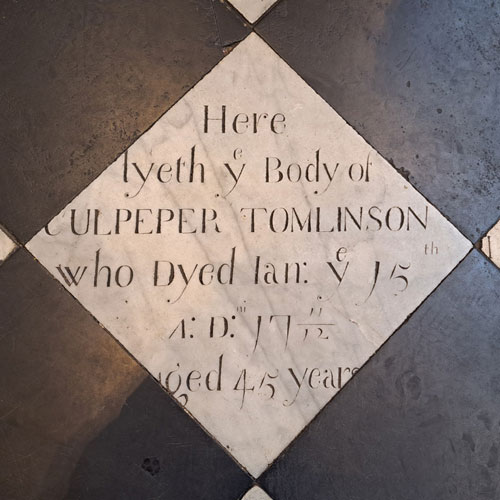
Left: Diamond in the floor of St Mary the Virgin Church commemorating Culpeper Tomlinson, the landlord of the Three Tuns from 1699 to 1719. It reads:
Here
lyeth ye Body of
CULPEPER TOMLINSON
who Dyed Ian: ye 15
A:D: 1711/12
aged 45 years
His wife Ann Tomlinson, formerly Mrs Taylor, who died on 12 May 1719 is also buried inside St Mary the Virgin Church and has a full-sized flagstone.
Shop(s), 1764–1842
The building appears to have ceased to be a pub after 1764. The 1772 Survey of Oxford shows two occupants: on the left (with a frontage of 10 yds 2 ft 9 in.) was Mr Kemp, and on the right (with a frontage of 5 yards 1 ft 3 in.) was the bookseller Mr Parker.
On 5 November 1831 W, & C. Bayne Chadwell (nephews of Charles Bayne), working cutlers, announced that they had taken a shop in the centre of the High Street, which was evidently this buiding, as on 15 October 1836 they announced that they were moving out of 89 High Street, where they had been for five years.
By 1839 the building was occupied by Robert Friend Sweetinburgh, who appears to have originated in London but had been duly matriculated by the University of Oxford as a “bibliopola” (bookseller) on 25 May 1833 so that he could trade in the city as a privileged person. Robson's Directory for 1839 duly lists the bookseller R. F. Sweetinburgh at 89 High Street.
In Jackson's Oxford Journal of 9 May 1840 Sweetinburgh announced that he had declined business here, and on 20 June 1840 a forthcoming auction of all the shop fittings and fixtures here at 89 High Street was advertised. The drawing at the top of this page shows the name SWEETINBURGH over the left-hand window, the number 89 over the door, and BOOKSELLER over the right-hand window.
The old building was demolished in 1842.
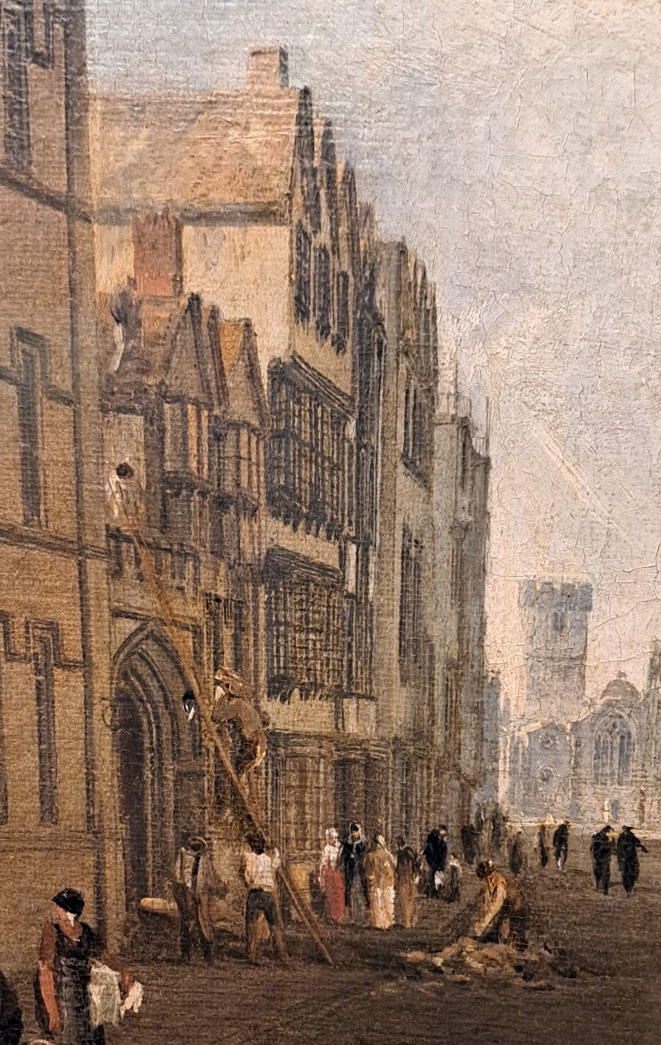
Right: Detail from J. M. W. Turner's painting of Oxford's High Street in 1809/10 with the former Three Tuns in the middle and Deep Hall (about to be demolished) to the left.
