
The Third Southern General Hospital in Oxford was a territorial-force hospital that could accommodate 336 officers and 1210 other ranks in different sections, based in university, college, and city buildings. It was officially opened on 16 August 1914 at the University's Examination Schools with a dedication ceremony attended by the Bishop of Oxford.
For people trying to trace the hospital where their relations died, the options can be narrowed down slightly by the fact that the sections of these hospitals were in the two different registration districts, indicated below by [O] for the Oxford registration district and [H] for Headington registration district.
Some of the men who died of their wounds in this hospital are buried in Oxford (Botley) Military CemeteryThe links in the list below take you to a section further down the page on each specific hospital
For officers only
- Somerville College, Woodstock Road [H]: 262 beds
For all ranks (in descending order of number of beds provided)
- Oxford Workhouse, Cowley Road [H]: 382 beds in the workhouse infirmary, including 110 beds for malaria cases
- Examinations Schools, High Street [O]: 346 beds, including 94 beds for orthopaedic cases and 25 for “nerve cases”. While the building was being prepared, Magdalen College School accommodated the wounded until their pupils returned in late September 1914
- Oxford Town Hall, St Aldate's [O]: 205 beds for malaria cases
- University College, Oxford [O]: 185 beds, with 76 beds in the Durham Building and 109 beds for recuperating servicemen in the Radcliffe Building
- New College, Oxford [O]: Shelter with 109 beds for tuberculosis, septic surgical cases, and cerebro-spinal fever carrier cases
- Oxford Masonic Buildings, Oxford [O]: 48 beds
The Radcliffe Infirmary [H]
In addition the Radcliffe Infirmary on the Woodstock Road provided 64 beds and the Oxford Eye Hospital (in the Infirmary's former fever hospital at the back, facing Walton Street) supplied 12 beds for eye cases only.
The 3rd Southern General Hospital also had responsibility for another 1,000 beds in local auxiliary and VAD (Voluntary Aid Detachment) hospitals, including the University of Oxford VAD Orthopaedic Auxiliary Hospital, which opened in the Sarah Acland Memorial District Nurses' Home at 23 Banbury Road, next to the Acland Nursing home (formerly Felstead House and now the Oxford Robotics Institute): Photograph.
Somerville College, Woodstock Road
In 1915 the War Office took over Somerville College, and the women there were relocated to Oriel College's St Mary Hall quadrangle. It provided 262 beds, and from 1916 these were for officers only.

“Somerville Section, 3rd Southern General Hospital, Oxford”
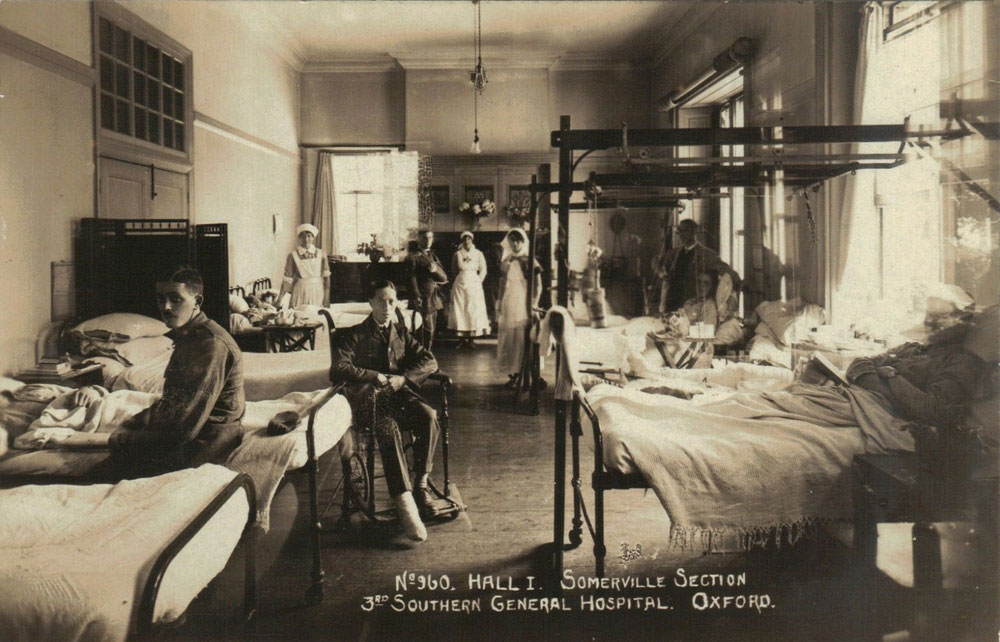 Patients and nurses inside the Somerville section of the 3rd Southern General Hospital

“Main Gateway. Somerville Section, 3rd Southern General Hospital, Oxford”
Photograph of officers in the quad on the east side of Walton House, Somerville College
More information about Somerville College when it was a hospital
Photograph of the library with convalescing officers
on the Somerville Historian blog by Dr Natalia Nowakowska

Plaque on the wall of Somerville College, Woodstock Road
A pamphlet of photographs entitled “Somerville Section, 3rd Southern General Hospital, Oxford” was published by the Qualis Photo Company in about 1918 and is available at the Oxfordshire History Centre (PA Pamphlets (strongroom) OXFO/362.1) and in the Bodleian Library
Oxford Workhouse, Cowley Road, Oxford
There were 382 beds in the workhouse infirmary, including 110 beds for malaria cases.
The postcard below produced by Henry Taunt (who lived nearby at Rivera) is entitled “3rd Southern Hospital, Cowley Rd, Oxford". The board just inside the gate reads: “3RD SOUTHERN GENERAL HOSPITAL, COWLEY SECTION. NO ADMITTANCE EXCEPT ON BUSINESS. BY ORDER"

Examination Schools, High Street, Oxford
The Examination Schools had room for 346 beds, including 94 beds for orthopaedic cases and 25 ‘nerve cases’. General information on the Examination Schools building here.
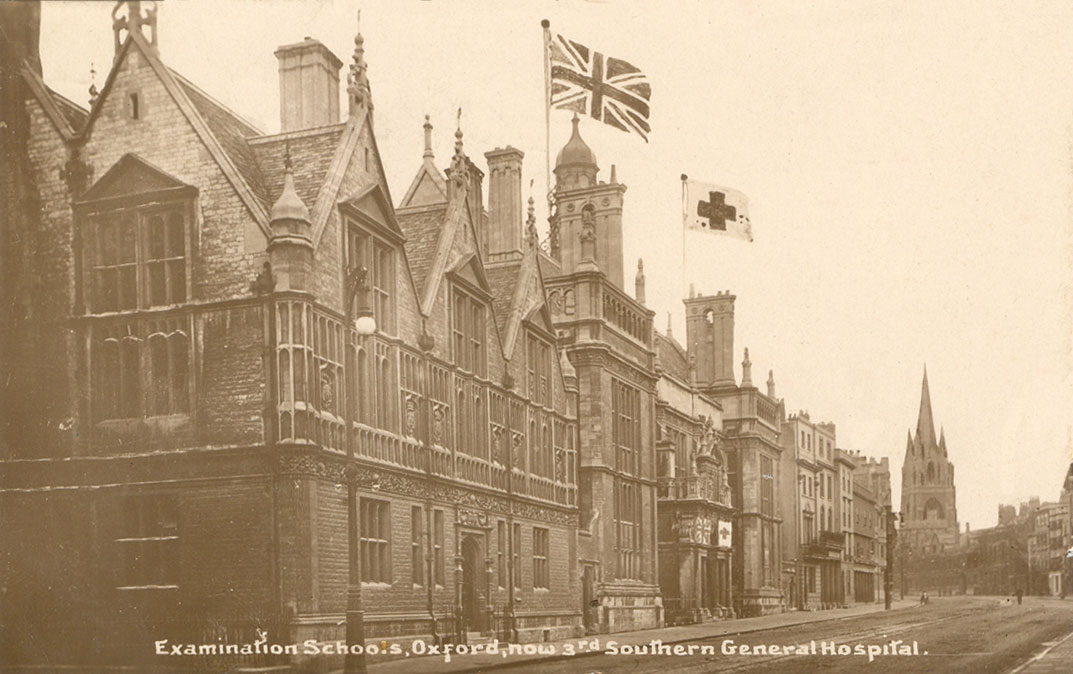
“Examination Schools, Oxford, now 3rd Southern General Hospital”, flying the Union and Red Cross flags
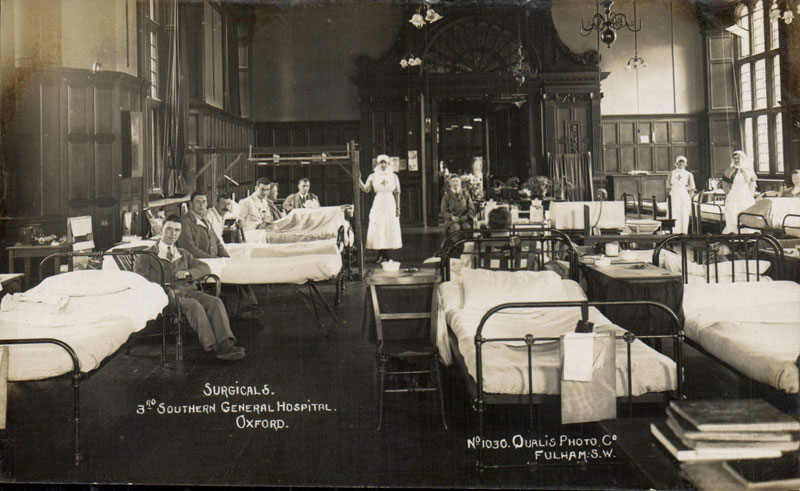
“Surgical 5, 3rd Southern General Hospital, Oxford” in one of the large Schools
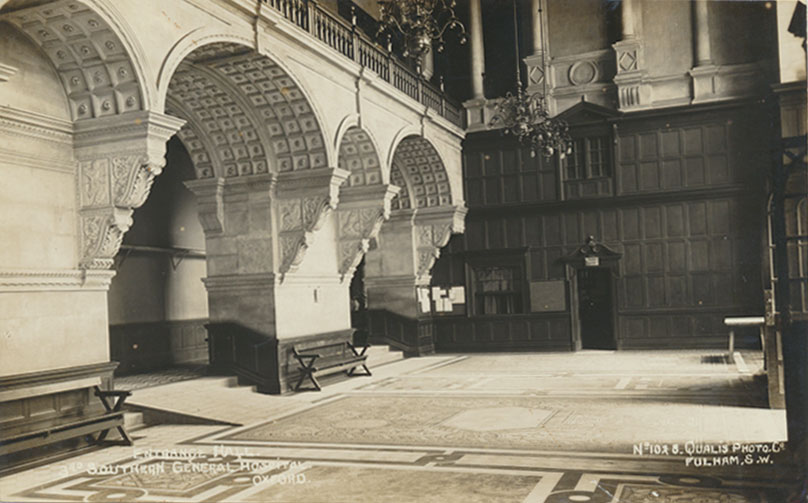
“Entrance Hall, 3rd Southern General Hospital, Oxford”
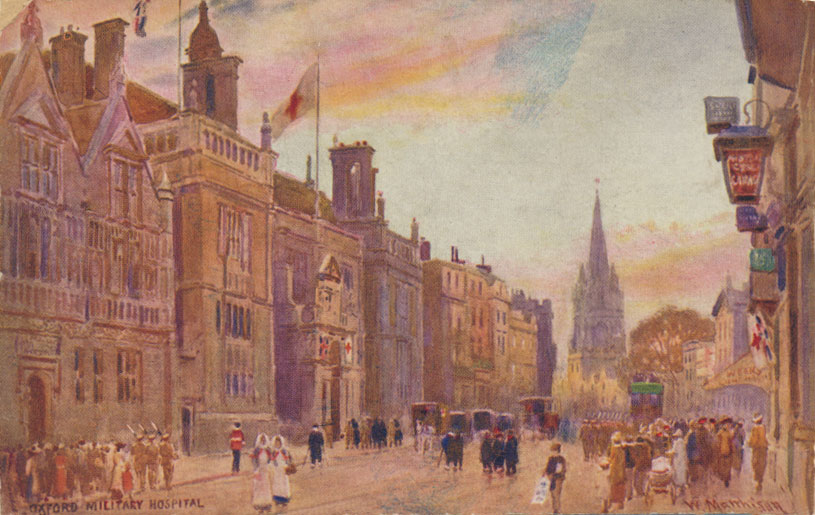
Painting of the Oxford Military Hospital (Examination Schools) by William Matthison, with soldiers and nurses
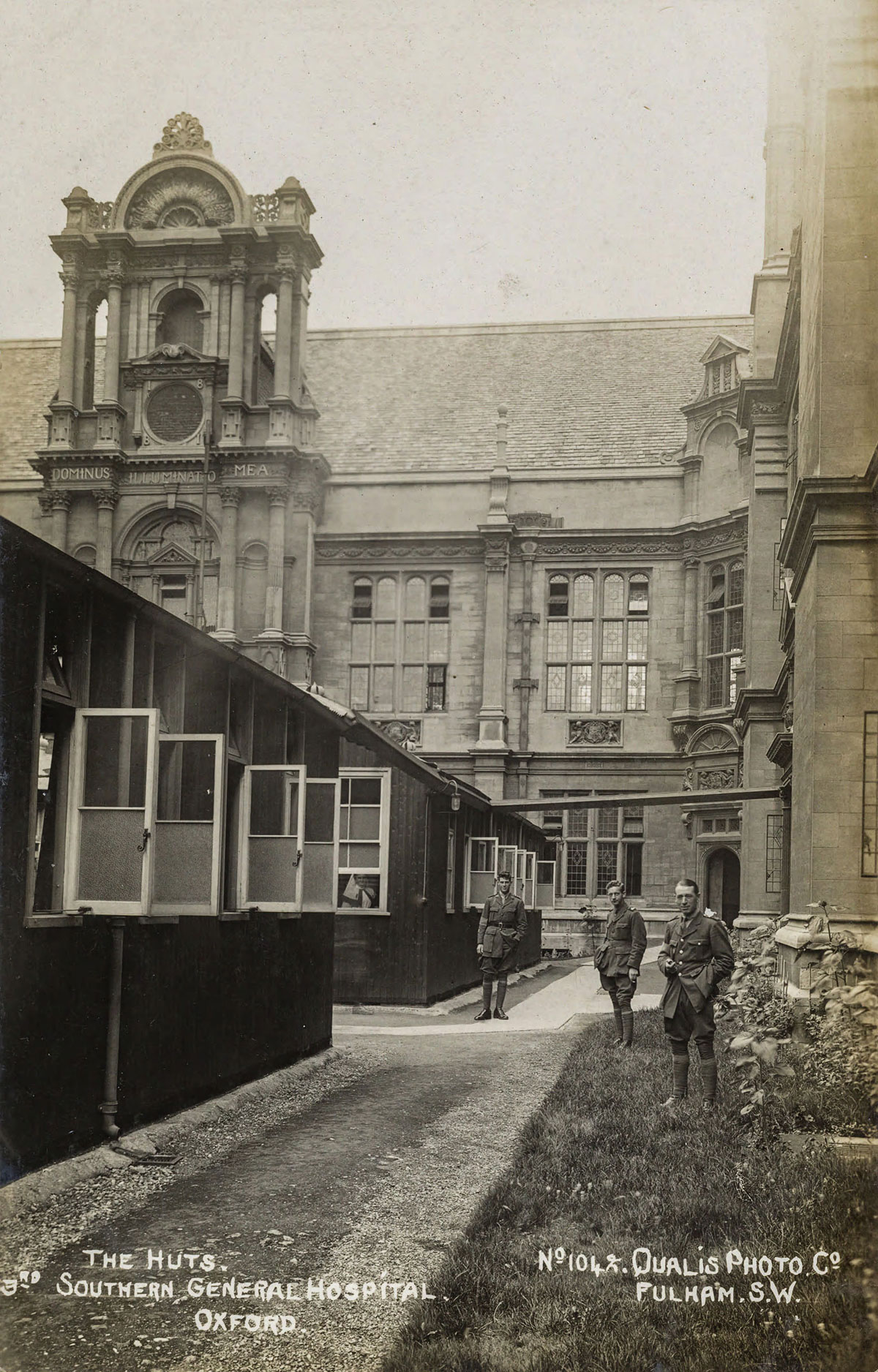
Three uniformed soldiers pose outside wooden huts in the quadrangle of the Examination Schools
(Picture Oxon 0251518: reproduced with the permission of the Oxfordshire History Centre
Oxford Town Hall
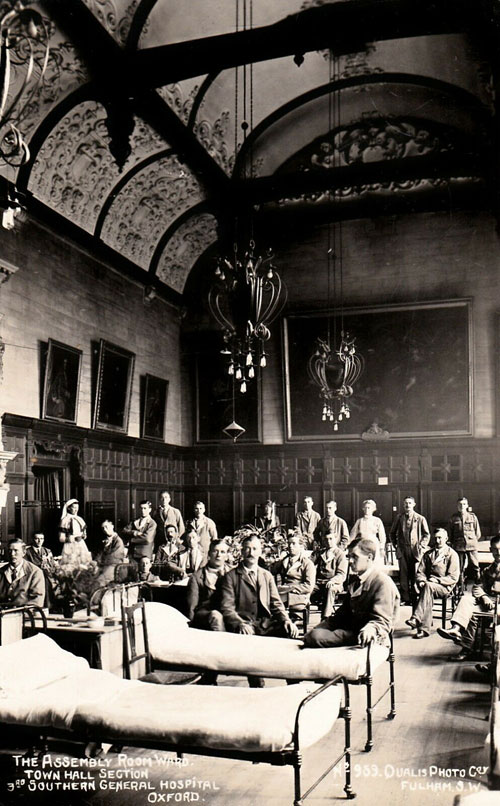
Oxford's Town Hall had 205 beds for malaria cases.
The photograph on the right shows the Assembly Room. This was used for patients' recreation, but appears to have also contained a few beds.
The Orchestra Room was used as a ward.
There is general information on the Town Hall building here
University College, High Street, Oxford
This had 76 beds in the college's Durham Building (88–89 High Street) and 109 beds for recuperating servicemen in the Radcliffe Building
The two postcards below are owned by Richard Keil and were sent by his great-grandfather to his great-grandmother.
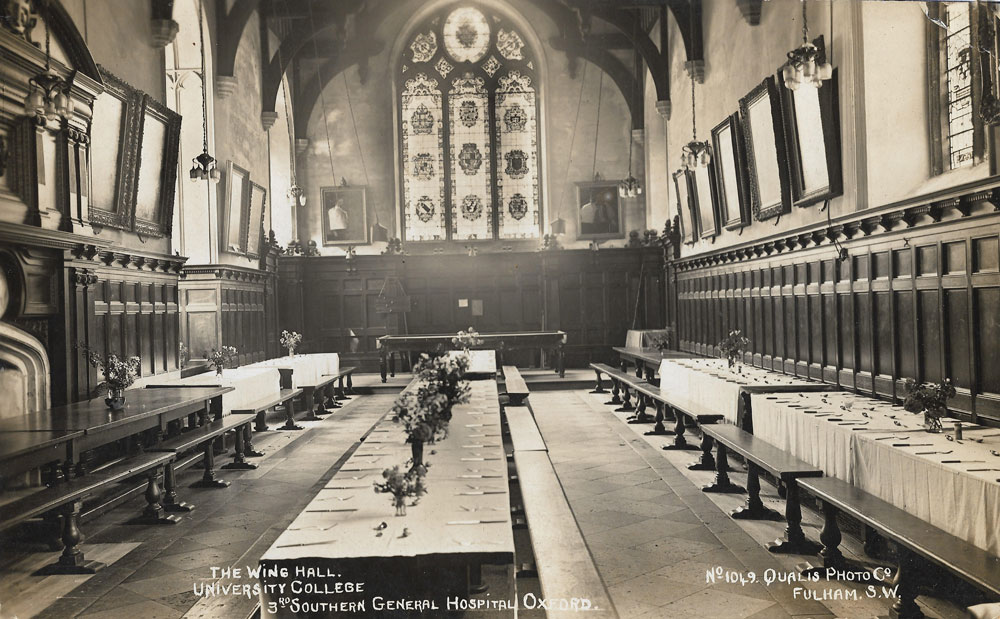
Above: The seventeenth-century Gothic dining hall at University College,
renamed the Wing Hall during the First World War
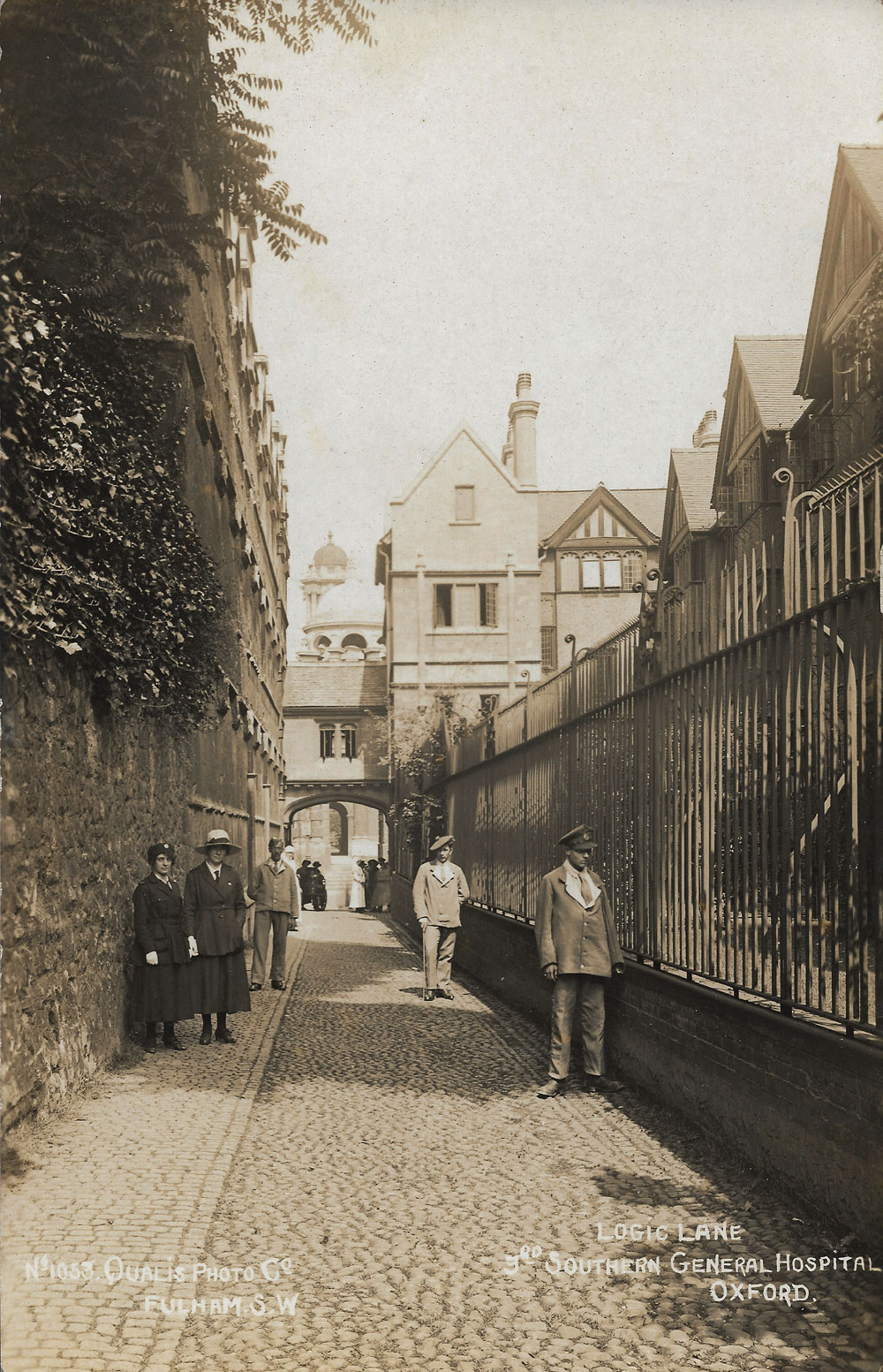
Below: Logic Lane, looking up towards the High, with patients wearing the Hospital Blues Uniform,
designed for those who could get out of bed. This lane separates the Durham Building of University College
on the right
from the main college on the left. General information on Logic Lane here
New College, Oxford
New College had a shelter with 109 beds for tuberculosis, septic surgical cases, and cerebro-spinal fever carrier cases.
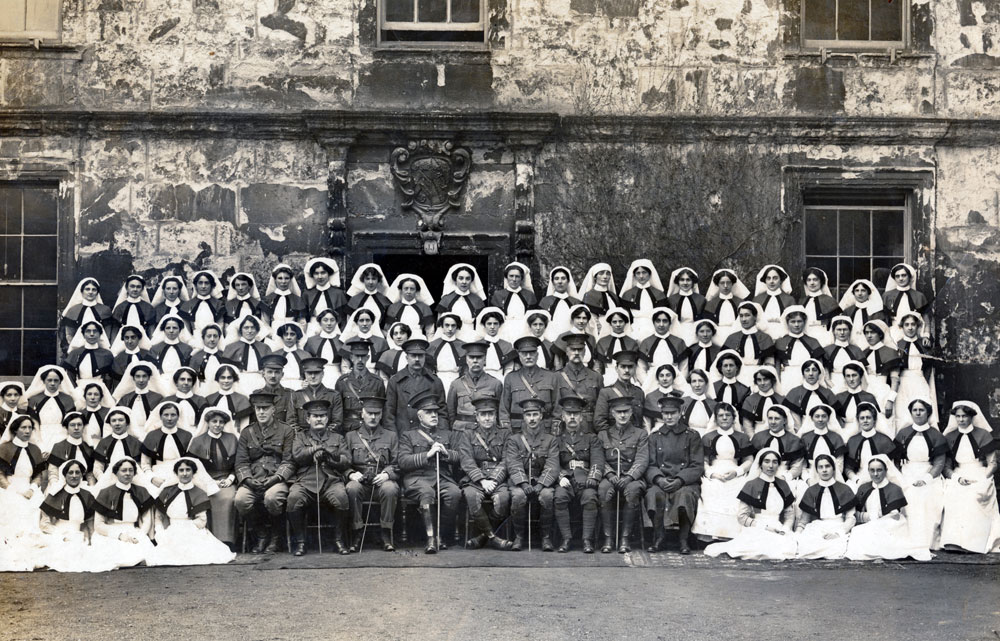
The photograph below shows territorial nurses and officers of the Royal Army Medical Corps (presumably staff at the 3rd Southern General Hospital) in the Garden Quad of New College. This photograph is owned by WW1PHOTOS.ORG and is reproduced with their kind permission.
Oxford Masonic Buildings, High Street, Oxford
The Oxford Masonic buildings which had 48 beds were behind Nos 49–52 High Street and reached via the central archway shown below in a watercolour by Walter Ernest Spradbery dated 1919, which includes a nurse with an umbrella and a soldier near an ambulance.
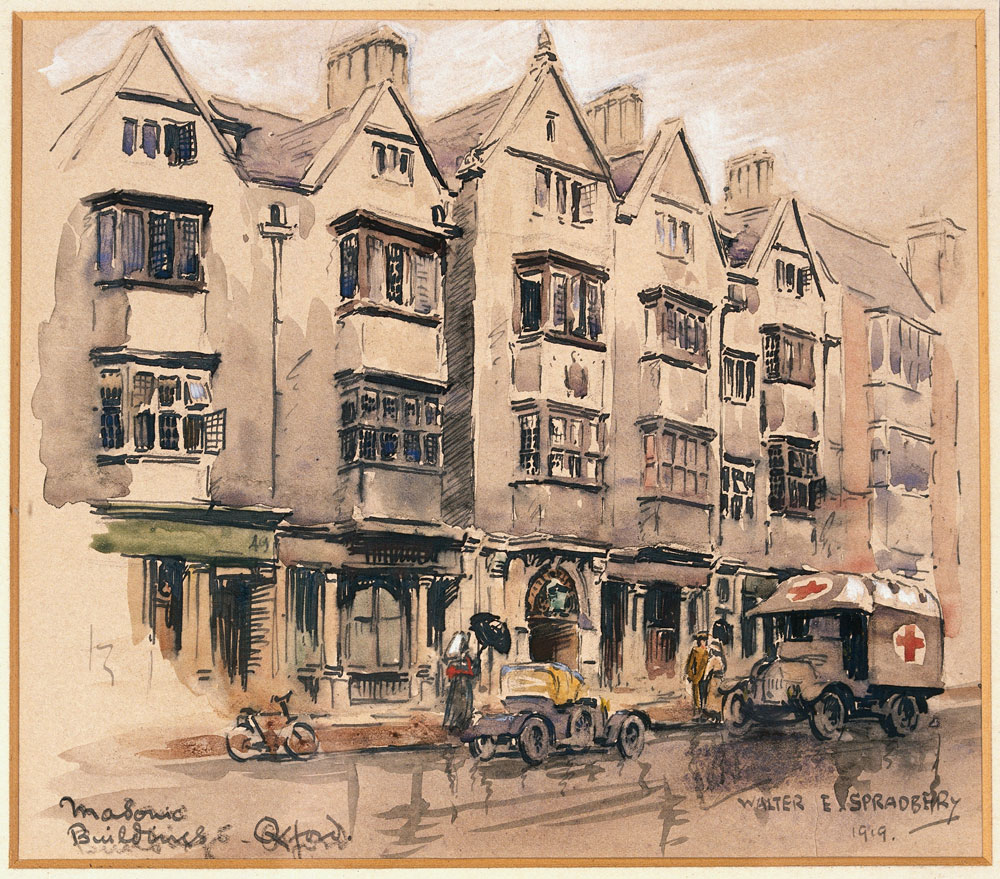 World War I: Third Southern General Hospital, Oxford, extension in the Masonic Buildings.
Watercolour
by
Walter Spradbery, 1919. Wellcome Collection. In copyright.
Source: Wellcome Collection
The Wellcome Library in London holds the photograph album of Grace Mitchell, which includes photographs that she took when she worked as a nurse at the 3rd Southern General Hospital in Oxford.
Three First World War hospitals in villages (now suburbs) just outside the city of Oxford
(all in the Headington Registration District)
Headington:
- The Wingfield Convalescent Home was converted into a 20-bed military hospital. By 1916 wooden huts were added to provide another 75 beds, and the Oxford Orthopaedic Hospital was set up in huts in the grounds. (This hospital was to survive, and eventually became the present Nuffield Orthopaedic Centre). General information on the building here
- High Wall in Pullen's Lane, Headington was also used for officer casualties during the First World War. General information the house here
Littlemore:
The Ashhurst War Hospital Hospital, with a 580-bed specialist neurological section, took over the Littlemore Asylum from May 1918 to August 1920. Soldiers suffering from shell-shock were sent here and were committed to the hospital by a legal process that required them to stay there until they were deemed fit to leave, and hence many died and were buried there. (No one who died after 31 December 1921 was granted a war grave.)
First World War military hospitals elsewhere in Oxfordshire
- VAD Hospital, Bicester Hall, Bicester
- VAD Hospital, Sywncombe House, Henley-on-Thames,
- VAD Hospital, Town Hall, Henley-on-Thames
- Harpsden Court, Henley-on-Thames
- VAD Hospital, Battle House, Goring-on-Thames
- VAD Hospital, Bruern Abbey, Chipping Norton
- Clanfield VAD Hospital, Clanfield, R.S.O.
- VAD Hospital, Old Grammar School, Thame
- Hill Lodge, Chipping Norton
- VAD Hospital, Grimsbury, Banbury
First World War military hospitals in the parts of Berkshire that are now in Oxfordshire
- Burcote House Hospital (Orthopaedic), Abingdon
- Milton Hill Hospital, near Steventon:
Milton Hill Section Hospital, near Steventon, Berkshire/Oxfordshire
Milton Hill House (now a hotel) is to the south of Steventon and four miles south-west of Abingdon. In 1912 the house was bought by Sir Mortimer Singer of the Singer Sewing Machine Company, and two days after war was declared he turned it into the first private military hospital for NCOs and men, with the first patients arriving on 28 September 1914. Singer administered the hospital himself, and the crew of his yacht staffed the hospital as orderlies. By March 1916 it was also the largest private hospital in existence in the war, with 220 beds.
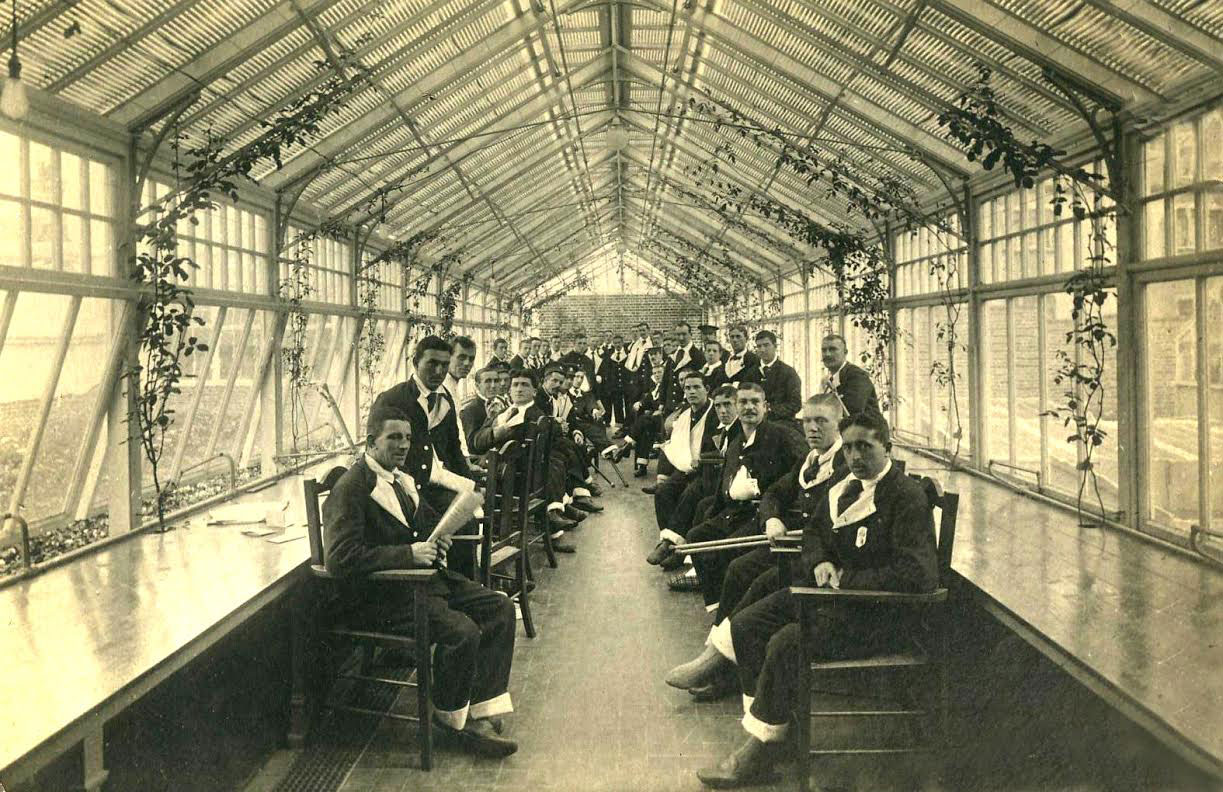
Above: Privately owned photograph of wounded men in the Milton Hill Hospital.
They are wearing the Hospital Blues Uniform, designed for those patients who could get out of bed
Below: Privately owned photograph of soldiers and nurses, probably at the Milton Hill Hospital
More photographs of Milton Hill Section Hospital
Some references in the Oxford Journal Illustrated to military hospitals throughout Oxfordshire
- 21 October 1914: Photographs of the funeral of Private Egleton of the 1st Wiltshire Regiment who died at the Oxford Military Hospital (the first of a number of funerals reported from this hospital)
- 4 November 1914: Photograph of Blenheim Palace as a Military Hospital
- 17 March 1915: Photographs of staff an wounded soldiers at Burcote Military Hospital
- 23 June 1915: Photograph of a group of wounded soldiers and staff at Teasdale House Military Hospital, Abingdon
- 20 September 1916: Photograph of the King arriving at the 3rd Southern General Hospital and shaking hands with Lieutenant-Colonel Rankin
- 14 February 1917: Photograph of what was formerly the lecture room at the School of Forestry in Parks Road, which was used by 40 or 50 volunteers making bandages and dressings for hospitals in the City (under the direction of Lady Osler and Mrs Balfour)
- 20 March 1918: Photograph of wounded soldiers and some of their needlework at the Annexe Ward of the Cowley Road Section of the General Hospital
