

Nos. 26–27: Blackwell’s Booksellers
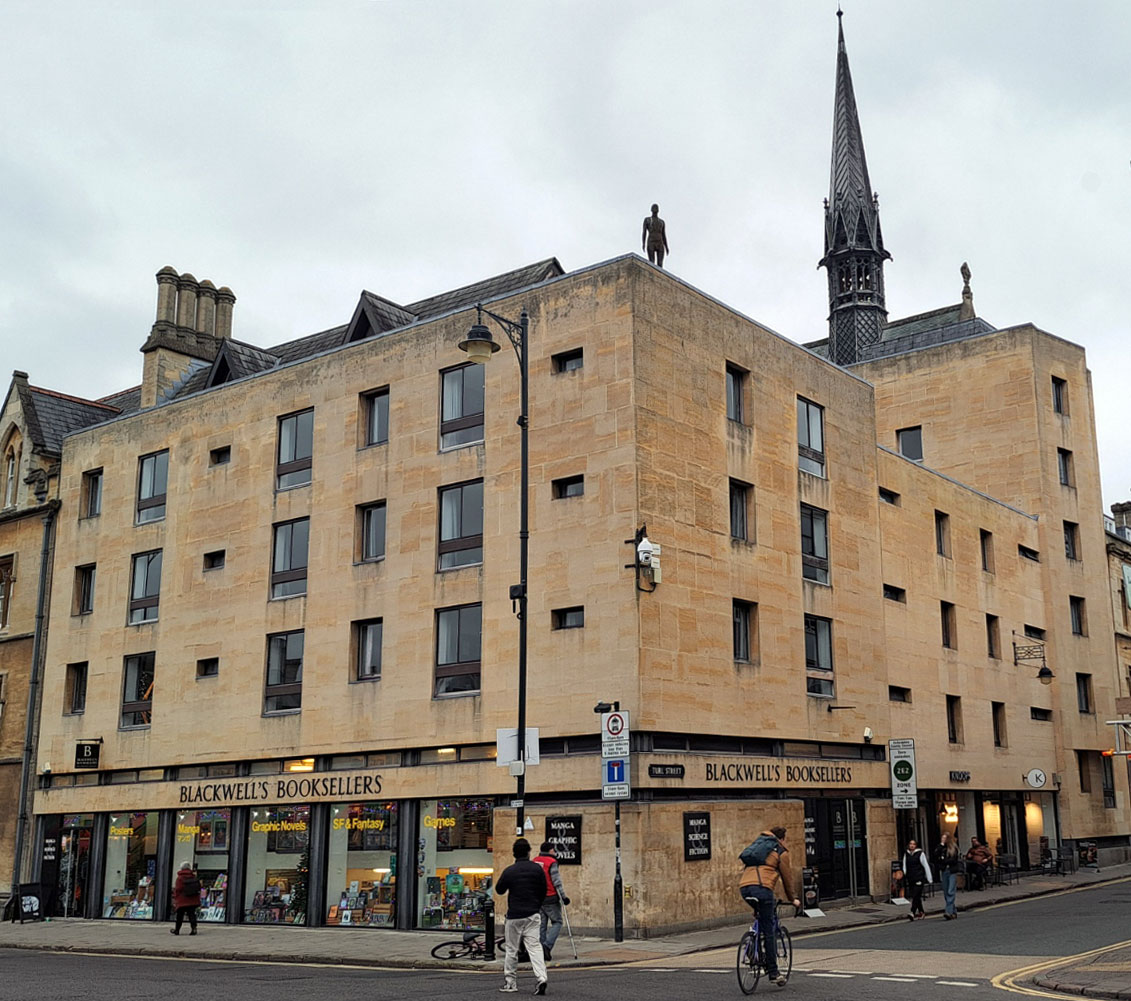
In 1964 the two houses that stood on this site on this site that were then occupied by Parker's Bookshop were pulled down by Exeter College and replaced by their Thomas Wood Building, shown above, designed by Brett & Pollen. A new split-level bookshop for Parker’s was incorporated into the design, and it was opened by the Chancellor of the University, Harold Macmillan. Since the early 1990s it has been part of Blackwell's.
Since February 2009 a statue by Antony Gormley has stood on the corner of the roof looking over Broad Street.
The building is in St Michael-at-the-Northgate parish.
The former No. 26 (on the right-hand side of the pair)
This was the corner building on the Turl. It was first built between 1606 and 1610 and then rebuilt as two tenements in 1813. On 29 February 1816 the Oxford Council Acts recorded:
Also it is agreed that Mr Joseph Parker shall have a new lease of a Messuage or tenement now in his own occupation late Elizabeth Fletcher situate in the Turl formerly in three Leases from Lady day last for forty years for a fine of Sixty three pounds under the old rents and covenants. It is agreed that the small house in Broad Street now used as a warehouse and renewed to Mrs Fletcher in 1808 be included in this Grant for the above fine.
The photograph below (Historic England CC72/02254) shows the four-storey building (No. 26) on the corner just four years before it was demolished and replaced by a smaller house in 1889. (The photograph also shows No. 27 to the east, which was a much smaller house and survived until the 1960s.)
In 1889 it was rebuilt again, but in 1964 was demolished for the third time in 150 years to make way for the above Exeter College development.
During the excavations in 1889 evidence was found of the ancient Canditch which lay here outside the wall. A considerable heap of leather (about 2ft 9in thick) was found, as well as shoemakers’ knives, and an ornamental book cover.
The house was owned by the city, and so the records of leases from 1610 survive.
(1) House on the site of No. 26 from 1813 to 1889
Here are the leases since 1813, when it was two tenements
- 1813: John Hudson, builder, leased two messuages newly erected by him on a site formerly occupied by George Malbon
- 1827: John Hudson leased one portion (occupied by Busby) and Harriet Syms, widow, leased the other, which she occupied herself
- 1841: Alderman Charles James Sadler leased one tenement, and Benjamin Badcock the other one
The 1841 census shows the confectioner Charles Sadler living at No. 26 with his wife Jane and daughter Mary, plus two servants, and he is duly listed at No. 26 in Hunt’s Directory for 1846. Badcock, however is listed at No. 27 (rather than at the second tenement at 26), which upsets subsequent numbering on the south side, and it does not settle down in directories until 1861. Benjamin Badcock, a land agent, is then listed correctly at No. 26 to 1866, and Miss Badcock from 1884 to 1889. The 1841 census shows Miss Sarah Badcock (aged 30+) living here with her servant.
At the time of the 1881 census Miss Sarah Badcock was still living here with a 63-year-old general servant. She was described in more detail as an annuitant aged 75, born at Pyrton Manor House. In that census the medical general practitioner Julius Ottaway Sankey and his wife, plus a “lunatic” boarder and four servants, lived at the back of No. 26 (facing Turl Street).
The auction of this leasehold property belonging to the City was advertised thus in Jackson's Oxford Journal of 22 March 1884:
Lot 3.—The valuable and splendidly-situated LEASEHOLD DWELLING HOUSE, at the corner of Broad-street and Turl-street, now occupied by J. O. Sankey, Esq., at the moderate rental of £80 per annum, and containing, in the basement, a kitchen, pantry, and cellar, larder, coal cellar, and scullery; on the ground floor, dining room and sitting room; on the first floor, drawing room and library; on the second floor, two bed rooms, and 3 attics above.
Quit rent payable to the City of Oxford, £2 1s. 11d. Land Tax, £4 8s. 10d.
This property is held by Lease under the City of Oxford for the term of 40 years, renewable every 14 years (the last renewal having been made at Michaelmas, 1883).
No. 26 fetched £2,240 at that auction, and must have been bought by Miss Sarah Badcock, who had lived there for about half a century. She died at No. 26 at the age of 81 on 8 June 1888, and in October 1888 it was advertised for sale again by direction of her Executor. The advertisement in Jackson's Oxford Journal of 1 September 1888 read as follows:
26, BROAD STREET, OXFORD.
A VALUABLE LEASEHOLD DWELLING HOUSE, Situated in the best and most Central Part of the City, and overlooking the beautiful grounds of Trinity College….The House contains—kitchen, scullery, and the usual offices in the basement; on the ground floor—entrance hall and 2 sitting rooms; on the second floor—2 bed rooms; and on the third floor—3 bed rooms.
The Premises are held under a lease granted by the City of Oxford for a term of 40 years from Michaelmas, 1869. The unexpired term is, therefore, 21 years clear. Ground Rents, £1 6s. 3d. per annum; Land Tax, £2 1s. per annum.
Miss Badcock's household furniture was advertised for sale on 6 October 1888.
The surgeon Julius Ottoway Sankey, who still lived at 22 Turl Street, appears to have purchased the lease of No. 26. He moved for a short period to 35 St Giles's Street, presumably to avoid building works.
(2) House on the site of No. 26 from 1889 to 1964 (inc. Barnett House 1914–1937)
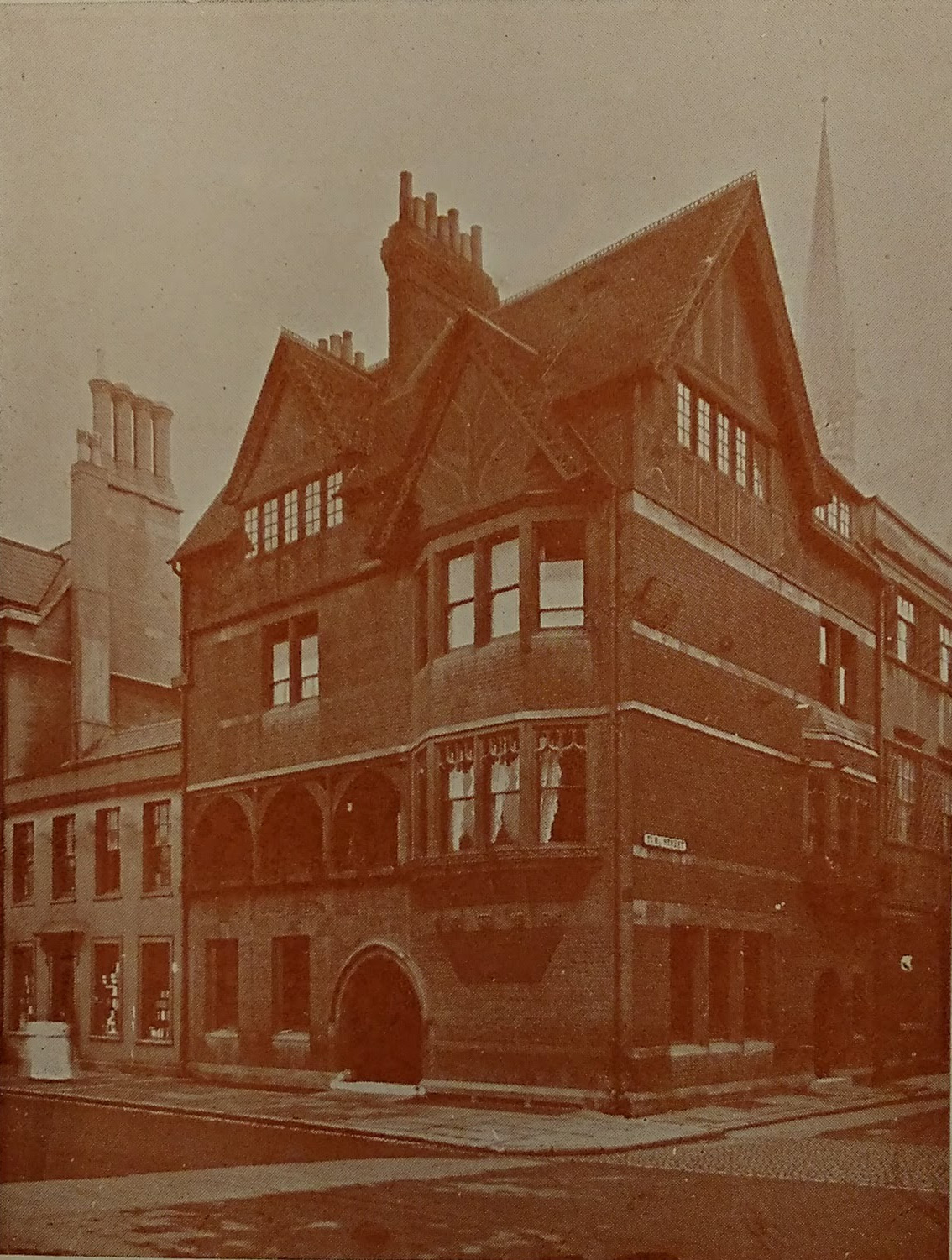

In 1889 the builder Symm rebuilt No. 26 as a house for the surgeon Julius Ottoway Sankey. In the 1895 Oxford Telephone Directory he is shown with the prestigious number 1.
The 1901 census shows Sankey (54), described as a surgeon, living at 26 Broad Street with his wife Agnes (52), a boarder, and their four servants.
Sankey was still here in this fourteen-roomed house at the time of the 1911 census, but had moved out by 12 November 1913, when he put the house up for auction.
He was buried in Wolvercote Cemetery on 9 January 1924.
Right and below: Sankey's home after he moved out. (The bow windows that are so prominent in the photograph below are barely visible in the upper photograph.)

In 1913 the University of Oxford founded Barnett House as a memorial to Canon Samuel Barnett, and its first premises (left) were opened in Sankey's former home on 16 July 1914.
Kelly's Directory for 1915/16 lists the following departments here: Oxford University Tutorial Classes Committee, the Department of Social Anthropology, and the Agricultural Economic Institute.
In 1926 the Oxford Journal Illustrated of 17 March 1926 (p. 9), reported that although it was still city property, Barnett House at 26 Broad Street was required by Exeter College for an extension to their premises. None the less it remained here for another ten years.
Kelly's Directory for 1936 shows Barnett House in Broad Street housing the Institute for Social & Economic Studies, the Social Training Course for University Certificate, the Oxfordshire Rural Community Council, the Oxfordshire Federation of Women’s Institutes, the League of Nations Union, and the Oxfordshire Red Triangle Federation of Village Clubs.
In 1937 Barnett House sold the remainder of its lease on this building to Exeter College and moved to 34 & 35 Beaumont Street.
Parker's Bookshop next door at 27 Broad Street expanded to include No. 26. In 1964 both shops were demolished.
The former No.
27 (on the left-hand side of the pair)
and the Fletcher and Parker families
This much lower two-storey house to the left originally belonged to the City, and remained virtually unchanged from the time it was built in 1788 until it was demolished in 1964. It can be seen here in 1906 with the buildings of Exeter College to the left (Historic England CC50/00254:
James Fletcher senior
From 1731 the house was leased to the bookseller James Fletcher senior, who on 3 January 1729/30 at St Cross (Holywell) Church had married Mary King. On 13 February 1729/30 he had been matriculated by the University of Oxford as a bookseller in order to be allowed to trade in the city.
They had twelve children, but only four survived infancy, including James Fletcher junior who took over the business, and William Fletcher, who became a draper, was the joint founder of the Old Bank, and served three times as Mayor of Oxford.
James Fletcher senior's wife Mary Fletcher died of apoplexy on 15 December 1766. He himself died at the age of 87 on 12 June 1795, after having been retired for a number of years.
James Fletcher junior
James Fletcher junior was born in Oxford in 1830, the son of the above James & Mary Fletcher, and was baptised at St Michael-at-the-Northgate Church on 22 October that year. He moved to London, where he was the partner of James Rivington at the Oxford Theatre in Paternoster Row in London. On 13 February 1756 he was matriculated by the University of Oxford as a bookseller and by July 1756 he was advertising his bookshop here at the top of Turl Street, while the business of J. Rivington and J. Fletcher ran concurrently in London. He appears to have continued to live in London originally, as on 24 December 1762 his first wife died at St Paul's Churchyard. By 1767 James Fletcher & Co had a printing works in St Paul's Churchyard.
On 13 July 1777 at St Michael-at-the-Northgate Church James Fletcher junior married his second wife, Sarah Wood, but just under a year later on 3 June 1778 she died after a lingering illness.
On 26 May 1787 at that church James Fletcher junior married his third wife, Elizabeth Langford.
James Fletcher junior died at the age of 68 on 20 May 1798. He was survived by his third wife Elizabeth Fletcher, who took over the lease and held it until her own death on 27 October 1815.
Transcript of Will of James Fletcher junior

There is a memorial tablet to James Fletcher junior on the wall of St Michael-at-the-Northgate Church (right) which reads:
“In a Vault beneath this Seat,
Lyeth the Body of JAMES FLETCHER,
Junior, who died 20 May, 1798
Aged 68 Years.
Also SARAH his second Wife,
who died 3 June, 1778.
Also ELIZABETH his third
Wife who died Octr 27th 1815.”
Joseph Parker
After Fletcher’s death in 1798 William Hanwell and Joseph Parker, who had been partners of James Fletcher junior, took over the business, but Elizabeth Fletcher held on to the lease until 1813. William Hanwell died aged 44 on 2 October 1805.
Thereafter Joseph Parker ran it on his own. He was a direct descendant of Samuel Parker, the Bishop of Oxford 1686–1688, and the great-nephew of Sackville Parker who had established a bookshop at 88 High Street, and had served his apprenticeship in the book trade with Daniel Prince. He was matriculated at the University of Oxford as a “bibliopola” on 27 January 1798.
Joseph Parker is described by William Tuckwell in his Reminiscences of Oxford (1900) thus:
[Henry “Horse” Kett's] mien and presence were carefully preserved and copied by old Joseph Parker, the bookseller, who resembled him curiously in face and voice, and, in a suit of formal black, with frill at the breast and massive gold seals pendent from the fob, imitated his walk and manner.
On 17 September 1813 the Council recorded: “A licence of alienation to be granted to Mrs Elizabeth Fletcher to assign her Estate in the Turl to Mr Joseph Parker, Bookseller.” Hence in 1817 Joseph Parker was recorded as occupying property both to the east and south of 26 Broad Street, namely No. 27 and Fletcher’s old Turl Street shop (a tiny house, 16 feet square, just inside the city wall). It appears that Parker ran his bookshop in Broad Street and lived in the little Turl Street house.
Joseph Parker died in 1850. One of Joseph Parker’s sons became a Vicar, the other a surgeon, so he left the book business to his London-born nephew, John Henry Parker.
John Henry Parker
For more about John Henry Parker, his son James Parker, and his grandson James Henry Parker, see this grave in the St Michael's section of St Sepulchre's Cemetery, Oxford.
In 1937 Parker’s expanded their shop into No. 26 next door.
In 1964 both shops were demolished, but Parker's would soon reopen in the new building.
The present (1964) shop at Nos. 26 & 27
On 12 September 1961 planning permission was granted to Exeter College for an extension to form college rooms, a bookshop, and bank at 27 Broad Street (61/08309/A_H).
Parker & Son Ltd, secondhand booksellers, were still listed at 26 & 27 in Kelly's Directory for 1962, but with a note that during alterations their temporary address was 103 Walton Street. They were back in the new building on their original site by 1964, and continued to operate here for about another thirty years before being taken over by Blackwell's.
Exeter College installed a statue by Anthony Gormley on the north-west corner of the shop's roof on 15 February 2009.
|
Occupants of the present shop at 26–27 Broad Street listed in directories | ||
Dates |
26 |
27 |
1964–c.1988 |
John Henry Parker: |
|
c.1988–present: |
Blackwell’s
Art & Poster shop |
|