

Red telephone kiosks in Oxford
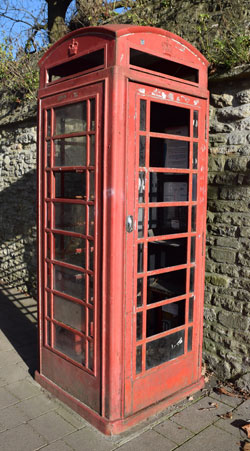
There are ten red telephone kiosks currently surviving on the streets of Oxford (although most no longer have a functioning payphone). All except the one at Carfax are K6 square kiosks with domed roofs, which were designed by Sir Giles Gilbert Scott in 1935 and introduced as part of King George V's Silver Jubilee celebrations. Scott, who was a trustee of the Sir John Soane's Museum, was inspired by the design of the tomb of Sir John's wife, Eliza Soane, who died in 1815.
They were made of cast iron by various contractors, and have unperforated crowns to the top panels and margin glazing to the windows and door.
Oxford's seven Grade II listed kiosks
The seven kiosks immediately below are Grade II listed. The first three, which granted listed status in 1987/8, were not replaced when BT brought in its new-style telephone boxes in the 1980s, so were still on their original site at the time they were listed (although the one at Jowett Walk had to be moved a short distance in 2019: see below).
The fourth listed kiosk, at Carfax, was donated to the city by Nicholas Medley* in 1994, and is Scott’s earlier K2 design of 1924, a type not previously seen in the city: it was listed in 2009. Medley also donated at least three other kiosks to Oxford.
The last kiosks to be listed (in 2017, 2019, and 2020 respectively) are in Market Street, outside St John's College on the east side of St Giles', and outside All Souls College in the High Street.
|
|
|
|
|
|
|
|
|
Notes: Listed K6 kiosk in Jowett Street (second kiosk shown above) Listed K6 kiosk in Pembroke Street (third kiosk shown above) Listed K2 kiosk at Carfax (fourth kiosk shown above) Listed K6 kiosk in Market Street (fifth kiosk shown above) |
|


* Nicholas Medley (1953–1994) was born in Andover, but his family moved to Oxford when he was aged ten as he suffered from haemophilia and they wanted to be near the Churchill Hospital. He worked in the travel centre at Oxford Station, and collected red telephone boxes. Sadly he became HIV positive as a result of receiving Factor VIII therapy. In the last weeks of his life he paid for the restoration of the clock and bells at Ss. Philip & James's Church, and began discussions with the council with a view to giving his telephone boxes to the city. He died at the Churchill Hospital on 14 My 1994 at the age of 41.
Three other surviving public red telephone kiosks in Oxford (not listed)
Three of these are in central Oxford, all of the K6 design. They were donated to the city either by Nicholas Medley (see the report on his donation in the Oxford Mail of 21 July 1994) or by BT. They were reinstalled in the following locations, but some of them have been adapted for other use:
- Broad Street (south side)
- St Giles’ Street west side (outside No. 65)
The third is the only one in the Oxford suburbs:
- Old High Street, Headington (outside Baptist Chapel):
Adopted by the Friends of Old Headington for notices
Three red telephone kiosks that have been removed in recent years
Former kiosk in Parks Road

Left: The telephone kiosk that formerly stood in Parks Road outside Wadham College, shown in a state of dereliction, with most of its glass broken.
See this kiosk on
Streetview
in January 2022
Right: BT attached this notice dated 1 April 2019 inside the kiosk, stating that they were planning to remove the payphone and were no longer obliged to consult regarding the removal of the kiosk.
The kiosk itself was eventually taken away in 2022/3.

Former kiosk outside 12 New Road (near Bonn Square)
This kiosk (shown right) had a telephone on the south side and an ATM on the east side in its later years. In December 2012 retrospective planning permission was obtained for this:
It is shown here on Google Streetview in July 2023, but was removed by September 2024.
Former kiosk at Gloucester Green (near former school and Walton Street)
In December 2013 a planning application was approved to upgrade this box to include an ATM service:
It is shown here on Google Streetview in August 2018, but was gone by August 2024.
Three red telephone kiosks in Oxford that were under threat in 2013 but still survive
In 2013 BT sought to remove many little-used red kiosks in the UK, or to replace them with modern combined phone and ATM booths.

(1) Red kiosk outside All Souls College
A planning application was submitted in November 2013 to replace the telephone kiosk outside the Warden's House, All Souls College (right) with a replica that included an ATM, namely 13/02991/FUL: “Replacement of existing public telephone kiosk with combined public payphone and ATM cash machine kiosk”.
This application was withdrawn in December 2013.
Oxford Mail, 28 November 2013:
“Conservation group sees red over plan to replace High Street phone box with cash machine replica”
In 2019 it was listed by English Heritage:
see above

(2) Red kiosk in Broad Street
BT proposed (13/02595/FUL): “Replacement and upgrade of existing public telephone kiosk with kiosk combining public telephone service and ATM service”. On 29 November 2013 this application was refused by Oxford City Council on the following grounds:
The phone box is iconic and holds significant historic, architectural and cultural value. It sits in a prominent position in one of Oxford's most recognised and historic streets, within the Central Oxford Conservation Area and adjacent to many listed buildings. The loss of the phone box and its replacement with a modern interpretation would be harmful to the setting of nearby listed buildings and the wider conservation area. The proposal is therefore contrary to policies CP1, CP10, HE3 and HE7 of the Oxford Local Plan and CS18 of the Core Strategy.

(3) Red kiosk in Old Headington
This kiosk is mentioned in the Old Headington Conservation Area appraisal:
Traditional street furniture including the red post-box, red telephone box and black painted “Lucy and Dean” street lamps are a positive element of the village's historic character.
This photograph was taken on 13 December 2013. Local residents and city councillors persuaded BT not to remove it, and it was adopted by the registered charity Headington Action. It is currently used as a mini-library.
- Cllr Ruth Wilkinson:“Red phone box saved!”
- Oxford Mail, 18 December 2013:
“BT puts call box removal on hold after residents' sit-in”


Brief early history of Oxford’s telephone system
BT sells the red kiosks that it removes.
Privately purchased telephone kiosks
can be found in unexpected places in Oxford,
for example
in Magdalen College (left) and
in Harris Manchester College (right)
The Oxford Sausage: “A call out for Oxford’s forgotten phone boxes”
Oxford Mail, 28 January 2018:
“End of the line: Only half
of BT phone boxes in Oxfordshire used more than twice in a year”
BBC Oxford News Magazine 6 Feb 2008: “Who uses phone boxes?”
The Guardian, 26 April 2013: “BT sells off phone boxes as demand declines”
BBC News Magazine, 24 April 2015:“The yard for red phone boxes that ring no more”
Wikipedia: Red telephone box:
“The red phone box is often seen as an iconic British symbol throughout the world”