

Inscriptions: Rewley Road Swing Bridge
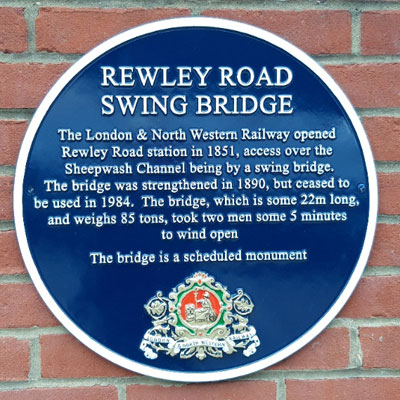
REWLEY ROAD
SWING BRIDGE
The London & North Western Railway opened
Rewley Road station in 1851, access over the
Sheepwash Channel being by a swing bridge.
The bridge was strengthened in 1890, but ceased to
be used in 1984. The bridge, which is some 22m long,
and weighs 85 tons, took two men some 5 minutes
to wind open
The bridge is a scheduled monument
[Coat of arms of the London and North Western
Railway, depicting Britannia with her trident]
This plaque was unveiled by Peter Hendy, Chair of Network Rail, on 9 August 2021.
This swing bridge is now owned by Oxford Preservation Trust. It is a scheduled monument (list entry 1003651) and Historic England described it here on their At Risk register 2020 as being in very bad condition; but a £900,000 restoration started in November 2020, and was completed in the summer of 2021. This project was funded by the Railway Heritage Trust Historic England, Network Rail, Chiltern Railways, and others.
The Rewley Road Swing Bridge was constructed in 1850–1 to designs by Robert Stephenson (son of George Stephenson, the “Father of Railways”) and is thought to be the earliest moving-element railway bridge in Britain to retain its original mechanism. It was needed to take the trains over the Sheepwash Channel on this second railway into Oxford, which terminated at the Rewley Road station. It is constructed of steel lattice work girders with stiffeners and curved floor plates. It sits and turns on a pivot roller path at the centre of the bridge: this sits on the bank of the canal, so only half the swing bridge spans the waterway. It was substantially reconstructed in steel in c.1890.
This railway line was opened on Tuesday 20 May 1851 and came under the following railways:
- From 1851 to 1879 it was part of the Buckinghamshire Railway (with the London and North Western Railway)
- From 1879 to 1922 it was part of the London and North Western Railway,
- from 1922 to 1948 it was part of the London, Midland and Scottish Railway (LMS)
In 1948 the bridge came under British Rail, and when they closed Rewley Road station to passenger traffic in 1951 the former LNWR passenger trains were diverted to the Great Western Railway (GWR) station to the west, but goods trains continued to use it until both this part of the line and the station were closed in 1984.
The railway line used in Oxford today is the one to the west. This was opened seven years earlier by the GWR on 12 June 1844 but originally terminated at the north end at Grandpont. When it was extended north through Oxford towards Banbury in 1850 it has its own static bridge (now modern) over the Sheepwash Channel.
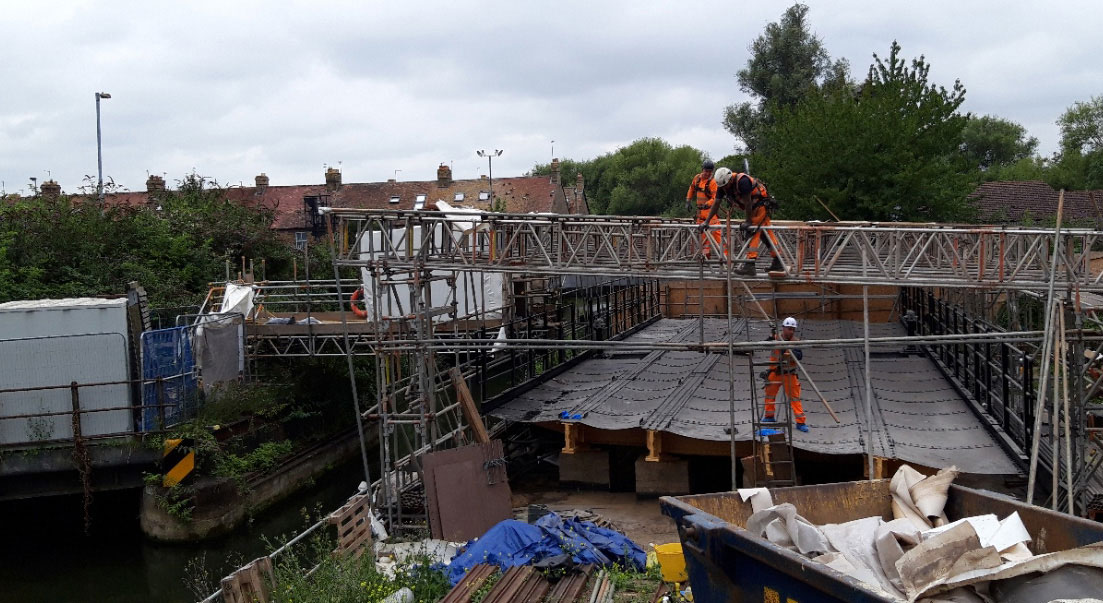 Rewley Road Swing Bridge under repair, 1 September 2021
There was an accident here just seven months after the swing bridge was opened. On 29 December 1851 this bridge was swung back at 9pm to allow a barge to pass, but the man who had charge of the signal at the bridge neglected to shift it to denote that the line was not clear, and the engine of a goods train pulling twelve trucks laden with stone and coal plunged into the Sheepwash Channel and became stuck in the bank (reported in Jackson's Oxford Journal of 3 January 1852).
Photographs, films, and articles about the Rewley Road swing bridge:
- Film from the 1970s showing two men opening up the Rewley Road swing bridge ready for the arrival of a goods train
- Photograph by Malcolm Graham of the redundant Swing Bridge in May 2003
- Movable Bridges in the British Isles: Rewley Road Swing Bridge (Sheepwash Channel)
- Dereliction in the Shires: Rewley Road swing bridge (2007, before it was restored)
- Oxford Preservation Trust information about the Swing Bridge
- Wikipedia: Rewley Road Swing Bridge
From central Oxford, Rewley Road Swing Bridge is best reached on foot by walking to the north end of Upper Fisher Row and continuing on the footpath. It can also be reached from the canal towpath.
Oxfordshire Local History Association Bulletin
- Vol. 6, No. 2 (Winter 1999/2000): Robert Sephton: “How the railways came to Oxford, Part 1:
“City fathers, farmers, and Folly Bridge” - Vol. 6, No. 3 (Summer 2000): Robert Sephton: “How the railways came to Oxford, Part 2:
“The University opposes: the defeat of the second Oxford & Great Western Union Railway Bill, 1838” - Vol. 6, No. 4 (Winter 2000/1): Robert Sephton: “How the railways came to Oxford, Part 3:
“Third time lucky: the GWR gets it act at last” - Vol. 9, No. 4 (Winter 2013/14): Liz Woolley, “How the railway changed Oxford” and corrections
in Vol. 10, No. 1 (Winter 2015/16): “Oxford's railways revisited”