

Oxford Inscriptions: Plaques on laboratories around South Parks Road
Royal Society of Chemistry plaque on former Dyson Perrins Laboratory
(now the Oxford University Centre for the Environment)
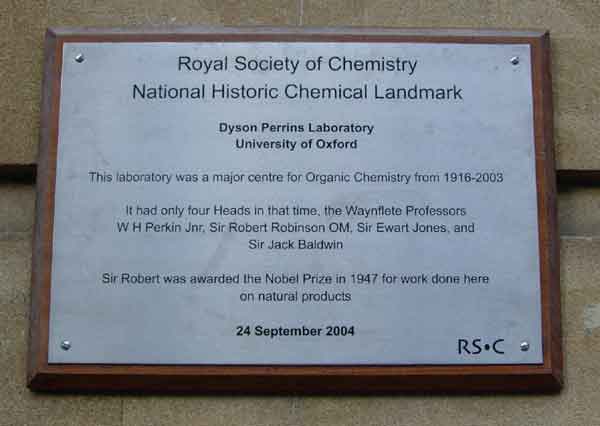
Royal Society of Chemistry
National Historical Chemical Landmark
Dyson Perrins Laboratory
University of Oxford
This laboratory was a major centre for Organic Chemistry from 1916–2003
It had only four Heads in that time, the Waynflete Professors W H Perkin Jnr, Sir Robert Robinson OM, Sir Ewart Jones, and Sir Jack Baldwin
Sir Robert was awarded the Nobel Prize in 1947 for work done here
on natural products
24 September 2004
Association of Jewish Refugees plaque on the New Biochemistry building

ERECTED BY
THE ASSOCIATION OF JEWISH REFUGEES
PROFESSOR
SIR HANS KREBS
FRS
1900 - 1981
Biochemist & discoverer
of the Krebs cycle
Nobel Prize Winner
1953
Worked here 1954 - 1967
This was unveiled in May 2013 on the
newly rebuilt Department of Biochemistry.
Although its address is 3 South Parks Road,
it is actually behind the laboratories
fronting the road and near Sherrington Road
See also the Oxfordshire Blue Plaque
on Professor Sir Hans Krebs' home in Iffley
Four Physiological Society plaques

On the Sherrington Building
THE PHYSIOLOGICAL SOCIETY
Sir Charles Sherrington
(1857–1952)
OM, PRS
Physiologist and Nobel Laureate
Worked on this site as Waynflete Professor of
Physiology from 1913–36 and shared the Nobel
Prize in Physiology or Medicine with Edgar
Adrian in 1932 for their discoveries regarding
the functions of neurons. Sherrington laid the
foundation for our understanding of the
central nervous system.
[Physiological Society logo]
Wikipedia: Charles Scott Sherrington
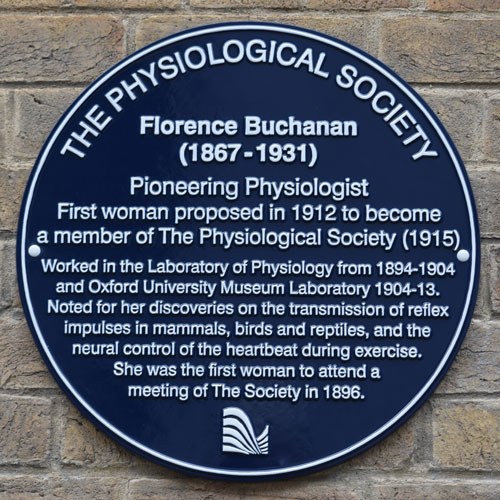
On the Sherrington Building
THE PHYSIOLOGICAL SOCIETY
Florence Buchanan
(1867–1931)
Pioneering Physiologist
First woman proposed in 1912 to become
a member of the Physiological Society (1915)
Worked in the Laboratory of Physiology from 1894–1904
and Oxford Museum Laboratory 1904–13.
Noted for her discoveries on the transmission of reflex
impulses in mammals, birds and reptiles, and the
neural control of the heartbeat during exercise.
She was the first woman to attend a
meeting of The Society in 1896.
[Physiological Society logo]
Wikipedia: Florence Buchanan
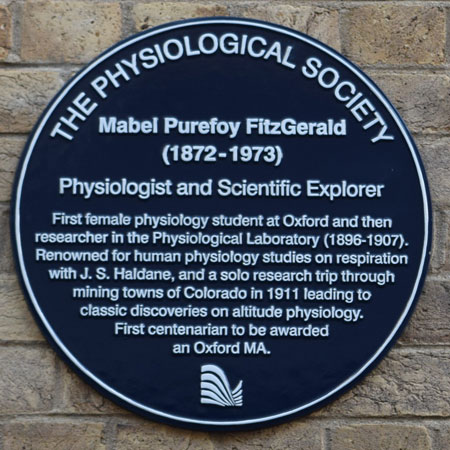
On the Burdon Sanderson Cardiac Science Centre
(attached to the Sherrington
Building)
THE PHYSIOLOGICAL SOCIETY
Mabel Purefoy FitzGerald
(1872–1973)
Physiologist and Scientific Explorer
First female physiology student at Oxford and then
researcher in the Physiological Laboratory (1896–1907).
Renowned for human physiology studies on respiration
with J. S. Haldane, and a solo research trip through
mining towns of Colorado in 1911 leading to
classic discoveries on altitude physiology.
First centenarian to be awarded
an Oxford MA.
[Physiological Society logo]
Wikipedia: Mabel Purefoy FitzGerald
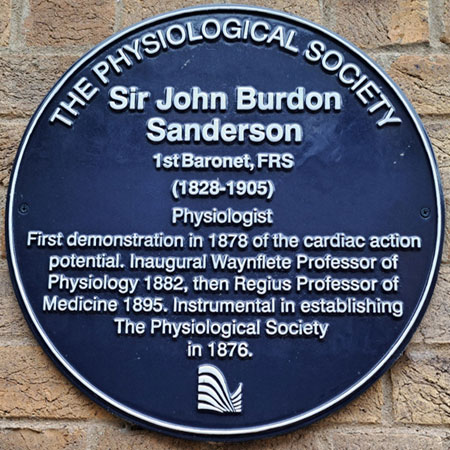
On the Burdon Sanderson Cardiac Science Centre
(attached to the Sherrington
Building)
THE PHYSIOLOGICAL SOCIETY
Sir John Burdon
Sanderson
1st Baronet, FRS
Physiologist
First demonstration in 1878 of the cardiac action
potential. Inaugural Waynflete Professor of
Physiology 1882, then Regius Professor of
Medicine 1895. Instrumental in establishing
The Physiological Society
in 1876
[Physiological Society logo]
Wikipedia: John Burdon-Sanderson
Three Royal Society of Chemistry (RSC) plaques on the Inorganic Chemistry Laboratory
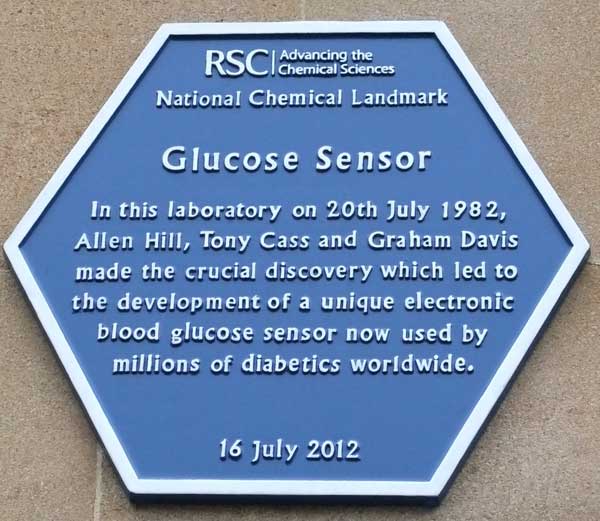
RSC | Advancing the Chemical Sciences
National Chemical Landmark
Glucose sensor
In this laboratory on 20th July 1982,
Allen Hill, Tony Cass and Graham Davis
made the crucial discovery which led to
the development of a unique electronic
blood glucose sensor now used by
millions of diabetics worldwide.
16 July 2012
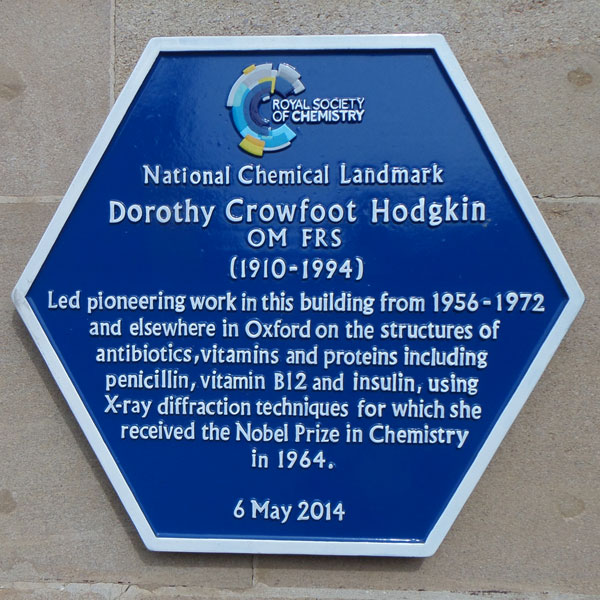
ROYAL SOCIETY
OF CHEMISTRY
National Chemical Landmark
Dorothy Crowfoot Hodgkin
OM FRS
(1910–1994)
Led pioneering work in this building from 1956–1972
and elsewhere in Oxford on the structures of
antibiotics, vitamins and proteins including
penicillin, vitamin B12 and insulin, using
X-ray diffraction techniques for which she
received the Nobel Prize in Chemistry
in 1964.
6 May 2014
In 2022 the new Biochemistry Building in Oxford was renamed the Dorothy Crowfoot Hodgkin building. She also has an Oxfordshire blue plaque on her home at 94 Woodstock Road
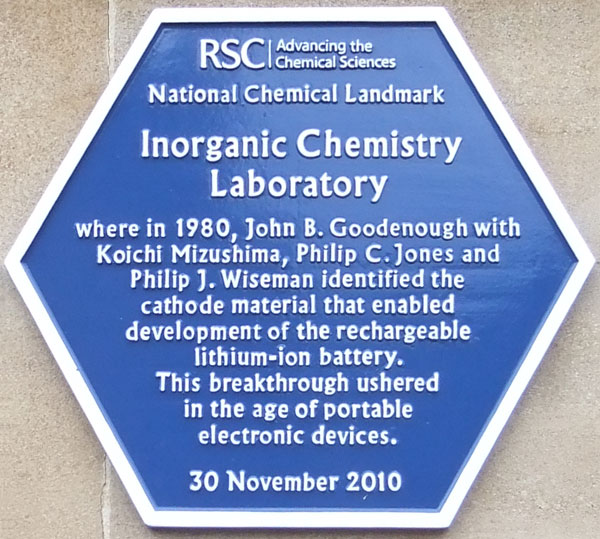
RSC | Advancing the Chemical Sciences
National Chemical Landmark
Inorganic Chemistry Laboratory
where in 1980,
John B. Goodenough with
Koichi Mizushima, Philip C. Jones
and
Philip J. Wiseman identified the
cathode material that enabled
development of the rechargeable
lithium-ion battery.
This breakthrough ushered
in the age of portable
electronic devices.
30 November 2010

The middle plaque above appears to have replaced the plaque dated 14 May 2001 shown below:

National Historic Chemical Landmark
The work of Dorothy Crowfoot Hodgkin
at the University of Oxford
In this building from 1956–1972 and at other
times elsewhere in the Oxford Science Area,
Professor Dorothy Crowfoot Hodgkin,
(1910–1994) OM, FRS, Nobel Laureate, led pioneering work on the structures of antibiotics, vitamins and proteins, including penicillin, vitamin B12 and insulin, using X-ray diffraction techniques. Many methods for solving crystal structures were developed taking advantage of digital computers from the very earliest days. The work provided a basis for much of present day molecular structure driven molecular biology and medicinal chemistry.
14 May 2001 RS•C