

Fire Insurance Plaques in Oxford and nearby villages

Fire plaques were placed high on properties to deter thieves, who sometimes removed them and placed them on their own houses. Hence they can be hard to spot when they are on large buildings; the arrow above points to the one on the south side of the Clarendon Building in Broad Street.
Originally each company had its own fire brigade, but in 1826 the Sun Fire Office, the Royal Exchange Assurance, and the Phoenix fire office agreed to combine their fire brigades when necessary.
On 22 November 1831 Oxford City council resolved "That the Collector of Quit Rents be instructed to require from the Lessees to see the receipt for the Insurance of the Property in Lease to them and that a notice to that effect be sent to the different Lessees."
Some fire plaques spotted in Oxford and nearby villages are shown below.
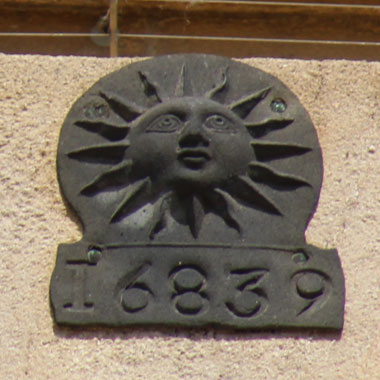
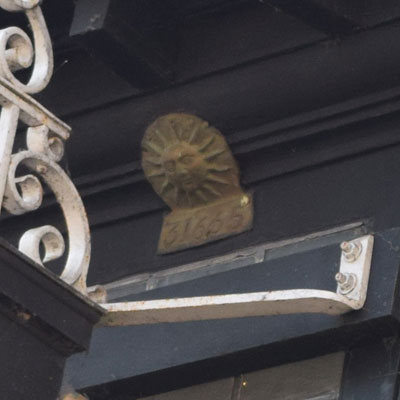
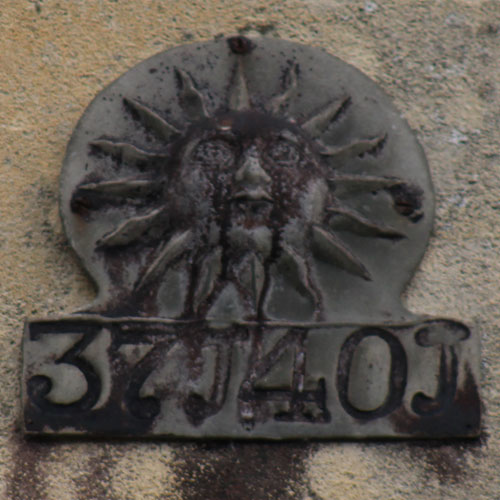
Sun Fire Office Ltd(now part of Sun Alliance) Founded in 1710. Plaque depicts the sun with a man's face and sixteen rays (26 variants): |
|
|
|
|
|
|
|
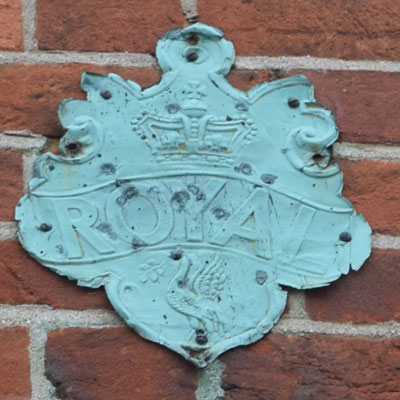
Royal Insurance Company (established in Liverpool in 1845)
|
|
|
|
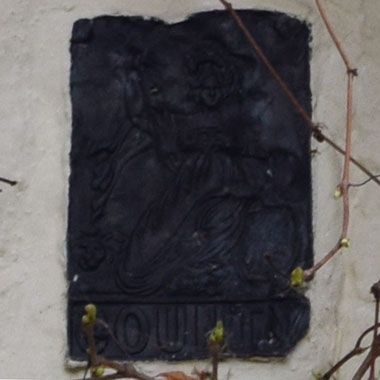
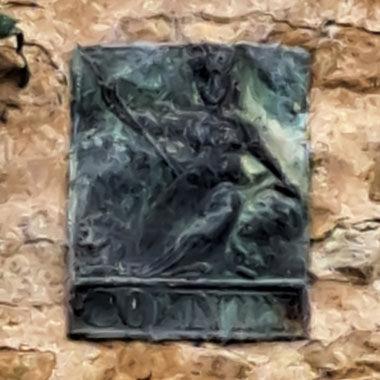
County Fire Office The County Fire Office was founded in 1807 by an “association of noblemen and gentlemen” for the particular benefit The plaque depicts Britannia armed with a spear and shield above the word COUNTY (12 variants) |
|
|
|
|
|
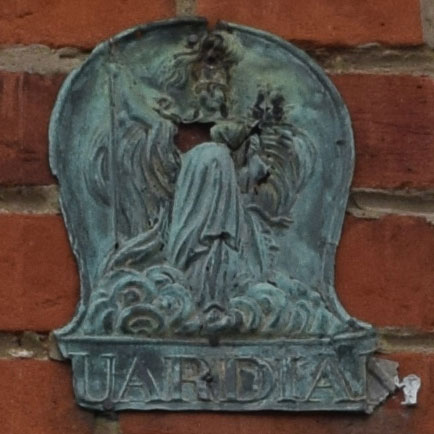
Guardian Assurance Company LtdEstablished in 1821 as Guardian Fire & Life
|
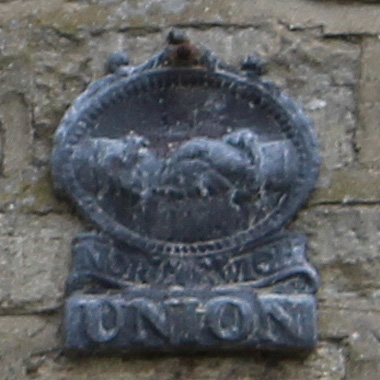
Norwich UnionFounded in Norwich in 1797
|
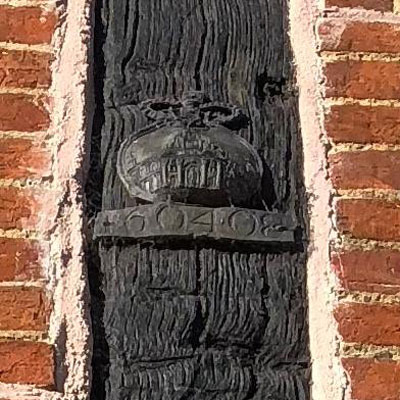
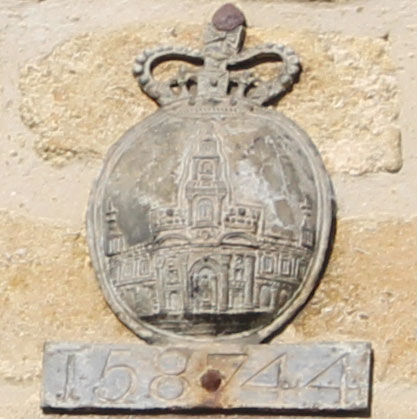
Royal Exchange Assurance Founded at the Royal Exchange, London in 1720. |
|
|
|
Phoenix Fire Office aka Phoenix Assurance Company
|
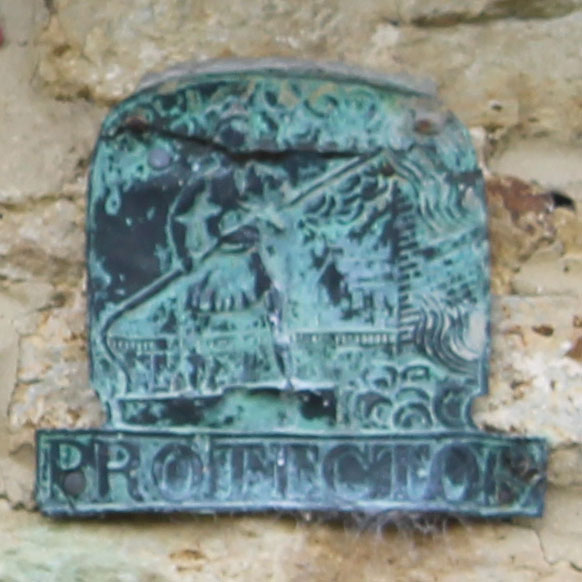
Protector CompanyFounded in London in 1825
|
Beware of reproductionsThe number on each plaque is unique, and the two shown below are both replicas Advice on distinguishing original fire marks from reproductions |
|
This Sun Insurance Office Ltd plaque (425573) is a modern replica of a fire plaque dating from c.1800 This plaque with the same number was sold by the Lacy Scott & Knight Auction centre in 2020, and others appear on eBay |
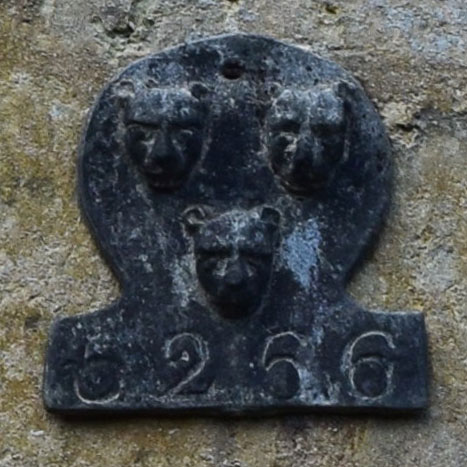
The three leopards' heads is the symbol used by the Salop Fire Office, and their records show that Policy No. 5266 was issued on 25 March 1807 to George Crockett Nichols, a gentleman of Windmill House, Madeley, Shropshire, for use on that house. As well as the original plaque in Shropshire and this one in Headington, there are at least two more Salop Fire Office ones bearing the same policy number 5266 (in Thame and Hungerford). One was auctioned in Plymouth in 2014. |






Links
- The fire marks of Woodstock, Oxfordshire
- Fire Insurance Marks Group on Flickr
- Firemark Collection at Kathryn and Shelby Cullom Davis Library, St John's University
- The Fire Mark Circle
- London Live: Fire Insurance Policy Registers, 1777–1786
Log in to search, then scroll down to Additional Datasets>Fire Insurance Registers (1777–1786) - Behind These Doors: Fire Marks and Insurance
- The Old Fire Station, Oxford
- Oxfordshire Local History Association Bulletin, Vol. 3, No. 5 (Autumn 1990):
Sydney Temple: “Firemarks and firefighting in an Oxfordshire Village” (Dorchester-on-Thames) - Victoria County History of Oxfordshire, Volume 4 (City of Oxford): Fire service
Insurance companies with agents in Oxford
By 1830 twenty insurance companies (of which seventeen offered fire cover) had agents in Oxford. Pigot's Directory for that year lists the following:
FIRE &c. OFFICES & AGENTS:
ALBION (life): Joseph Andrews, Ship Lane
ALLIANCE: Crews Dudley, Broad Street
BERKS, GLOUCESTER & PROVINCIAL (fire): Richard Smith, High Street
BIRMINGHAM (fire): William Cooke, High Street
CLERICAL & MEDICAL (life): John Freeman Wood, St Mary Hall Lane
COUNTY (fire): John Coleman, St Mary Magdalen's
CROWN: Michael Underhill, High Street
GLOBE: Charles Talmage, St Aldate's
GUARDIAN: William H. Butler, St Aldate's
HERTS and CAMBRIDGESHIRE (fire): Samuel Ste[a]ne, Cornmarket
MANCHESTER (fire): Charles Mallam, St Aldate's
PALLADIUM: Charles Watts, High Street
PELICAN: George Cecil, Beaumont Street
PHOENIX (fire): Thomas Sheard, High Street
PROTECTOR: Michael Underhill, High Street
PROVIDENT (life): John Coleman, St Mary Magdalen's
ROYAL EXCHANGE: Thomas Wyatt, Holywell Street
SUN: Richard Cox, High Street
UNIVERSITY (fire): Rev. John William Hughes, Holywell
WEST OF ENGLAND (fire): George Rackstrow, St Mary Magdalen's.
Back in 1823, Pigot's Directory had listed thirteen insurance offices which had agents in Oxford, and these included three which were not listed seven years later in 1830: the COMMERCIAL, the HOPE, and the NORWICH.
Brief background to the establishment of Oxford's Fire Brigade
Those men who had to purchase their freedom of the city often had to supply money to the city council (in addition to the fee) for the purchase a leather bucket: this ensured that there was a good supply ready when there was a fire in Oxford.
On 7 August 1654 the Mayor of Oxford announced to the council the need for purchasing an “engine for the quenching of fire”. A tax was levied in every parish, and Oxford's first fire engine was bought in London.
By 1661 the city council had another two fire engines. Salter in Oxford Council Acts records on 17 September 1661:
On the report of the gentlemen appointed to consider how best to place the fire engines for public use, it is agreed that the great engine shall be kept in the Lower Hall and a lean-to built for the other two near the workhouse at a place chosen by the aforesaid gentlemen, the expense of which is to be paid for out of the money which remains from that collected in the City towards providing the engines. The care of the engines is to be entrusted to John White, carpenter, who, with his two sons, is to keep them in good order and “be alwayes in readinesse to play them upon all occasions”, for which is is to be allowed 20s. p.a. from next Michaelmas from the City.
In December 1835 the Committee of the Water Works reported to the City Council that they "felt it incumbent upon them to direct their attention to an ample and more effective supply of Water in the event of fire — and have, with that view, laid down eighty fire plugs and fixed thirty two brass Cocks at the Corners of the various Streets, to enable them to turn the supply into such situations, as any sudden emergency should require".
By 1845 nine of Oxford's fifteen fire engines were owned by the University or by individual colleges. The other six were singletons owned respectively by the City, the County, Oxford University Press, St Mary the Virgin parish, St Michael-at-the-Northgate parish, and the Sun Insurance Company.
Nine years later, however, the City and County fire engines were disposed of, and only privately owned machines and those belonging to the University and colleges remained.
In 1870 a volunteer fire brigade was created.
When a fire broke out in the villages around Oxford, a considerable time would elapse before the arrival of the fire brigade: for instance when a fire broke out in a room in the centre of Headington Workhouse on 6 December 1871, a messenger had to be dispatched to Oxford to fetch the volunteer fire brigade. Within the city, it was very much faster: a report in Jackson's Oxford Journal on 18 July 1874 stated that the engine from the Volunteer Fire Brigade station was able to arrive in seven minutes to put out a fire in Walton Street.
On 24 October 1874 Jackson's Oxford Journal reported that an engine house for the volunteer fire brigade had been erected in the north part of the present New Inn Hall Street (the new section that had been cut through to George Street in 1872):
VOLUNTEER FIRE BRIGADE.
An engine house for the Oxford Volunteer Fire Brigade has been erected in the new thoroughfare leading from New In Hall-street to George-street, at a cost of nearly 400l., which sum was raised by voluntary subscriptions. The engine room is, of course, on the ground floor, the Committee room on the second floor, and the top of the building is set apart for the residence of the man in charge. Telegraphic communication has been established between the Police Station, the Water Works, the engineer's residence in Corn Market-street (Mr. Neill), and the Fire Brigade Station, so that in case of an alarm simultaneous notice is given at all the above places. Mr. Dover was the builder.
Oxfordshire Fire Brigade material held at the Oxfordshire History Centre
The introduction of the telegraph, and the new fire station in George Street
By 1878 it was possible when there was a fire within the city to telephone the Oxford volunteer fire brigade, and Jackson's Oxford Journal reported on 26 January 1878 that the telephone (“this recently-invented and marvellous instrument”) was now in active operation in Oxford at the Post Office and at the depot of the Volunteer Fire Brigade in New Inn Hall Street, and that “to the latter body must be attributed to the credit of its first public introduction here”. The wire was connected to the house of Mr J. G. Neill, engineer to the Brigade (a cutler at 48 Cornmarket Street). The Fire Brigade telephone was constructed by an employee of the ironmongers Gill & Co, “who constructed it himself from particulars given in a periodical, and dedicated it to the public service”.
Villages, however, were not yet on the telephone, and were not connected to a mains supply of water. On 31 August 1878 it was reported that when there was a big fire on a farm at South Hinksey, a man on horseback rushed to the Oxford Fire Station: it took eight minutes for the “Isis” engine to set out, and less than half an hour later was at work.
By 1889 as well as the Central Fire Station there were five district stations at St Clement's, Osney, Summertown, Plantation Road, and the University Printing Office.
This photograph of 1890 shows fire-fighting equipment, including steam-powered pumps, lined up outside Balliol College (Historic England HT13399):
By 1892 many surrounding villages were also able to telegraph the fire station. This report of a fire at Church Hill Farm (now 4 St Andrew's Lane) in Headington in Jackson’s Oxford Journal on 17 September 1892 reports on 21 firemen coming up from New Inn Hall Street in Oxford to extinguish a fire in what was then a country village after being summoned by telegram:
FIRE AT HEADINGTON. — Shortly after four o’clock on Wednesday afternoon, a postal telegram was received at the Fire Brigade Station announcing that a fire had broken out at Church Hill Farm, Headington, in the occupation of Mr. Walter Wheeler, farmer and butcher. A large cowshed and a rick of hay containing about 25 tons were found to be alight, and the larger part of the latter was saved from the flames, but was damaged by removal, &c. There were twenty-one members of the Brigade present, with a steamer and hose van; the property is insured in the Phoenix Fire Office, and the cause of the outbreak is stated to be “unknown”. The only supply of water was from a brook.
The farm was insured by the Phoenix Fire Office, which no longer had to send out its own engine now that Oxford had its own fire brigade.
In 1896 the fire brigade premises in New Inn Hall Street were replaced by the fire station in George Street, and this remained in operation there until 1971.