

13: Vacant
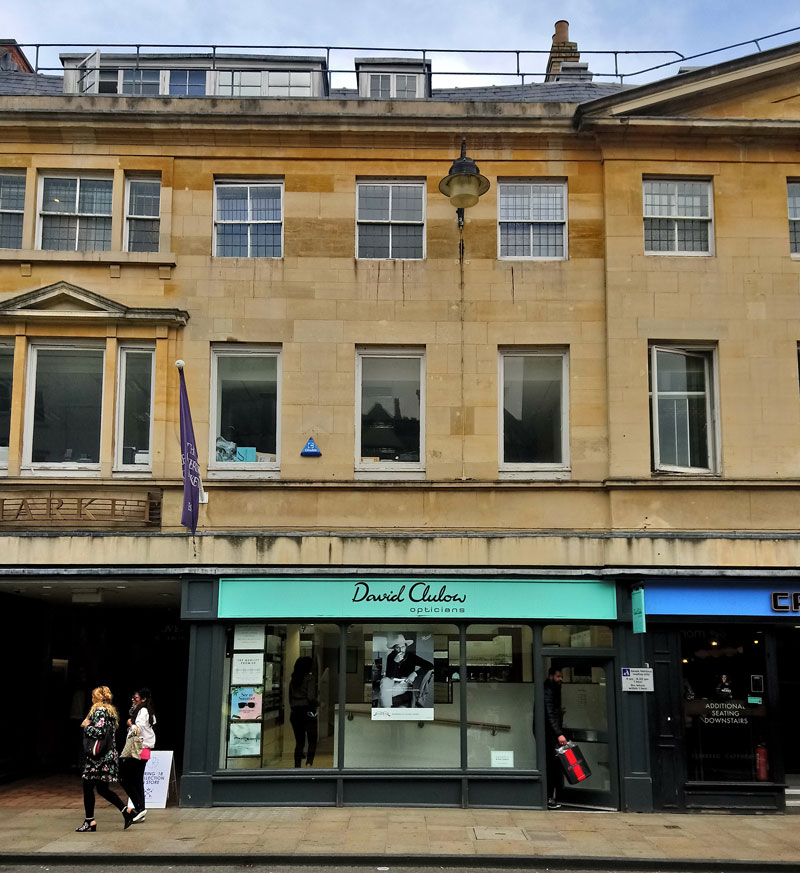
All Souls College now owns all eight shops from No. 8 to No. 15 High Street. On 30 April 2025 its planning application was approved for substantial work on Nos. 10–15 to provide college facilities upstairs (with the reinstatement of the ground floor at No. 12 on the right which will become the entrance to college facilities upstairs). The Archaeological Desk-based Assessment (in two parts) on Nos. 8–15 High Street and the Heritage Impact Assessment (in five parts) on Nos. 10–15 give more information about these three shops and can be accessed from the Documents tab of the planning application (24/00958/LBC) |
The present Nos. 13–16 High Street were built in 1773–4 by John Gwynn to form the frontage to the new covered market and were known as “New Parade” until about 1812. Nos. 13, 14, and 15 are jointly Grade II listed (List Entry No. 1369376, wrongly numbered as 12–15) and are owned by All Souls College. No. 16 on the right is separately Grade II listed (List Entry No. 1047270) and is owned by Lincoln College. These four shops forming the original market front were in the parish of All Saints until that church closed in 1971. They are now in the parish of St Michael-at-the-Northgate Church.
Before the Market expanded westwards in 1838, there was the main central entrance between Nos. 14 & 15 with a small entrance at each end: West Avenue to the left of No. 13 (shown above), and East Avenue to the right of No. 16.. (The above was once the furthest entrance to the west, but following the expansion of the market another entrance was made through No. 10 High Street.)
The first business to occupy the newly rebuilt No. 13 was Clarke & Castle, mercers & drapers in Cornmarket, who on 1 October 1774 announced that they had “opened their Shop upon the NEW PARADE in the High-Street”. James Clarke inscribed in the wet plaster “James Clarke, mercer, 1774”. In 1766 Clarke had married Mrs Mary Ann Smith, the widow of the mercer Henry Smith and the daughter of the mercer Alderman John Austin, and when his father-in-law died on 14 May 1775 Clarke announced he would take over his business in all its branches, so Clarke & Castle moved to Austin's shop in the Cornmarket, and this shop in the High Street was vacated after less than a year. On 9 September 1775 in Jackson's Oxford Journal the forthcoming auction of this “modern-built Stone House and Shop” at No. 13 described it thus:
The House is extremely well situated for Trade, and fit for any genteel business; the sashes, counters, doors, &c. in the shops are mahogany, and in the newest taste; the dining-room is stuccoed, with a marble chimney-piece, richly carved; there are four rooms each on the first and second floors; exceeding good garrets; with a kitchen, good cellaring, and other conveniencies below stairs: And the premisses have not been finished above nine months.
It appears that No. 13 may have been taken over by a linen-draper, mercer, & undertaker called Brown who advertised his shop on the New Parade on 23 May 1778.
D. Parr advertised on 10 October 1801 that he had moved his linen, hosiery, mercery, and haberdashery warehouse from Cornmarket to a shop in the New Parade that he called the Bee Hive, and this seems the most likely shop.
William Juggins was here at the beginning of the nineteenth century, but in 1807 he declined business in favour of Robert Juggins & William Frogley. They dissolved their partnership in May 1813, and Juggins continued in the old shop while Frogley started a separate drapery business in another shop in the High.
By 1830 Nathaniel Castle, a hatter, men's mercer, hosier, and glover, was here at No. 13 in partnership with Robert Juggins. (Castle had probably already been working here from 1822, as when Juggins died at the age of 53 on 5 December 1837 he announced that he had been in sole charge of this shop for fifteen years.)
At the time of the 1841 census Castle lived here over his shop with his wife Mary, two apprentices, a clerk, and a servant, plus a student lodger. He and his wife were still listed here in the 1851 census with his apprentice Robert Juggins, two servants, and two student lodgers. On 5 April 1856 Nathaniel Castle announced in Jackson's Oxford Journal that in fulfilment of the wishes of his former partner Robert Juggins he had taken his nephew William Robert Juggins into partnership with himself.
Nathaniel Castle died in 1860, and in March 1861 his widow Mary announced that she had disposed of the business to John Juggins. The 1861 census the following month shows John Juggins (29), described as a hatter & hosier, living here over his shop with his wife Mary Ann and baby son, plus two servants, and they were still here at the time of the 1871 census. The premises above No. 13 were listed as unoccupied in the 1881 census, and Juggins was a widower living at the present 69 Banbury Road (then numbered 3 North Parade). A month later on 3 May 1881 he announced that he had moved his business to 6 & 7 Ship Street.
The milliner Miss Alice Slade had her shop here from 1882 to 1903. The photograph below (Historic England CC72/02323) shows the exterior of her shop:
The 1891 and 1901 censuses show that Miss Slade did not live over the shop, and the upstairs was occupied by the Gridiron Club, members of which can be seen looking out of the first-floor window in the above photograph. .
Gridiron Club
The upstairs of No. 13 was home to the Gridiron Club from 1890 to 1913 (when it moved to premises over the Midland Bank near Carfax).
The 1899 census shows Miss Eliza Cobbledick (41), described as the Proprietress of the Gridiron Club, living over No. 11 with seven servants of the club (the bookkeeper, kitchen maid, scullery maid, head waiter, second waiter, houseboy, and messenger.
The 1901 census shows Edwin Cross, the club manager, living at the club with his wife Eliza and four servants (a housemaid, kitchenmaid, kitchen porter, and page boy). Cross died at the age of 70 in 1909, and the 1911 census shows that his widow Eliza Cross (59) was now the club manager and lived in the eighteen rooms over these premises with the club's bookkeeper, page, and general servant.
Occupiers of 13 High Street | |
1774–1775 |
Clarke & Castle (James Clarke, mercer) |
By 1830–1861 |
Robert Juggins (possibly from 1781) |
1861–1880 |
John Juggins, Hatter & hosier |
| 1882–1903 |
Miss Alice Slade, Milliner, florist, &c. |
1904 |
Part of City Drapery Stores |
1905–1912 |
Johnson
Bros., Dyers |
1913–1914 |
Johnson
Bros., Dyers |
1915 –1923 |
Johnson Bros., Dyers Sydney Herbert Jones, Tobacconist
(1915–1918) |
1925–1971 |
C. P. Webber (see also Nos. 9, 10–12, and 15) |
1973 |
Costa International Menswear (also at 9–12) |
1975–1976+ |
Stag Shop, Men’s wear |
By 1995–2014 |
Skipton Building Society |
2014–2016 |
Vacant |
2016–2025 |
David Clulow opticians (moved to the Westgate Centre) |
2025– |
Vacant: Nos. 10–15 being redeveloped by All Souls College |
