

10–12: Vacant

All Souls College now owns all eight shops from No. 8 to No. 15 High Street. On 30 April 2025 its planning application was approved for substantial work on Nos. 10–15 to provide college facilities upstairs (with the reinstatement of the ground floor at No. 12 on the right which will become the entrance to college facilities upstairs). The Archaeological Desk-based Assessment (in two parts) on Nos. 8–15 High Street and the Heritage Impact Assessment (in five parts) on Nos. 10–15 give more information about these three shops and can be accessed from the Documents tab of the planning application (24/00958/LBC) |
Nos. 10 & 11 (the large double-fronted building on the left of the above photograph) has an eighteenth-century façade on a fifteenth-century building, and the top floor was added in 1883. It is Grade II listed (List Entry No. 1047312, where the present Nos. 10 & 11 are treated as one house, numbered as 10). At ground-floor level, the shop on the left (No. 10) was sacrificed in 1838 to afford an entrance to the newer section of the Covered Market opened up behind (Market Avenue 1).
No. 12 on the right is also Grade II listed (List Entry No. 1116316, numbered as 11). Its ground floor is now just an entrance to the basement (formerly a restaurant) of all these three shops and of No. 9 to the west. In the nineteenth century, however, it had “extensive and convenient Premises, which run back the whole length of the Old, and adjoin the back of the New Market”.
These three shops were in the parish of All Saints until that church closed in 1971. They are now in the parish of St Michael-at-the-Northgate Church.
These three shops have been owned by All Souls College since 2020/1.
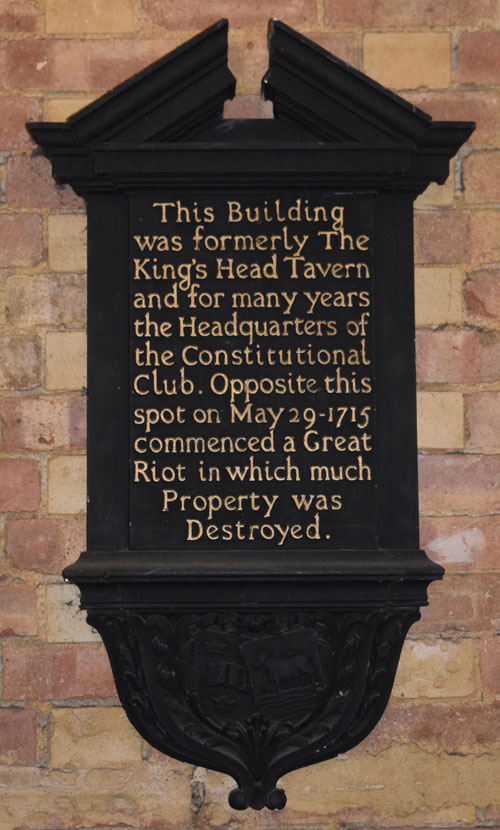
The King’s Head Tavern
This once stood on the site of 10–12 High Street. It was the headquarters of the Constitutional Club and this inscription (right) remembering both the tavern and the club is on the stairs inside No. 9, on the wall of No. 10. It was put up by C. P. Webber in about 1920.
The Constitutional Club held a dinner here in honour of the birthday of George I (28 May 1715) and this sparked off two nights of rioting against the dissenters, who had supported his succession. A rumour spread that Queen Anne, Lord Bolingbroke, Ormonde and Sacheverell were to be burnt in effigy. Both town and gown attacked the members of the Constitutional Club and broke into the Presbyterian meeting house, setting its pulpit on fire.
The following night (29 May) the Quaker meeting house behind Nos. 63 & 64 St Giles' Street (now the south part of Blackfriars and the north part of the Ioannou Centre) and the Baptist meeting place in Oxford were also attacked.
These riots of 1715 took place all over England, and led to the passing of the Riot Act. The government paid compensation to the Oxford victims, the largest amount (c.£109) going to the Presbyterians, and with it they were able to buy the site of what would later become New Road Baptist Chapel. The Baptists, however, had no home in Oxford until they joined the Presbyterians at their New Road Chapel in 1780, and the Quakers until they purchased the former Scottish Presbyterian church in Nelson Street in Jericho in 1888.
For more on the early history of these buildings, see Oxford City Properties, Appendix 10: The site of the Market
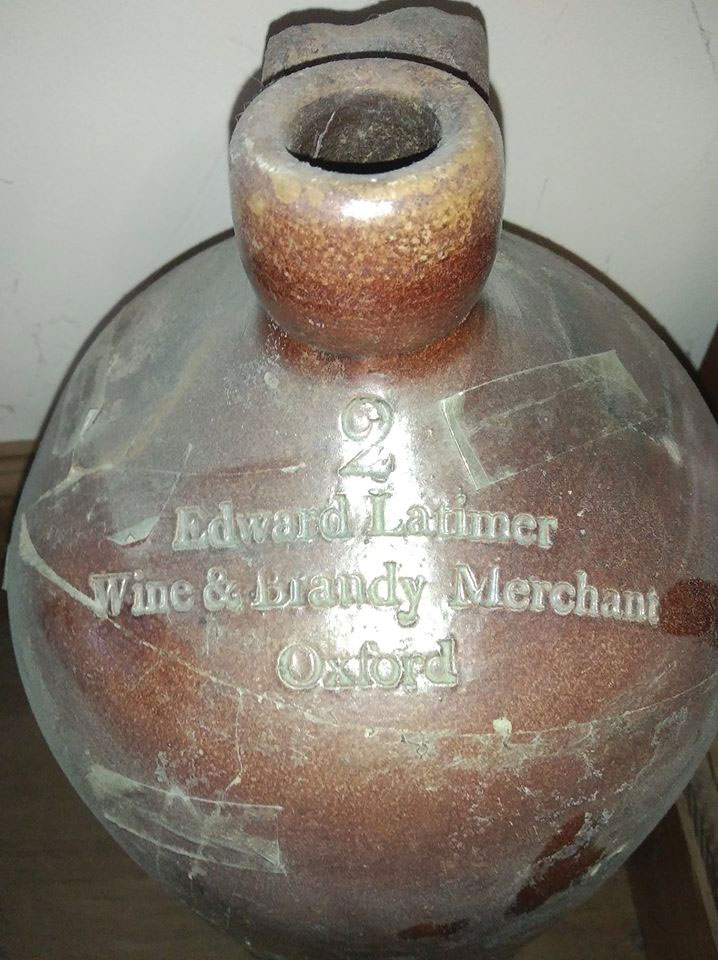
In 1770 Nos. 10 & 11 High Street were sold by James Darker of London for £375 to William Jackson, the proprietor of Jackson’s Oxford Journal.
In 1771 Jackson also bought No. 12 from James Adams for £650, and used it as his printing house.
The 1772 Survey of Oxford shows No. 10 (with a frontage of 5yds) occupied by Mr Brown, and No. 11 (with a frontage of 4yds 2ft 6in) and No. 12 (with a frontage of 6yd 1ft 9in) both occupied by L. Jackson (possibly an error for W. Jackson).
On William Jackson’s death in 1794, his sister inherited Nos. 10–12 and immediately conveyed them to her brother's employee Miss Mary Jones, who had herself inherited from Jackson over 200 acres of land in Headington, including Headington House. On her death in 1815 she in turn left them to her niece and her husband, Elizabeth and Edward Latimer. The Latimer wine shop remained here at No. 11 until 1882.
In 1835 an Act of Parliament was passed for the enlarging of the Market on the west side, and under this Act the northern half of Edward Latimer's property at the back of 10, 11, and 12 High Street was acquired by the Paving Commissioners for £5,000.
On 25 March 1875 the Revd William Latimer and others conveyed to the Vice-Chancellor and others Nos. 10–12 High Street for £8,300. The front portion facing the street was sold immediately to the City Drapery Stores.
Occupants of the three separate shops at 10, 11, & 12 High Street to 1880
No. 10
The tailors & drapers W. & J. Wallington were here in the 1830s, but on 14 October 1837 announced that they were moving out of 10 High Street into 45 Broad Street.
The stationer Frederick Trash occupied the shop from at least 1839 to 1846. At the time of the 1841 census a young tailor lived over the premises with his wife and child.
The bookseller & stationer Henry Ladd had these premises by 1851, and the 1851 census shows him as a single man of 26, living over his shop with a general servant. He was still here with one servant at the time of the 1861 census.
No. 10 was unoccupied at the time of the 1871 and 1881 censuses
No. 11
Edward Latimer ran his wine merchant’s business from No. 11 in the early nineteenth century, and “Latimer’s immortal tun” is praised in the poem Brasenose Ale. He was in partnership with William Scott for a period to December 1832, when Scott opened his own wine shop on the other side of the High.
In 1835 an Act for enlarging the covered market on its west side was passed, so that the market now extends across the rear of these premises. A hole was punched through the western side of No. 10 to create a new entrance to the market (Market Avenue No. 1).
The house appears to have been occupied by two clerks, a servant, and a governess at the time of the 1841 census.
Edward Latimer died on 18 November 1845, and the wine business at No. 11 was taken over by his son Frederic Latimer. He lived in Headington, and the 1851 census shows Robert Braine, a wine merchant who presumably helped to manage the business, living over the premises with his family. By the time of the 1861 census the upstairs premises were occupied by Henry de Bariau, a teacher of languages, and his wife and son.
Frederic Latimer died in September 1870 at the age of 56, and his eldest son Edward Hugh Latimer took over the business. He went into partnership with James Hinton Tustin, and for a short while the business was known as Latimer, Tustin & Co.
The upstairs continued to be let out, and the 1861 census shows Henry de Brian, a French teacher of languages, living here with his wife Elizabeth and their son, and in a separate household described as 11½ lived the Worcester College undergraduate Sackville Davis (30), and his wife Annie, plus their cook and housemaid and their lodger, the surgeon Thomas Fletcher Tyerman. In 1872 Davis became the first Jew to graduate from the University of Oxford, and by the time of the 1871 census Tyerman and his two servants had the whole of the upstairs premises. .
Latimer, Tustin, & Co soon became insolvent, and the first meeting of creditors was held on 29 June 1874. On 18 July 1874 Jackson's Oxford Journal advertised a forthcoming auction of all their stock in trade:
The Stock consists of Port, Sherry, Champagne, Sparkling Moselle, Claret, Sauterne, Chablis, and a variety of Liqueurs.
The Fixtures and Utensils comprise Mahogany-top Counter, Shelving, 7-motion Beer Engine, Two 8-motion Spirit Engines, Copper Muller, Spirit Measures and Funnels, Pewter Spirit and Beer Measures, Spirit Force, Sykes's Hydrometer, Office Desk, Drawers, Prints, Bottle Racks, Jars, Bottles, Casks, Skids, Horsing; also a four-wheel Spring Truck, and a variety of other useful articles.
On 25 March 1875 Edward's uncle, the Reverend William Latimer, and others sold the premises at 10–12 High Street to the Vice-Chancellor and others for £8,300
Edward Hugh Latimer died at 11 High Street in June 1876 at the age of 28. Mrs Latimer (possibly his mother rather than his widow) is listed as a wine & spirit merchant at 11 High Street in 1880 only.
No one was listed as living at No. 11 at the time of the 1881 census, and then Mr J. Long, another wine merchant, is listed in the 1882 directory only.
No. 12
In April 1839 the drapers Morley & Co moved in here (from four doors to the east at No. 16), and the 1841 census shows the draper James Morley living over the premises with his wife Jane and 15-year-old John Morley, plus six shop assistants, an apprentice, and three servants.
The partnership of James Morley, William Philip Gale, and Samuel Lavington Evans was dissolved on 27 May 1841, and the firm then became Morley & Evans. The 1851 census shows Samuel Lavington Evans living over the shop with his wife and two young children, as well eight draper’s assistants and two servants. Evans was still here at the time of the 1861 census with his wife Elizabeth and daughter Henrietta, plus eight assistants, and again in the 1871 census, when he was a widower, with his son Frederick and his daughters Louisa and Henrietta, plus three servants and eight draper's assistants. He died here at the age of 73 on 31 August 1878.
On 1 March 1879 the City Drapery Stores announced that they had purchased Evans's stock from his executors, and from then until 1882 they occupied just this shop prior to taking over the whole group. There was no one living at No.12 at the time of the 1881 census.
City Drapery Stores at 10–12 High Street: 1880–1905
There were extensive alterations to these premises by Messrs Beaumont & Co. in 1880, as reported in Jackson's Oxford Journal of 23 October that year:
Nos. 10, 11, and 12, High-street, have come into the hands of the old-established firm of Messrs. Beaumont and Co., linen drapers and silk mercers, and very extensive alterations are being made by Mr. G. Jones, builder, under the direction of Mr. Codd. First, a new avenue [shown above, to the left of the group] is constructed to the Market, or rather to that part of the Market which is about to be added. The refreshment bar and wine business so long and so creditably conducted by the Latimer family will be approached from both the new avenue and the old one between Mr. Juggins's [No. 13] and the late Mr. Evans's premises [No. 12]. The shops Nos. 10 and 11 are being rebuilt; a large room about 35½ft. by 30½ft., for the sale of carpets, is being added to the already extensive show rooms of Messrs Beaumont and Co.; and other improvements are in progress.
Beaumont & Co named their shop the City Drapery & Linen Stores, and announced on 18 December 1880 that the alterations were complete. Initially at ground-floor level they only occupied one of the three shops (S. L. Evans' old shop at No. 12), but stated that their carpet room “the greater portion of the First Floor of Nos. 10, 11, and 12, High Street, extending over an area of 1000 superficial feet”
On 4 June 1881 the proprietors of the City Drapery & Linen Stores announced in Jackson's Oxford Journal that “in addition to the large CARPET ROOM opened last December, they have been compelled to take the two adjoining Shops, Nos. 10 and 11, HIGH STREET, in order to obtain the necessary space, consequent on the rapid development of their Business”
Jackson's Oxford Journal of 13 October 1883 reports on further alterations:
THE CITY DRAPERY STORES.
The alterations at these premises (10, 11, and 12 High-street), which were commenced in the early part of the Long Vacation, are now completed. The old front which was inserted some thirty years back has been taken out, and a handsome modern one has taken its place, the centre pane of which, we believe, is the largest sheet of glass in the City. The thick wall at the east end of the premises has been pierced in two places, to make room for two large windows. The greatest addition, however, has been made by adding a new storey to the premises, by which a large room is available for the display of the numerous articles sold by this enterprising firm. This room is approached by a handsome staircase (copied as nearly as possible from the one in the drapery shop o[f] this establishment, which is so well known to antiquarians of the University and City) and has a floorage of 1000 square feet, and is 25 feet in height. A gallery, with an iron palisade, has been erected on three sides of the room, which is intended for storing reserve stock, &c. Two new rooms, devoted to bedsteads and bedding, have also been added: in the latter the original lantern light of Elden Hall has been carefully preserved. The alterations have been made under the able supervision of Mr. F. Codd, of Bocardo Chambers in this City, and have been carried out in a most satisfactory manner by Mr. F. H. Kingerlee, of Banbury and Oxford.
The City Drapery Stores made further alterations in 1886, as reported on 16 October:
Very important alterations have been made at the City Drapery Stores, 10, 11, and 12 High-street. The carpet and cabinet rooms have been considerably enlarged, so that each of them now have a floorage of 1200 superficial feet. A new room of large proportions has been fitted up exclusively for the lace and fancy goods, and another apartment is devoted entirely to body linen and ladies' underclothing. A handsome staircase (in the early decorative style of architecture) leading to the new premises has been erected on the ground floor, from designs supplied by A. Mardon Mowbray, Esq., F.R.I.B.A. The work has been executed in a highly satisfactory manner by Mr. T. H. Kingerlee, under the able superintendence of Mr. Watson.
More improvements were reported on 15 October 1887:
The proprietors of the City Drapery Stores have again taken advantage of the Long Vacation to make somewhat extensive alterations to their already large premises, and have also made a great improvement in their windows. In consequence of the rapid and continued increase of business, this enterprising firm has also adopted the Lamson Cash Railway, which is one of the most useful and clever inventions of our “cute cousins” across the “silver stream.” The “railway” may be briefly described as a series of elevated lines suspended from the ceiling, radiating from the cashier's desk to all parts of the shop, upstairs and down. There are two tracks in each line, one of which is inclined towards the cashier's desk, so as to convey the hollow balls containing the ash and bill to the cashier; and the other, which is inclined in the opposite direction, returns the change and receipted bill to the customer.
At the time of the 1891 census the widowed housekeeper Charlotte M. Long (46) was living over the City Drapery Stores at Nos. 10, 11, & 12 with three draper's assistants and a servant.
Beaumont & Co. of the City Drapery Stores were one of the first shops in Oxford to get a telephone line installed, and in 1895 they had the simple phone number 45.
This advertisement published in Jackson's Oxford Journal on 9 September 1899 shows that as well as fabrics the City Drapery Stores sold hats, ladies' jackets, underwear, and corsets, and also furnished houses:

There was no one living over the City Drapery Stores at the time of the 1901 census.
Webbers at 10–12 High Street: 1905–1971
In 1905 Charles Webber bought Nos. 10–12 from Edward Beaumont. He soon acquired adjoining shops on both sides, so that in its heyday Webber’s had thirteen bays facing the High Street and included Market Avenues 1, 2, and 3. The firm was bought by Hide & Co. in 1952, and closed in October 1971.
The photograph below (Historic England HT00113) shows Webber's shop in 1905:
- PictureOxon: Webber's shop at 10–12 High Street at a later date: by this time it had extended further east
- Images of Webber's and memories of people who worked there in the Oxford Mail Memory Lane section
No one lived over this shop at the time of the 1911 census.
The removal of the floor of No. 12
Between 1982 and 1984, permission was granted to remove the greater part of the ground floor of 12, and insert a curving staircase to provide access to a restaurant in the basement of Nos. 10, 11, & 12 High Street. 21 Sept 1984 - 84/00840/NFH, - 84/00384/NFH, and 84/00385/L).
Occupiers of 10–12 High Street | |||
Date |
10 High Street |
11 High Street |
12 High Street |
1830s |
W. & J. Wallington |
Edward Latimer Gillham, Tailor & robe maker, is listed at No. 11 from 1839 to at least 1841 |
J. Rainsford, Draper |
1839–1876 |
Frederick Trash Henry Ladd (by 1851–1861) B. R. Baker (1866–67) W. N. Webster (1869) Henry Harris (1871–1876) |
(Address given as Frederic Latimer & Co. Latimer, Tustin, & Co Mrs Latimer |
Morley
& Co. Morley & Evans Samuel Lavington Evans (1851) S. L. Evans & Co. Drapers & mercers |
1879–1880 |
Vacant |
The City Drapery Stores |
|
1880–1881 |
Part of E. Beaumont's |
Market Wine
& Spirit Vaults |
|
|
1881–1905 |
City Drapery Stores | ||
|
1905–1971 |
Webbers (Oxford) Ltd. | ||
1973 |
Costa International Menswear (also at 9 and 13) | ||
| 1975–1980+ |
John Menzies, Stationer | ||
|
By 1993–2007 |
Boots Opticians |
Pizzaland, |
|
|
2008–2017 |
L. K. Bennett [moved to Westgate Centre] |
||
2018 |
Oxford Heritage |
||
Aug 2018–2022 |
Vacant |
||
2022–present |
Vacant: Nos. 10–15 being redeveloped by All Souls College |
||
