

Oxford Inscriptions: Former Public Library
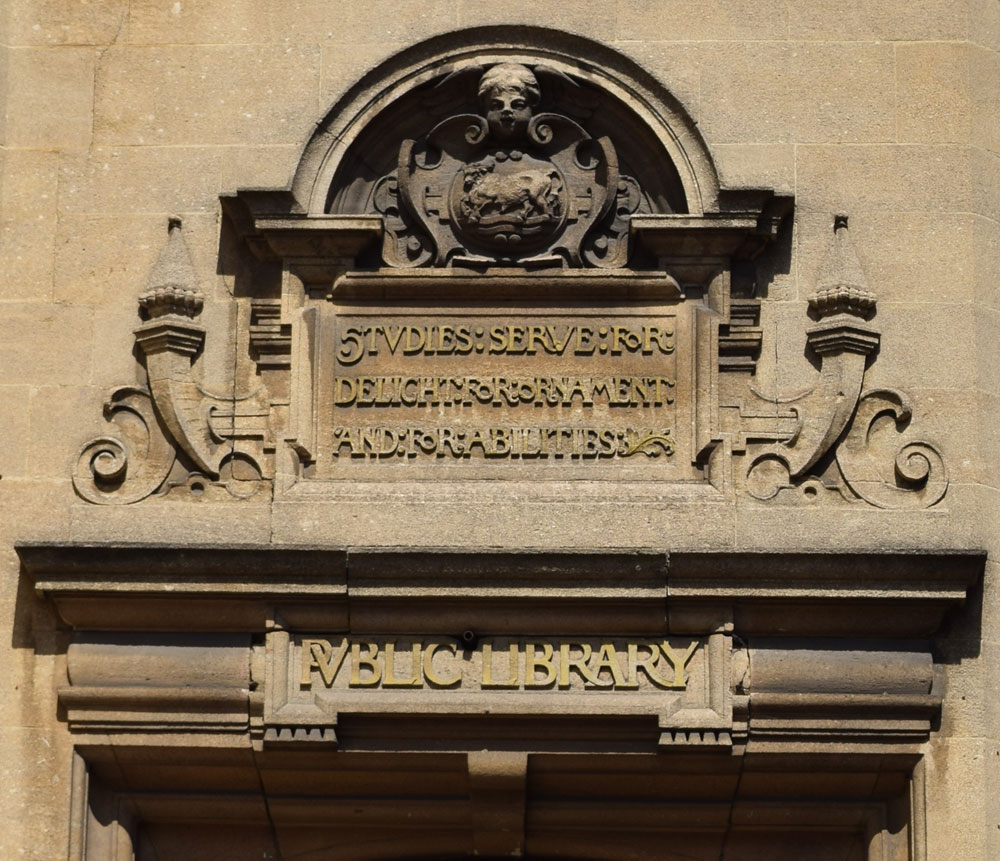
STUDIES SERVE FOR / DELIGHT, FOR ORNAMENT, / AND FOR ABILITIES
This inscription on the section of the Town Hall on the corner of St Aldate’s and Blue Boar Street comes from Francis Bacon’s essay Of Studies. This was the site of Oxford's public library from 1895 to 1973. The lending library opened in December 1895 and the reference library in February 1896 when the main bulk of the Town Hall (opened on 12 May 1897) was not yet completed.
Jackson's Oxford Journal reported on 12 October 1895:
The Free Public Library, which occupies a position at the corner of the two frontages, is practically a separate building, though forming architecturally a part of the general group. The entrance to it will be in Blue Boar-street. This is the most advanced portion of the work, and the Free Library will be ready for occupation in the course of a few weeks. The ground floor contains a general reading room, accommodating 104 readers, a ladies room, 23ft. long, by 18ft. wide, with seating for 24, and a lending library 44ft. long by 24ft. On the first floor is the reference library 59ft. long by 36ft., which provides for 72 readers, the book cases being arranged in alcoves along one side of the room. This will be one of the most interesting rooms in the building, the whole of the fittings and furnishings being in American walnut, and the walls lined to a height of eight feet with a panelling of the same material. In the windows are shields bearing the arms of Sir Thomas Bodley, J. R. Green, Sir William D'Avenant, and Sir William Boxhall. A very large amount of storage for books is provided in various parts of the buildings, and the extreme capacity will probably not fall short of 100,000 volumes. A repoussée [sic] copper tablet has been fixed in the entrance vestibule bearing an inscription stating that the library was founded in 1854, this being one of the first established under the Public Libraries Act.
Then on 28 December 1895 that newspaper duly reported:
The Library has been already opened, and we believe all will agree that we have a most handsome and well proportioned set of rooms, which will be still more highly appreciated when St. Aldate's rise has been laid with asphalte [sic], and when the generosity of leading citizens and members of the University has well stocked the shelves of the library.
Oxford's previous public library
Prior to 1850, there were no free public libraries in England, although in January 1813 Oxford City Council allowed the Committee of a Library and Reading Room in Oxford to fit up the room lately used for the Soup Charity and to hold it for two years rent free. This survived for only eleven years: on 1 June 1824 the minutes of the city council record that a communication had been received from the Committee of Subscribers to the Library (then in the room under the Grand Jury Room) that “the institution is about to be dissolved and will not want the room beyond the period of two months from this time”,
On 15 April 1850 Oxford Town Council was unanimous in agreeing to form a committee to consider whether it was desirable for them to take steps towards the formation of a Public Library, prior to the Public Libraries Act receiving Royal Assent on 14 August that year. Jackson's Oxford Journal reported on 31 August 1850:
In any borough, the population of which exceeds 10,000, the Mayor, on the request of the Town Council, may ascertain by the votes of the burgesses whether the Act shall be adopted. When adopted in a borough, all necessary things are to be provided out of a rate of not more than one halfpenny in the pound in the year. The public libraries and museums are to be held by the Town Council in trust for the benefit of the inhabitants. The admission to such libraries and museums is to be free of all charges.
A vote was duly taken by the burgesses of Oxford on 6 October 1852, and they were unanimously in favour of a public library being founded, not least because “there was no place of resort for the working men or the youth of Oxford, except the tavern, where vicious habits were contracted, and former good impressions obliterated”. Arguments about where it should be situated came up at the Oxford Town Council meeting on 27 January 1853, where:
Mr Baxter objected to the appropriating part of the Town Hall [sic] for the Public Library and Reading Room, on the ground that it might cause confusion and interruption to public business; that the Act provides that the building for the library should be a permanent one and held in perpetuity, which it was not intended the Town Hall should be; that should the room be insufficient for the accommodation of the public, there were no means of enlarging it; that if the Council should mortgage property to make the alterations in the Town Hall, it must be paid for ultimately by a borough rate; and that it would, therefore, be more advisable for the inhabitants to form their own Committee, and to manage and expend the rate in such manner as they may deem most advantageous, in erecting a building and providing all necessary matters for opening the Reading Room, the Council undertaking to render all the assistance they may, both individually and collectively, in promoting the objects of the Institution.
For reasons of economy, Oxford's first public library was not purpose-built like its successors, and opened in part of the old Town Hall in 1854 (full report in Jackson’s Oxford Journal of 3 June that year), with Benjamin Harris Blackwell (the father of the founder of Blackwell's bookshop) appointed the first city librarian. Its opening hours were impressive: 9am to 11pm in the summer, 9am to 10pm in winter, and 6pm to 10pm on Sundays. (The parishioners of St Martin's protested against the Sunday opening, but to no avail.)
Blackwell died at the age of 41 on 9 January 1855, and this notice advertised the election of a new librarian, with a salary of £60 a year.
The City Building Improvement Committee in 1886 described the public library and reading room as “unhealthy, mean in arrangement and a disgrace to an enlightened and progressive city”; the courtroom and it offices as “very defective”, and the Town Hall itself as “ill-shaped and not convenient”, and it was all pulled down in May 1893.
A temporary City of Oxford Public Library was opened in Bath Court. The Town Clerk announced in Jackson's Oxford Journal on 9 November 1895 that this would be closed down on and after Monday 11 November 1895.
Oxford's present public library
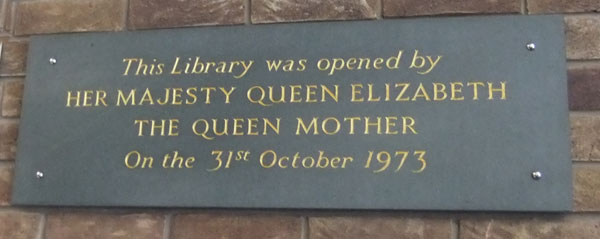
The Central Library moved to the Westgate Centre in 1973, and this inscription is inside the library, but is included because it can be seen easily on the right-hand wall if you look through the door.
This Library was opened by
HER MAJESTY QUEEN ELIZABETH
THE QUEEN MOTHER
On the 31st October 1973
It was briefly renamed the Oxfordshire County Library in 2019, but this was changed to the Oxford Westgate Library in October 2023