

Nos. 65–67: Ioannou Centre
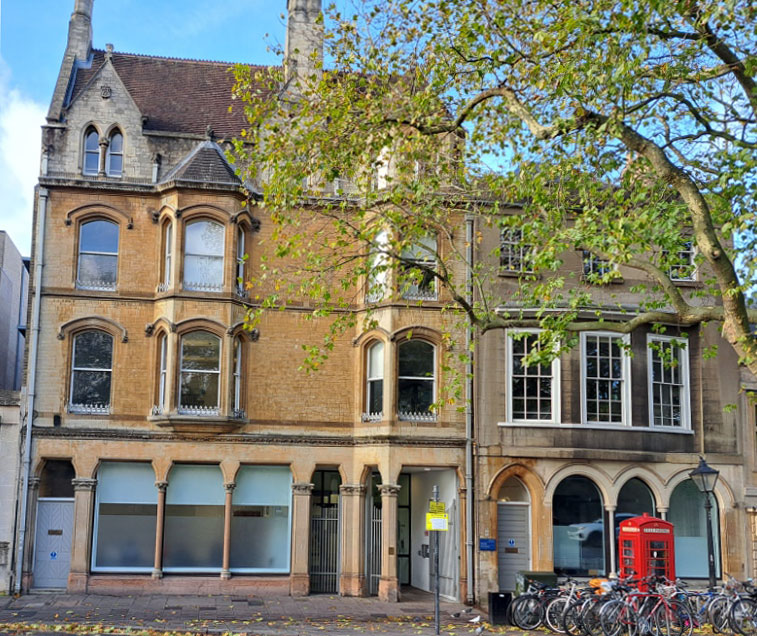
No. 65 (on the right of the above picture) dates from the early eighteenth century and is Grade II listed ( List Entry No. 1246866).
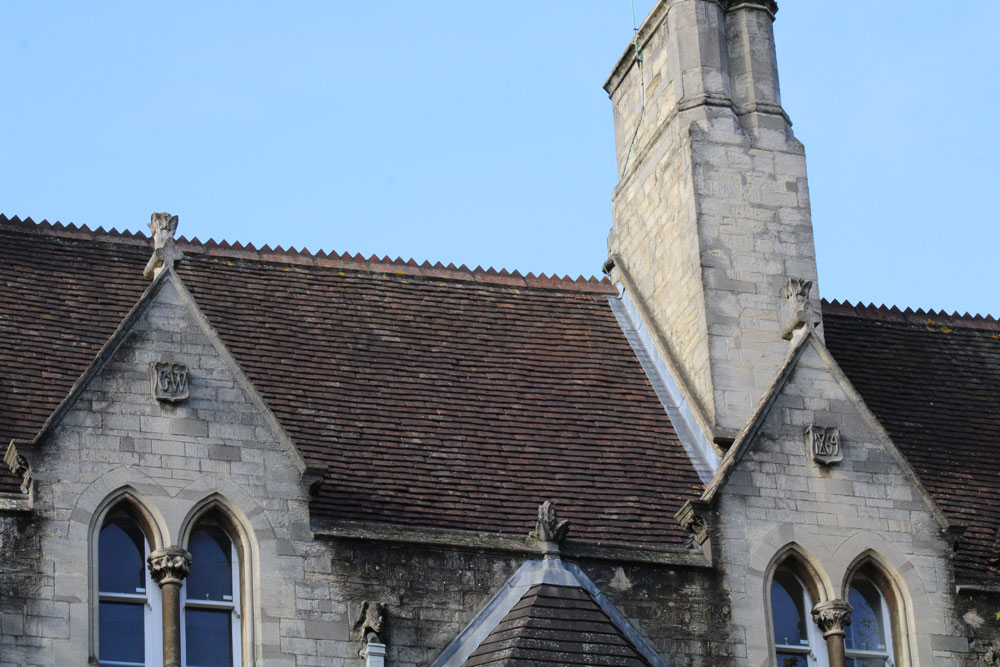
Nos. 66/67 to the left were built in 1869 by George Wyatt in the Gothic style of the University Museum. In 1984 the Oxford Civic Society, with the support of the Oxford Preservation Trust, saved this pair of newer houses from demolition by the University, and they are now also Grade II listed (List entry 1047078). Wyatt' initials GW can be seen in the left gable and the date 1869 in the right one in the image below:
All three houses are in St Mary Magdalen parish.
Photograph of this building in 1949. when it was three separate shops
No. 65
A house on this site was given by Robert Abdy and William Prede to Balliol College in 1454, and the latter held it until 1804, when it was sold to Worcester College. For details of the house throughout this period, see H. E. Salter, Oxford Balliol Deeds, pp. 211–18. Here are some of the later lessees of Balliol:
- 20 March 1502: Richard Bernyngham and Robert Lake, clerks
- 13 June 1568: Richard Whytt, cook of Balliol College, and Elizabeth his wife
- 18 April 1601: Leonard Maior, a musician, and Elizabeth his wife
- 6 November 1622: Thomas Wyands, cordwainer
- 22 March 1627/8 and 12 September 1649: Nicholas Day, whitebaker
- 18 December 1663: Richard Day, whitebaker
- 3 March 1696/7: William Ford of Newcastle-under-Lyme, clerk
- 1 March 1708 and 1737/8: Jeremiah Franklin
- 6 January 1752/3: his widow, Catherine Franklin
- 2 June 1769: Henry Keene, Esq. of Ealing.
- 24 July 1777: Elizabeth Bentham, a widow
Henry Keene was an architect, and was probably responsible for remodelling the house, which still has a late eighteenth-century open-well staircase. By the time of the 1772 Survey of Oxford, his protégé James Pears, the builder who worked with him, was the occupant of this house. In 1773 Pears moved five doors north to 60 St Giles.
At the time of the 1841 census No. 65 appears to have been occupied by Harriet King. Later In 1841 the Revd Dr Charles Atmore Ogilvie, who became the first Regius Professor of Pastoral Theology on 23 April 1842, moved in here. He moved out in 1849/50, and a sale of all his furniture was advertised on 23 July 1850.
The house was unoccupied at the time of the 1851 census, and on 14 June 1851 it was advertised for sale:
A VALUABLE FREEHOLD FIRST-CLASS DWELLING HOUSE AND PREMISES,
Situate near to the Taylor and Randolph Buildings,
In the best part of SAINT GILES'S-STREET, OXFORD.TO BE SOLD BY PRIVATE CONTRACT,—An excellent FREEHOLD RESIDENCE and PREMISES, lately occupied by the Rev. Dr. Ogilvie, and containing on the ground floor a dining room, 18ft. by 16ft.; entrance hall, lobby, and store closets; kitchen, butler's pantry, scullery, and out-offices; spacious bow fronted drawing room, 22ft. by 19ft.; study and bed room on the first floor; 4 bed rooms and dressing room on the second floor, and servants' attic over, water closets, &c.; in the basement are two arched wine cellars, beer cellar, and larder; also a stable and loft over at the back, with a side entrance to the same.
The above substantial Stone-built and superior Dwelling House stands on an exceedingly valuable plot of Freehold Land, containing a frontage of 26½ft. by a depth of about 280ft; is situate in the best part of St. Giles's, Oxford, and will afford an opportunity rarely met with for any person requiring a superior situation either fro trade, any of the professions, or as a private dwelling.
The house was altered and extended in about 1860, and at the time of the 1861 census it was occupied by Mrs Caroline Johnson, a 39-year-old widow of independent means, with six children aged between two and nine, plus four house servants.
In 1867 Charles Cripps the chemist moved here to No. 65 from two doors to the south at No. 67. The 1871 census shows him living here as a bachelor with his assistant and servant. In 1881 he was here with his wife Rebecca and their four young children, plus a servant. He moved out in early 1885, with an auction of all his furniture advertised on 21 March, but held on to the house and let it out unfurnished until about 1890.
The 1891 census shows Eliza Howe (65) and her boarders Emma Beaufoy (59) and Alice Floyd (29), all described as retired schoolmistresses, living here at No. 65 with their cook and housemaid. (They had recently moved from their school at 60 St Giles' Street to make way for the expansion of Pusey House.) Living in a separate part of the house was the electroplate & cutlery dealer Frank E. Webb (46) and his wife Elizabeth, plus their servant girl.
By the time of the 1901 census Frank E. Webb had moved into the main part of the house with his wife and servant, and the Revd Frederick C. Nash (47) lived here in a separate household with his wife Sophia and their servant.
The booksellers W. H. Smith & Son had a shop here in 1911, occupied by their manager William Russell Hickman and his wife and two children, plus their servant.
The 1921 census shows Sydney Hoare (38), a retired soldier, living here with his wife Daisy (35), who worked at home as the business manager of the Oxford Correspondence College Ltd, and their servant.
The original No. 66 prior to 1867
The early occupants of the original house on this site can be identified from Balliol College deeds relating to the house next door (No. 65), as it also names the adjoining neighbours to the south:
- 13 June 1568: Tenement of Roger Huett
- 18 April 1601: Tenement of William Prickett and a garden of William Munday
- 6 November 1622, 18 December 1663: Tenement of Robert Butler and a garden of William Munday
By 1696 this was the Hare & Hounds pub.
- 3 March 1696/7: Tenement in the tenure of William Wildgoose, and a garden now or late in the tenure of Thomas Annison, cook
- 1 March 1737/8 and 6 January 1752/3: Tenement now or late in the tenure of John Wright Esq.
- 2 June 1769, 24 July 1777: Tenement and garden in the tenure of Thomas Lucas
In 1830 the landlord of the Hare & Hounds was Isaac Archer, but by 1839 Mrs Hannah Archer had taken over. The 1841 census shows that she was aided by her 15-year old daughter Matilda. She appears to have been the last licensee of the pub.
At the time of the 1851 census No. 66 was in the occupation of the watchmaker Israel Levi or Levy and his wife Selina, both born in Poland, and a servant. They were still here in 1861, by which time they had been joined by their niece Edith Lazarus.
This house belonged to the Feoffees Charity in the Parish of St Mary Magdalen by 1866 when it was leased to George Wyatt. On 19 May that year it was reported that his lease would run out on 29 September 1866 and that the Trustees proposed to sell the house by private contract for £402.
It appears that George Wyatt purchased No. 66, as in 1868 he demolished it (along with No. 67) and built a new pair of houses on this site.
The original No. 67 (to 1867)
In 1841 George Wyatt, a widower and ironmonger, lived in the house that was on this site with his sister Elizabeth, his son Thomas, aged 6, and a servant. He married his second wife, Martha West, on 25 July 1846. On 27 April 1850 he announced that he was moving his shop from here to 70 St Giles' Street.
Wyatt let out No. 67 for twenty years: the 1851 census shows Ben Kench, a plumber, lived here with his wife and four daughters, and in 1861 the chemist Isaac West lived here with his assistant Charles Cripps (who was soon to take over the business) and a servant.
In 1867 Wyatt decided to pull down Nos. 66 and 67 and rebuild them as they are today, choosing to live in No. 67 himself.
The rebuilding of Nos. 66 & 67 in 1867/8
This new building has the last surviving Gothic Victorian shop front in Oxford. It was praised lavishly In Jackson’s Oxford Journal of October 1868:
The chief improvement in St. Giles’s is the erection of the two very fine houses in place of the two old ones occupied by Mr. Cripps, chemist, and Mr. Levi, jeweller; and Mr. G. Wyatt, to whom the ground belongs, has certainly made the most of it. The two houses which he has erected will bear comparison with any in Oxford for solidity of material and originality and excellence of design. These two houses are splendidly built in stone, and throughout are constructed in a style of durability and completeness which is seldom seen in these days of rapid building and “railway contracts”. The staircases are of stone. The frontage is full of original design, being handsomely built and adorned with carvings of animals, birds, heads of human beings, &c., which reflect great credit on the skilled workmen Mr. Wyatt employs, one of whom drew up the plans, while another carved the stone. The whole work is a durable monument of local talent, wrought out by “cunning hands”, with something of the olden spirit of enthusiasm, when “clerks of works” were Secretaries of State, and when builders dwelt for years on the scene of their beloved labour. Mr. Cripps has removed next door to these new houses, and has had a new shop front put in, the windows set in handsome arches of stone, divided by elegant pillars of marble.
The set of heads above the first- and second-floor windows are thought to represent members of the Wyatt family.
The present No. 66 from 1868
At the time of the 1871 census this house was occupied by Michael A. A. Matthews (49), who described himself as an “Engraver, Printer, Stationer, Artist & Life & Fire Insurance Agent”. He lived here with his wife Mary and their two children. He was still here with his wife and daughter at the time of the 1881 census.
The 1891 census shows the chemist's assistant Arthur Roberts (22) living here with his servant.
By 1901 the chemist & druggist Thomas Thurland (59) lived here over his shop with his wife Miriam and their three children. He was still here in 1911 with his wife and two children.
The present No. 67 from 1868
The 1871 census shows the ironmonger George Wyatt living here at the new house he had built with his wife Martha and their two children, his sister-in-law Ann Goodall, and their two servants. He died here at the age of 67 in February 1872, and his widow Martha Wyatt announced in Jackson's Oxford Journal on 2 March 1872 that she would be carrying on his ironmongery business in co-operation with her son William West Wyatt. At the time of the 1881 census the house in St Giles was occupied Mrs Wyatt, who described herself as an ironmonger, and her daughter Charlotte and her three-year-old granddaughter Ada Burbridge, while her son William (27), who described himself as a master ironmonger employing eight men and four boys, was living at “Canterbury” in Kingston Road with his wife and two children. On 24 February 1883 his childless half-brother Thomas Alder Wyatt, who had just sold their father's yard at No. 74 to the University of Oxford, announced that henceforth the family's building business would be carried on here at No. 67 by William West Wyatt.
Martha Wyatt was still living at 67 St Giles' Street at the time of the 1891 census with her granddaughter Ada Burbridge (13) and her two servants. She died here on 2 April 1894 at the age of 80, and her executors wasted no time, as on 21 April Jackson's Oxford Journal advertised the forthcoming auction on the premises of her household furniture, china, glass, and oil paintings.
The ironmonger & builder William West Wyatt had been living with his family at 39 Wellington Square, but by 1901 he was living here at 67 St Giles' Street with his wife Edith and his daughter and his mother-in-law Sarah J. Wheeler, plus their servant. By 1911 this family had moved again, this time to Cumnor. He died in 1919 at the age of 66, but the business survived at 67 St Giles's Street until 1926.
At the time of the 1911 census Miss Jane Gegg (64) ran a boarding house in the twelve rooms above the shop, now described as No. 67A.
From 1921 to 1926 No. 67A was occupied by Mrs Rose Drinkwater (the widow of the architect Harry George Walter Drinkwater), and the 1921 census shows her at the age of 66, described as the Director of the Oxford Theatre Co. Ltd,, living here with her daughter Grace (42) and their two servants. She died here at the age of 71 on 13 April 1926, and her daughter Miss Grace Drinkwater from continued to live here until 1940.
In 1940 the upstairs rooms became a small hotel. The Romanian writer Mircea Eliade wrote in his diary on 5 November 1940 that he was lodging in “Oxoniensis, Private Hotel, St Giles’s Street 67” and that he had been there since 15 September. This hotel was run by Miss A. C. Hobson, and she soon changed its name to the Ashmole Private Hotel.
From 1952 to 1954 it was the Pickwick House Private Hotel, run by Mrs V. B. Forsythe.
The plan below shows the three houses in 1876. No. 66 is tiny, with no back garden, while No. 67 has a fountain and a large outbuilding.

|
Occupants listed in censuses and
directories |
|||
Year |
65 St Giles |
66 St Giles |
67 St Giles |
1841–1846 |
Charles Atmore Ogilvie, D.D. (to 1850) |
Hare & Hounds: |
George Wyatt |
1851 |
Uninhabited |
Israel Morris Levi |
Ben Kench |
1852 |
Thomas Sear |
||
1861 |
Mrs M. J. Johnson |
Isaac West |
|
1867 |
J. B. Sedgefield |
Charles Cripps |
|
1869–1890 |
Charles Cripps (House let unfurnished |
Michael Angelo Alfred Matthews |
George Wyatt
Tel. 211 |
1891 |
Francis Edward
Webb |
James Wylde |
|
1893 |
Ernest Henry Rogers |
||
1894–1902 |
Thomas |
||
1904 |
Bhojraj Khatanmal |
||
1905 |
East India Hotel |
||
1906–1913 |
W. H. Smith &
Son |
||
1914 |
Frederick Lionel |
||
1921 |
Oxford Correspondence College Ltd |
||
1922–1923 |
Dawson K. Bunn & Co. |
||
1924–1926 |
Layton Garages |
||
| 1927–1954 |
Numerous organizations,
including: + The Alley Workshops of Arts & Crafts in 1926 & 1927 |
||
John Blundell
Ltd Upstairs at 67A: Ashmole Private Hotel Pickwick House Private Hotel |
|||
1956 |
Barnett Library |
||
1958 |
Taylor Institution annexe |
||
1964 |
John Blundell Ltd |
||
1968–1976 |
Taylor Institution annexe |
||
1977–1989 |
Unused |
Sporadic use by |
|
1989–1994 |
Oxford University Libraries Automation Service |
||
1994–2002 |
Oxford University Libraries |
Centre for the Study of Ancient Documents and Department of Continuing Education |
|
2002 |
|||