

Nos. 62–64: Blackfriars

This Dominican chapel and priory on the corner of Pusey Street (formerly Alfred Street) was built in 1921–9 by Edward Doran Webb in a late-seventeenth-century style. Pevsner described it as a “domestic looking façade of late C17 character, with cross-windows and a pediment not in the centre”. It is a listed building (List Entry No. 1380933), and lies in St Mary Magdalen parish.
It is now Blackfriars Priory (a community of Dominican Friars) and Blackfriars Hall (which became a permanent private hall of the University of Oxford in 1994).

The three houses that stood
on this site until 1929
The photograph on the right shows the block of three houses numbered (right to left) 62, 63, and 64 St Giles' Street that were demolished to make way for Blackfriars, which also took over the land to the right of this group of houses, attaching itself to Pusey House to the north.
No. 62
John Marriott Davenport, solicitor and Clerk of the Peace for the County of Oxford , lived here from about 1842. The 1851 census shows him in residence with his wife Sophia and their children Thomas, Susanna, Edward, Francis, and Alfred, plus four servants. In 1861 they were here with Thomas (19) now an undergraduate and a new young son, Arthur, waited on by a cook, housemaid, nursemaid, and footman, and in 1871 with three of their children plus servants. In 1881 Davenport and his wife were here with their daughter Susanna and three servants. He died on 31 January 1882.
The 1891 census shows his widow Sophia living here with her daughter Sophia and her sons Francis and Alfred, and Alfred's wife and two children, plus five servants. In 1911 Mrs Davenport (92) occupied 17 rooms here here with her daughter Susannah and son Francis, plus four servants. Her groom occupied two rooms over the stables here. Mrs Davenport died here at the age of 98 on 1 December 1916
No. 63
Dr James Adey Ogle (1792–1857) lived in this house, probably from the time that he was appointed Physician to the Radcliffe Infirmary in 1824. He was first elected Aldrichian Professor of Medicine, and then in 1830 Professor of Clinical Medicine, and gave his lectures in this house. Ogle’s wife died in 1835, leaving him with one son and five daughters, and they can all be seen at this house in the 1841 census, looked after by five servants; by then he also occupied No. 64 next door. He was still here in 1851, with three unmarried daughters at home. He was Regius Professor of Medicine from 1851 until his death in 1857.
By 1861 the house was occupied by the Revd John Griffiths (54), Keeper of the University Archives and former Warden of Wadham College, and his sister Sophia (52), plus their two servants. He was still here in 1871 with his 17-year-old cousin and four servants. Only his servants (a groom & gardener and his wife) were here at the time of the 1881 census. He died here on 14 August 1885.
The 1891 census shows Archer Robert Tawney (72) living here with his wife Emma and their five children, plus five servants. He died here on 27 February 1893, and his widow Emma Harriett Tawney continued to live here. At the time of the 1901 census she was here with four of her children and three grandsons, plus six servants
The dentist James Bertie Pettey (34) lived here in 1911 with his three servants.
No. 64
The early occupants of the original house on this site can be identified from Balliol College deeds for No. 68, which list the next-door neighbours to the north. The house was in the tenure of Richard Needle in 1601 and 1663. From 1697 to 1777 it is described as a Quaker meeting house,as well as having various occupants: Edward Spender in 1697, Mary Fletcher in 1708 (late in her tenure in 1737), and Major Hargreave in 1769 and 1777.
In 1841 Dr Ogle had this house, but it was empty in 1851, when he had retreated back into No. 63.
From 1861 to 1874 No. 64 was occupied by Henry John Stephen Smith, the Professor of Geometry. He was away on census night in 1861, when his sister Miss Eleanor Elizabeth Smith was here with two servants, and the situation was the same in 1871 when Eleanor (described as “Member of the School Board”) was here with her parlourmaid.
On 1 May 1880 this house was advertised to let (furnished) and described as “containing three sitting rooms, seven bedrooms, and the usual servants' offices
The house was still unoccupied at the time of the 1881 census.
The 1891 census shows the Revd Charles Henry Bickerton Hudson (29) living here with his wife Caroline, his sister Ellen, and their four servants.
Walter Horatio Pater lived at No. 64 briefly and died here at the age of 56 on 30 July 1894.
In 1901 the hospital nurse May Orton (28) lived here with her servant.
The medical practitioner John Wood (58) lived here in 1911 with his daughter and two servants.
The 1921 census lists the Girls' Friendly Society at both No. 63 & 64 under the superintendence of Miss Margaret Fraser (60). There were about eleven boarders, five visitors, and two servants occupying the 28 rooms.
Dominican friars took over all three houses in c.1922 and demolished them to make way for Blackfriars.
Blackfriars
 Postcard of Blackfriars published in 1933
Dominican friars first founded a house in Oxford in 1221, and when Father Bede Jarrett was elected Provincial of the English Province in 1916, he was determined to build another Dominican priory in Oxford. He planned for a community of a hundred at an estimated cost of £100,000, and helped by his American friends (especially Mrs Jefferson Tytus) he was able to purchase 62, 63, and 64 St Giles.
The chapel and priory were opened in 1929, but the latter was not completed until 1954 (twenty years after Father Bede’s death).
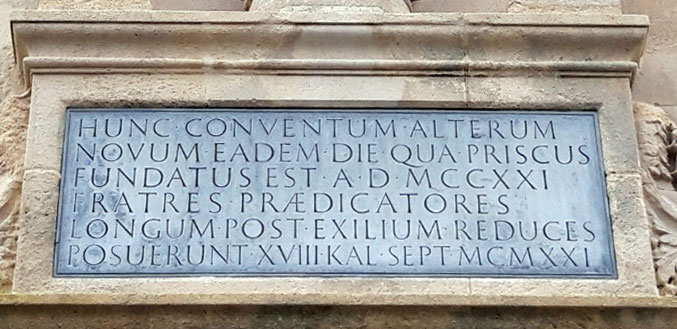
The above inscription over the entrance was carved by Eric Gill. It reads:
HUNC CONVENTUM ALTERUM
NOVUM EADEM DIE QUA PRISCUS
FUNDATUS EST AD MCCXXI
FRATRES PRAEDICATORES
LONGUM POST EXILIUM REDUCES
POSUERUNT XVIII KAL SEPT MCMXXI
Translation: The Preaching Brothers [Dominican Friars], returned after a long exile, set up this second new religious house on 15 August 1921, the same day [of the year] that the former one was founded in 1221.
Occupants of 62, 63, & 64 St Giles' Street listed in censuses
and directories |
|||
Date |
62 St Giles |
63 St Giles |
64 St Giles |
1839 |
— |
James Adey Ogle |
— |
1841 |
[Possibly |
[Possibly |
|
1842–1857 |
John Marriott
Mrs Sophia |
James
Adey Ogle |
|
1861–1874 |
Rev. John Griffiths |
Henry John Stephen
Smith |
|
1876–1880 |
Samuel Vines |
||
1882–1885 |
C. L. Shadwell |
||
1886–1887 |
Archer
Robert Then from 1893 |
||
1889–1890 |
Rev. Canon George Rawlinson |
||
1891–1893 |
Rev. Charles Henry Bickerton Hudson |
||
1894 |
|||
1895–1900 |
Robert W. Doyne, FRCS |
||
1902–1904 |
D.
Sanford-Barton
Mrs Sanford-Barton |
Vacant |
|
1905–1908 |
Rev. Henry Herbert Williams |
||
1909–1910 |
John Wood |
||
1911 |
|||
1913–1916 |
Girls’ Friendly Society Lodge & Hostel |
||
1918–1919 |
Vacant |
Part of Girls' Friendly |
|
1921 |
Ministry of Pensions |
||
1922 |
Vacant |
Blackfriars |
|
1923–1929 |
Blackfriars (The
Dominican Fathers) |
||
1929–present |
|||