

Isaac Grubb (1807–1885)
Mayor of Oxford 1857/8
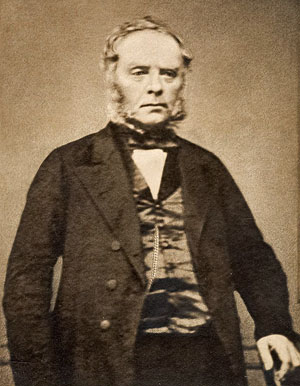
Isaac Grubb (Picture Oxon 0655039)
Isaac Grubb was born on 26 November 1807 (as recorded in the register of the New Road Baptist Chapel four years later in 1811).
His father Thomas Grubb, a carpenter of St Peter-le-Bailey parish in Oxford, had married Sarah Anderson, a minor, at Newington near Wallingford on 7 November 1796. They had two other children before Isaac: Thomas Grubb (brought to St Peter-le-Bailey Church on 20 June 1798) and Elizabeth Grubb (born on 29 July 1802).
Isaac was brought up in St Peter-le-Bailey parish (probably in Queen Street).
He was admitted free on 23 January 1829 and became a baker and corn dealer who used to boast that he had never done a “penn’orth of business” with the colleges. He was also a prominent Baptist at New Road Baptist Chapel.
On 16 May 1833 at St Clement’s Church, Isaac Grubb (25) married Elizabeth Taman of St Clement's, who was born in c.1810, the daughter of William & Mary Taman. (William Taman was listed as a broker & appraiser of St Clement's in a directory of 1839.) The marriage was announced thus in Jackson’s Oxford Journal on 18 May 1833:
On Tuesday last was married, at St. Clement’s Church, by the Rev. J. W. Hughes, Rector, Mr. Isaac Grubb, baker, corn and flour factor, Queen-street, to Elizabeth, eldest daughter of Mr. Taman, St. Clement’s.
In about May 1834 their daughter Elizabeth Taman Grubb was born, but her mother Elizabeth Grubb died about a month later on 19 June at the age of 24. The following notice appeared in Jackson’s Oxford Journal of 21 June 1834:
On Thursday last died, in the 25th year of her age, Elizabeth, wife of Mr. Isaac Grubb, corn factor, Queen-street, and eldest daughter of Mr. Taman, St. Clement’s.
Mrs Grubb was stated in the burial register as being of St Peter-le-Bailey parish when was buried in St Clement's churchyard on 23 June 1834: she was described in that register as the daughter of William & Mary Taman.
Despite being a Baptist, on 10 July 1834 Isaac had his two-month-old daughter Elizabeth Taman Grubb baptised at St Clement’s Church, which implies that the motherless baby was probably ailing; and indeed she died at the age of two months, and on 14 July 1834 ( just four days after her baptism), she too was buried in St Clement’s churchyard.
In the 1830s Isaac Grubb was one of the group from New Road Baptist Church that was instrumental in purchasing land in the Croft in Headington to build a new Baptist Chapel there, and it may have been in connection with this that he met his second wife, the Headington widow Mrs Sarah Anne Hiern. Born Sarah Ann Bateman, she had married Maurice Henry Hiern of Devon (who had entered Worcester College on 15 April 1823) at Stoke Damerel Church near Plymouth on 15 September 1826, and their son, named after his father, was baptised in Headington just two months later on 22 November but was buried there on 1 March 1827. Her husband was in the Madras Army and died on 10 November 1832.
On 28 January 1837 at St Peter-le-Bailey Church, Isaac Grubb married his second wife, Mrs Sarah Ann Hiern, née Bateman: both of them were then aged about 30. They do not appear to have had any children.
Grubb entered civic life in July 1837 when he was appointed Guardian for St Peter-le-Bailey parish, and in June 1843 he was appointed Chairman of the Board of Guardians of the Oxford United Parishes.
At the time of the 1841 census Grubb (33) was living over his shop at 22 Queen Street with his second wife Sarah and his niece Mary Ann Grubb, plus five baker’s shopmen and one servant. Mary Ann Grubb's birth on 18 October 1828 was registered at New Road Baptist Church, and she was the daughter of Thomas & Mary Grubb, who had moved to Oxford from Wantage in about 1825, eventually settling in Church Street, St Ebbe’s. Isaac Grubb, who was childless, obviously took a big interest in his brother's family:, indeed, her brothers Isaac Grubb junior and Robert James Grubb eventually took over his business.
Grubb was first elected on to the City Council for the South Ward in November 1841, despite the fact that he was regarded as a joke candidate. Jackson’s Oxford Journal, reported on 30 October 1841:
Mr. Grubb, of Queen-street (of radical notoriety) has suffered himself to be drawn late into the field as a candidate, but without the most distant chance of success – in fact his starting is looked on quite as a joke, and has caused considerable merriment in the Ward.
Isaac's brother Thomas Grubb died at the beginning of 1847. His death was reported thus in Jackson’s Oxford Journal: “Jan. 22, quite suddenly, in the 49th year of his age, Mr. Thomas Grubb, of St. Ebbe’s, in this city.” His widow must have fallen on hard times, as she was working as a straw-bonnet maker by 1851.
In 1850 Isaac Grubb complained that it was impossible for a dissenter to become mayor, sheriff, alderman, or magistrate in Oxford (but just three years later in 1853, he and John Towle were chosen as Oxford’s first nonconformist aldermen).
At the time of the 1851 census Isaac (43), described as a corn factor & baker employing eight men) was living at 22 Queen Street with his wife Sarah Ann (41), plus a baker’s journeyman, a baker’s shopman, and one servant. Gardner’s Directory for 1852 lists his business at this address, and adds “& at St. Clement’s” (where he also had a baker’s shop at No. 16). But he also had premises in St Ebbe’s, as this extract from Jackson’s Oxford Journal for 28 June 1851 shows:
Non-payment of Paving Rates.—Isaac Grubb, baker, of Queen-street, was summoned for the non-payment of lighting and paving rates, and stated that his reason for not paying them was, because there was no light to his premises, which are situated in St. Ebbe’s-street, and that other premises paying less rates were lighted.
Grubb lost his case with the Lamp Committee, who deemed his passage and yard private property without a thoroughfare. He was soon summonsed again for not paying for lighting and paving for his properties in St Clement’s, St Ebbe’s, St Michael’s, and St Peter-le-Bailey parishes, and again lost his case.
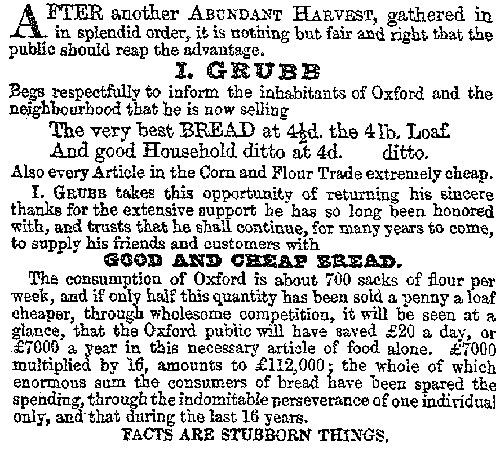
Grubb never lost an opportunity to make a political point, as this advertisement, which he inserted in Jackson’s Oxford Journal on 20 September 1851, shows:
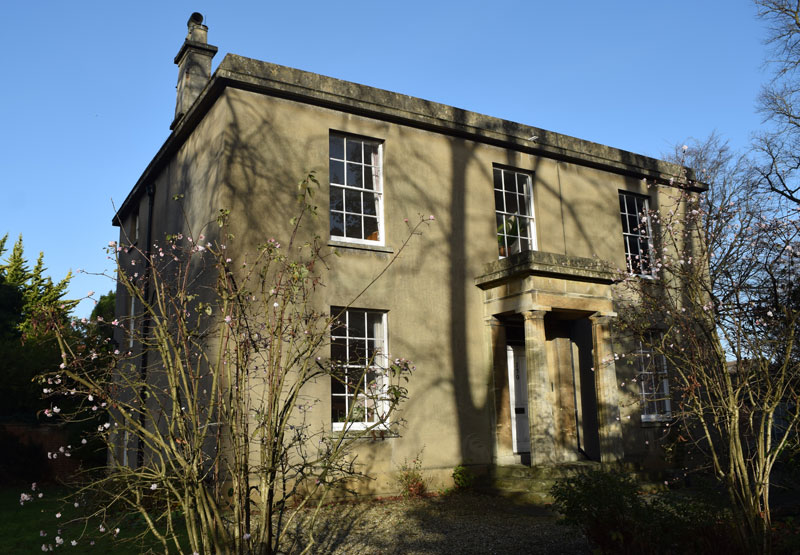
In 1853 Grubb was elected an Alderman. Around this time he moved out of 22 Queen Street, which was henceforth occupied by his brother Thomas’s widow and her family and Grubb’s nephews Isaac Grubb junior and Robert Grubb then ran the shop there. Isaac Grubb senior moved up to a much grander house in Summertown, Somerville House (now 130 Banbury Road), later Greycotes School, photographed below in December 2018:
At a council meeting in April 1854 Grubb made another stand in support of nonconformity: after stating that he had “no connection with the University, and nothing for which to thank any member thereof”, he introduced a motion “to petition Parliament in favour of the admission of Jews, Turks, Roman Catholics, Infidels, Heretics, and Dissenters of every denomination to enjoy the advantage of education in the national Universities”. (Towle himself later claimed that he was a Wesleyan, not a Dissenter.)
At a meeting about Income Tax held at the Town Hall on 13 January 1857 Grubb moved the adoption of the following rider to the proposed amendment:
That, in the opinion of this meeting, the most rigid economy ought to be prosecuted in every department of the public service—that no additional taxes ought to be imposed on the necessaries of life—that the financial policy of the late lamented Statesman, Sir Robert Peel, ought to be fully carried out—and that direct taxation is infinitely preferable to indirect taxation.
He went on to say that he was in favour of a tax on property but not on income, as it was unfair to tax a doctor who earned £500 a year from his practice at the same rate as one who earned the same from freehold property. His rider was carried unanimously.
In November 1857 Isaac Grubb was elected Mayor for 1857/8. He was well known for not putting up with “nonsense”, and refused to have “that bauble”, namely the city mace, carried before him when he attended Carfax Church. W. E. Sherwood records in Oxford Yesterday (1927) what happened when Grubb refused to attend the University Church at the start of his term of office in 1857 to take the oath “to observe and keep the lawful liberties of the University”, a relic of the St Scholastica’s Day of 1355:
The City, too, was still to a great extent under the control of the University…. A mayor, Mr. Isaac Grubb, greatly daring, when summoned with the Corporation to attend the annual sermon at St. Mary’s on St. Scholastica’s day — a sermon putting the town in what was considered its proper place, and for which, as an additional insult, they paid the fee — had
’Stated in emphatic language
What he’d be before he’d stand it.’Whether it was the vigour of his refusal which scared them, or whether it was that the University thought it was about time that a quarrel of five hundred years ago should be forgotten, we know not, but at any rate the summons was not pressed, nor was it renewed.
The case of The Queen v. Grubb relating to this oath to the University was held in the Court of Queen's Bench on 6 May 1858, and a rule nisi was granted.
The city had contributed to the upkeep of the city church (St Martin’s at Carfax) since at least 1579, but Grubb refused to pay the then yearly contribution of £35 on the grounds that any contribution from city funds towards a church was contrary to the Municipal Reform Act. He also refused to go to Court to present an address of congratulation to Queen Victoria because he would have had to wear court dress, and he had no mind “to make a Tomfool” of himself.
At the time of the 1861 census Isaac Grubb (53) was living at Somerville House with his wife Sarah (whose age had shrunk to 45), his wife's niece Sarah Bateman (11) of Headington, plus just one servant. He was then described as a Magistrate & Corn Dealer, Baker & Mealman.
By 1867 Grubb evidently had gone against his own principles and had started doing business with the colleges, because animosity towards him during the Bread Riots of that year arose from the fact that he sold his bread more cheaply to the colleges than to the public.
In 1871 Grubb still lived at Somerville House with his wife, and in addition to Sarah Bateman, another niece, Alice May Bateman, aged 14, was living with them. These were the daughters of the Headington stonemason James Bateman and his wife Mary Ann. Sarah Bateman is described as Isaac Grubb's adopted daughter in her marriage announcement in Jackson’s Oxford Journal of 15 July 1871:
July 6, at the Congregational Chapel, Summertown, by the Rev. O. Brand, Mr. J. H. Williams, University House, High-street, Oxford, to Sarah Anne Bateman, the adopted daughter of Alderman and Mrs. Grubb, Somerville House.
Grubb’s nephew Isaac Grubb junior emigrated to America; but Robert James Grubb was still living at the old business premises at 22 Queen Street in 1879. By the end of 1880, however, Isaac Grubb had moved up to live in his uncle’s home in Summertown, Somerville House; meanwhile Isaac Grubb had moved with his wife Sarah to a smaller more central house at 37 Beaumont Street. Sarah died here at the age of 73 near the beginning of 1881, and that year’s census shows Isaac Grubb as a widower and described as a retired corn merchant: he was then living alone at 37 Beaumont Street with three servants (a cook, a general servant, and a coachman).
† Isaac Grubb died at the age of 76 on 23 March 1885. His obituary in The Times of 3 April 1885 read as follows:
The death is announced of Mr. Isaac Grubb, of Oxford, in his 77th year. Deceased took a prominent part in the Anti-Corn Law agitation, and also in the movements for the repeal of the Test and Corporation Acts, the abolition of church rates, the removal of the paper duty, and the reform of Parliamentary and municipal institutions. During his public life in Oxford Mr. Grubb frequently found himself in hostility to the University. When overseer of one of the Oxford parishes he appealed to the Law Courts in favour of the permanent rating of the University and was successful. When elected as mayor in 1857 he declined to take the customary oath of submission to the University, which custom was subsequently abolished. Mr. Grubb, as a strong Liberal, long took an active part in the politics of the city.
He was buried at Headington Baptist Chapel in the Croft (now a private house). His gravestone reads:
To the memory of
Isaac Grubb of Oxford
who died March 23 1885
aged 77
Also Sarah Ann his wife
who died Feb ?17 1881
aged 73
Also William Bateman of Headington
brother of the above
who died Oct 24 1883
aged 72
His personal estate came to £6,808 2s. 5d. and his executors were his nephew Robert James Grubb (described as a corn merchant of Queen Street) and William Fowler Payne (a miller of Abingdon).
A month after his death Grubb’s executors advertised in Jackson’s Oxford Journal of 25 April 1885 the forthcoming auction of three of his properties: the Sherborne Arms on the corner of St Ebbe’s Street and Queen Street; a freehold shop at 45 St Ebbe’s Street occupied by Mr Brindley, and finally his own Beaumont Street home:
LEASEHOLD FAMILY RESIDENCE. No. 37, Beaumont Street, Oxford, with excellent Twin Stall Stable and Coachhouse, with small Garden and Walled-in Yard, approached by a separate entrance from St John Street.
Grubb’s executors put in another advertisement on 9 May 1885 describing his furniture, to be sold by auction on the premises of 37 Beaumont Street.
Grubb’s nephew, Robert James Grubb, appears to have inherited Somerville House, which is given as his address when he was proposed to represent the South Ward first on the new County Borough Council in October 1889 and then in the municipal elections in October 1891. He also took over his uncle’s business: an advertisement dated 7 September 1887 shows that Grubb’s old business (now called R. J. Grubb) had branches at 15 St Aldate’s and the Castle Mills in addition to 22 Queen Street and 16 St Clement’s. As well as selling bread, it was the “best establishment in Oxford for poultry and horse food”, with crushed corn for horses that was “unequalled in Oxford or elsewhere”.
Robert James Grubb was still living at Somerville House in 1915. He died at the age of 81 in 1921.
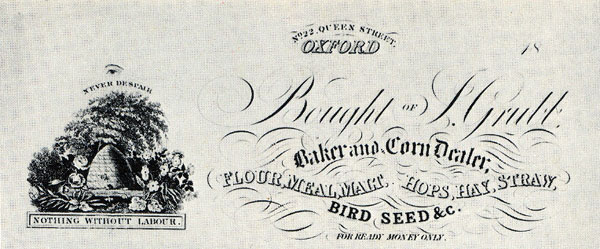
Above is Isaac Grubb’s engraved bill-heading. ”Never Despair”, with an eye drawn above it, and below it is a beehive with a second motto reading “Nothing without labour”. The rest of the bill heading reads:
No. 22 Queen Street, Oxford, 18–
Bought of I. Grubb
Baker and Corn Dealer
Flour meal mart, hops, hay, straw,
bird seed, &c.
For ready money only
See also:
- Jackson’s Oxford Journal, 28 March 1885, p. 5c: Obituary
- Jackson’s Oxford Journal, 8 May 1858 re Mayor’s oath to the University
- Oxford Mail, 4 November 1983, p. 5 and 31 January 1984 about the possibility of naming a street after him
- Michael L. Turner and David Vaisey, Oxford Shops and Shopping. A Pictorial Survey from Victorian & Edwardian Times (Oxford: B. H. Blackwell, 1972), page 27 for a comparison of the engraved bill-heading of Isaac Grubb with the jobbing printing of the hand-bill issued by his nephew R. J. Grubb in 1887
- 1841 Census: Oxford (St Peter le Bailey), 181/15
- 1851 Census: Oxford (St Peter-le-Bailey), 1728/482
- 1861 Census: Oxford (St Giles), 894/101
- 1871 Census: Oxford (Summertown), 1436/4
- 1881 census: Oxford (St Mary Magdalen), 1502/16
