

Sir Walter Gray (1847–1918)
Mayor of Oxford 1888/9, 1893/4, 1897/8, and 1901/2
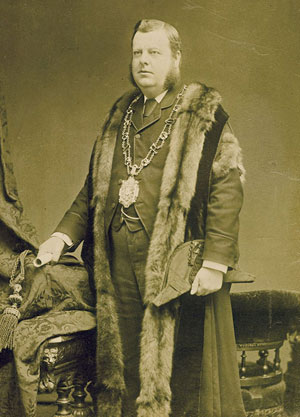
Walter Gray in 1888/9 (first term as Mayor)
(Picture Oxon 0655063)

Walter Gray in 1901/2 (fourth term as Mayor)
(Picture Oxon 0655062)
Walter Gray was described as “the Father of English Conservatism”.
He was born at Weston, Hertfordshire in 1847 and baptised there on 21 March. His father was Thomas Gray, a farmer’s son from Litlington in Cambridgeshire who had run off with his underage sweetheart Ann Dearman and married in the Hitchin district near the end of 1844. He settled with her in her home village of Weston, where he initially got a job as a hurdle-maker, and Walter's older sister Mary Elizabeth Gray was baptised there on 1 March 1846. His younger brother Thomas William Gray was born there in 1848.
At the time of the 1851 census Walter (4) was living in Wallington, Hertfordshire with his father Thomas (36), who was now a carpenter, his mother Ann (27), and his siblings Mary (5) and Thomas (2).
Near the beginning of 1856 when Walter was nine years old his father Thomas Gray died in Wallington.
On 20 July 1857 at St Mary's Church, Cambridge, Walter's mother Ann Gray married her second husband, Albert Grundrill, and their son Albert Grundrill was born in Weston, Hertfordshire soon after the wedding and baptised there on 8 November 1857.
Walter was educated at Stevenage Grammar School, but by the age of 14 he he was working in a solicitor's clerk in Baldock, and can be seen in the 1861 census described as a solicitor's clerk and living in the High Street, Weston with his mother Ann (36) and his stepfather William Grundrill (37), who was a tailor. Also at home were Walter's full brother (Thomas) William Gray (12) and his half-brother Albert Grundrill (4)
When the solicitor who employed him went bankrupt, Walter joined his younger brother (Thomas) William in working for the Great Western Railway. His first job was as a porter at Chalk Farm, where he and two other porters shared the same bed in three shifts.
Walter Gray progressed to be a railway ticket-collector; and then at the age of 22 became stationmaster at Waddington in Lincolnshire.
Colonel John Shaw-Stewart, a member of the council of Keble College in Oxford (whose foundation stone had been laid in 1868) frequently used Waddington station and so came to know Gray. He thought that he would make an excellent Steward for the college, and in 1870 Gray moved to Oxford and started work at Keble: he was given a free cottage in Oxford and a salary of £50 a year. He was successful at the job and also began to educate himself in finance by reading newspapers and talking to members of the Conservative Club to which he belonged.
The 1871 census shows Walter (24) living in a Keble College property with other college servants and described as the college butler.
In the third quarter of 1874 in Hertford, Walter Gray of St Giles' parish, Oxford married Emily Alice Savage of Bennington in Hertfordshire: the banns were read in July at St Giles' Church in Oxford, as Ss Philip & James' Church was under repair. Emily was born in Hertford in 1846 and baptised at Walkern on 17 January 1847, the daughter of the bricklayer James Savage and his wife Elizabeth, and the age of 15 was working in Walkern as a farm servant.
They had three children:
- Maude Alice Gray (born at Blackhall Road, Oxford on 12 March 1877 and baptised at St Giles's Church on 13 April)
- Hilda Emily Gray (born at Blackhall Road in 1879 and baptised at St Giles's Church on 20 May)
- Francis James Gray, always known as Frank Gray (born at Blackhall Road on 31 August 1880 and baptised at St Giles's Church on 25 September).
In 1877 a Government Commission recommended that Fellows of Colleges should be allowed to marry, and Gray foresaw the need for new housing in Oxford. He borrowed £600, took an option of a plot of land from St John’s College, drew up plans for three houses, and sold all three to Thomas Murray Gorman, who was coming with his wife to Oxford as the new curate of the University Church.
At the time of the 1881 census, Gray’s speculative building career was only just taking off, and aged 34 he was still described as the Steward and servant of Keble College. He was living at 7 Blackhall Road with his wife Emily (34) and their children Maud (4), Hilda (2), and Frank (seven months).
Later in 1881 Walter Gray was elected a Conservative councillor for the North Ward.
Soon after this Gray was able to give up his job at Keble College. He went into partnership with the builder John Money and made his fortune in speculative development. His success partly lay in the fact that he was involved with small houses (such as those in Kingston Road) as well as large ones. In 1883 he was appointed as liquidator of a rival company, the Oxford Building and Investment Company, and took over the New Inn Hall Street office of its Secretary and Surveyor, former mayor John Galpin. Henceforth Gray was responsible for most of the development of North Oxford, working together with the architect Harry Wilkinson Moore. Thus Gray was responsible for many of the houses in St Margaret’s, Rawlinson, Polstead, and Chalfont Roads.
Walter Gray served as Sheriff of Oxford in 1884/5, and in 1888 was elected Mayor of Oxford (for 1888/9).
At the time of the 1891 census Walter (44), described as a Surveyor and Justice of the Peace, was living at 1 St Margaret’s Road in north Oxford with his wife Emily (44) and their children Maude (14), Hilda (12), and Frank (10). They employed a cook and a housemaid.
In 1893 Walter Gray was elected Mayor a second time (for 1893/4), and in 1897 a third time (for 1897/8).
His son Frank was educated at Rugby School.
At the time of the 1901 census Walter (54), described as a surveyor, auctioneer, &c, was still living at 1 St Margaret's Road with his children Maude (24), Hilda (22), and Frank (20) who was a solicitor's articled clerk. They employed a cook and a housemaid. His wife Emily Gray (52) appears to have left him and was living with her widowed mother Elizabeth Savage (84) and three of her unmarried sisters at Stevenage. Walter's own widowed mother Ann Grundrill (77) was living on her own in Weston, Hertfordshire.
Later that year Walter Gray was elected Mayor a fourth and last time (for 1901/2), and was thus Mayor at the time of the Coronation of King Edward VII on 9 August 1902.
He was knighted in 1903.
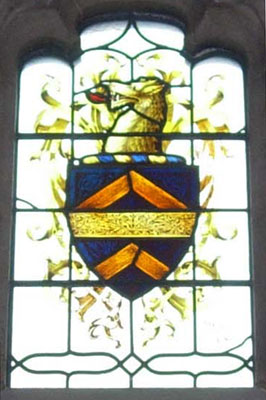
Gray’s arms (left) appear in stained glass in the high windows of the Council Chamber.
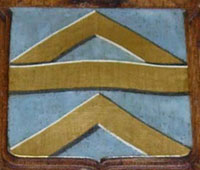
A wooden version of Gray’s arms (right) was also added to the wall of the Lord Mayor’s Parlour when he served as Chief Magistrate

Because Gray was on the Municipal Buildings Committee when the new Town Hall was opened (1897), his head is carved in stone in the Council Chamber corridor (right).
On the census night of 1911, Sir Walter Gray (63), described as a county magistrate) was staying at a big hotel in Russell Square, London, while his son Frank (a solicitor of 31) was staying at the Clarendon Hotel in Oxford. Walter's wife Emily Alice, Lady Gray (64) was living with her brother Walter Savage and his wife Clara at Hatfield in Hertfordshire. Their two unmarried daughters Maude Alice Gray (34) and Hilda Emily Gray (32) were staying at a private hotel in the Bayswater Road, London.
Near the end of 1912 his mother Ann (Mrs Grundrill) died in the Hitchin area at the age of 88.
By 1914 Sir Walter Gray was living at 50 New Inn Hall Street.
In 1917, when Lord Valentia retired from the House of Commons, Sir Walter Gray decided to try for Parliament, but the Tory selection committee chose instead the historian J. A. R. Marriott. Gray went off on holiday to Northumberland to get over the disappointment, but died there:
† Sir Walter Gray died suddenly at Rothbury, Northumberland at the age of 69 on 17 March 1918 and four days later was buried in Wolvercote Cemetery (H1/173). His effects came to £212,234 1s. 7d., and his address at the time of his death was still given as 50 New Inn Hall Street. Probate was granted to the Public Trustee in London.
His wife Emily Alice, Lady Gray died at The Gables, Pangbourne, Berkshire at the age of about 77 (recorded as 75) on 30 June 1923 and was buried on on her own in Wolvercote Cemetery on 4 July (H1/161). Her effects came to £1866 12s. 1d., and her son Frank was her executor.
His son Francis James Gray (1880–1935)
Frank Gray was to represent Oxford in Parliament from 1922 to 1924, but as a Liberal. He then took up the interest of tramps, and disguising himself as a vagrant saw for himself the conditions in local workhouses, and also welcomed tramps at this home at Shipton Manor, Shipton-on-Cherwell and tried to find work for them. In 1928 he helped to found the Oxford Mail.
He died at sea of a stroke on 3 March 1935 when returning from South Africa at the age of 54 and was buried in his father's grave at Wolvercote Cemetery on 6 March. His home was then still at Shipton Manor. His effects came to £30,160 0s. 11d., and his bank was his executor.
See also:
- Obituary of Walter Gray in the Oxford Chronicle of 22 March 1918, p. 7
- Entry for Frank Gray, Walter's son, in the Oxford Dictionary of National Biography
- Charles Fenby, The Other Oxford: The Life and Times of Frank Gray and his Father (London: Lund Humphries, 1970)
- Tanis Hinchcliffe, North Oxford (Yale University Press), pp. 52, 60–3, 78–80, 85, 119–20, 123, 146, 210
- Portrait of Walter Gray in the Assembly Room of the Town Hall (shown above)
- Oxfordshire County News, 25 February 1898, p. 11
- Oxford Journal Illustrated, 19 May 1915, p. 9 (“Who’s Who in Oxford”)
- Oxford Journal Illustrated, 20 March 1918, p. 3c (obituary)
- Oxford Journal Illustrated, 27 March 1918, pp. 1, 7, 8a–b (funeral)
- Oxford Journal Illustrated, 15 May 1918, p. 10b–c (will)
- 1871 Census: Oxford (St Paul), 1436/83
- 1881 Census: Oxford (St Giles), 1499/143
- 1891 Census: Oxford (St Giles 4), 1166/87
- 1901 Census: Oxford (St Giles), 1381/36
