

120–122: The Ivy
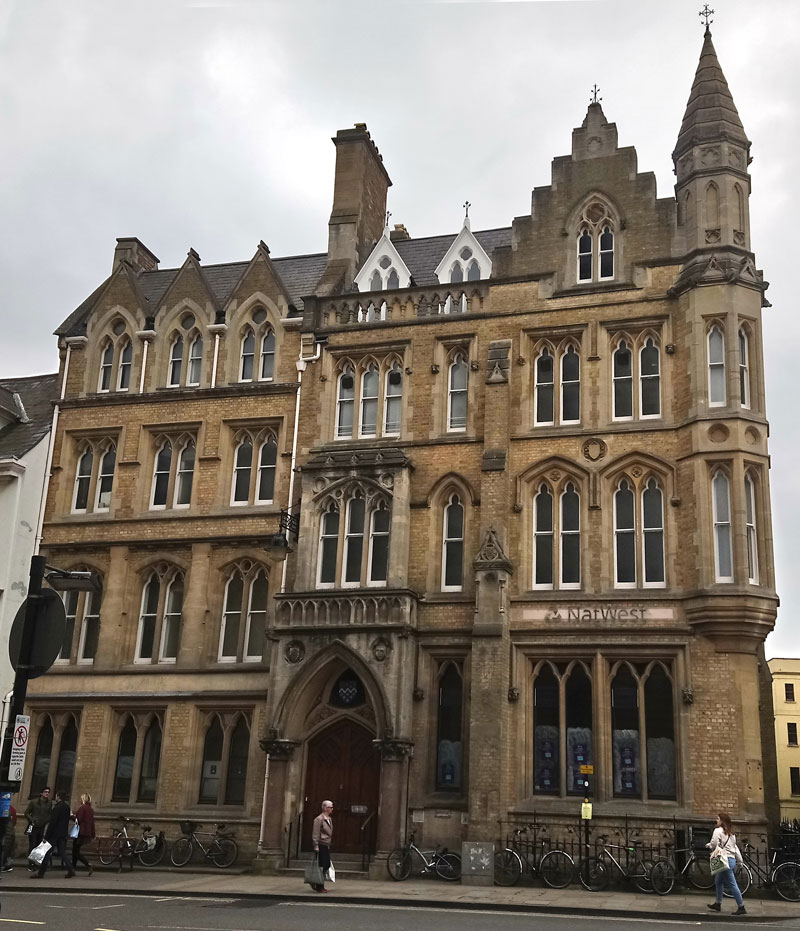
By the early 1860s the London & County Bank at 16 High Street needed larger premises, and leased the site of 121 High Street on the corner of Alfred Street from New College. This building was erected from 1866 on the site of three old shops numbered 120, 121, and 122 High Street and completed in September 1868. The group of buildings was designed by F. & H. Francis of London in the Gothic style and built by Messrs Jones. The bank was at Nos. 121–2 on the right, but No. 120 on the left (now part of the bank) was originally rebuilt as a music warehouse. The combined premises are Grade II listed (List Entry No. 1047258), and were in the parish of All Saints until that church closed in 1971. The building is now in the parish of St Michael-at-the-Northgate Church. It is owned by Lincoln College.
Jackson’s Oxford Journal of 19 October 1867 reports on the progress of the rebuilding work. No. 120 on the left was built for Russell’s Music Warehouse (which had already been on the site, having moved from 125 High Street in the mid-1860s). Nos. 121–2 on the right were built for the London & County Bank (the forerunner of the National Westminster, which was then in much smaller premises at 16 High Street).
Former No. 120 before 1866
The 1841 census shows the shoemaker John Vincent living here with his servant and a student lodger. He was still here alone at the time of the 1851 census, again with one servant: aged 43 and a student lodger;, he was described as a bootmaker employing two men,
By the time of the 1861 census the carver and undertaker William Payne (45) lived here with his wife Emma and their eight children, plus a house servant and a nursemaid. Two separate families lodged with them as separate households: (1) Edmund Anstey and his wife Charlotte and their servant, and (2) the widow Caroline Pethbridge with her four children.
Former No. 121 before 1866
At the time of the 1841 census the chemist Harry Hitchcock lived here with Ann Hitchcock and their apprentice and servant,, plus two people who appear to be lodgers.
By the time of the 1851 census the chemist & druggist Harry Hitchcock (36) lived here with his wife Anne and their two daughters and his sister-in-law, plus a servant.
The 1861 census shows the tailor & mercer William Hayward, a widower of 39, living here with his five children. a teacher, and two servants. .
No. 121½
There was formerly an alley known as High Street Passage between Nos. 121 and 122, but this disappeared when Nos. 120–122 were rebuilt in 1866.
At the time of the 1841 census No 121½ appears to have been occupied by the Berlin wool dealer Mary Gadney and her family
The upholsterer William Payne lived at No. 121½ with his family at the time of the 1851 census. It is not listed in 1861.
Former No. 122 before 1866
At the time of the 1841 census the saddler William Blackwell lived over No. 122 with his five children and a female servant. The 1851 census shows Blackwell still here with his wife and two daughters, and a young milliner called Ann Booth living separately in the building, and William and his wife Sarah were still here in 1861 with a different lodger and one servant.
The current building at 120, 121, and 122 (built in 1867)
No. 120 (to the east)
James Russell & Co. occupied the shop premises at No. 120 from the time it opened in 1867 until 1952. (The company then merged with Acott’s and joined their business on the other side of Alfred Street at 124 High Street: Russell & Acott survived there until 1999.) On 18 July 1868 Russell advertised that the upper part of No. 120 was to let, and was suitable for a club, chambers, or lodgings.
The 1871 census shows the upstairs let to a labourer, Joseph Cripps, who lived there with his housekeeper.
At the time of the 1881 census Mary Ann Mills, the housekeeper to the Inland Revenue Office (which then shared the building with James Acott) lived over No. 120 with her daughter, the assistant housekeeper.
The 1881 census shows the widow Mary Ann Mills, described as the housekeeper to the Inland Revenue Office, living here with her daughter Ellen (29), who was her assistant. Ellen was living here on her own in 1891, described as the housekeeper
The 1901 census shows the widow Annie Cox (50), described as a servant and housekeeper living over No. 120 (“Inland Revenue offices & Music Shop”).
By the time of the 1911 census the widow Emily Pearce (54), described as the caretaker, lived in four rooms over the office and shop here with her two daughters.
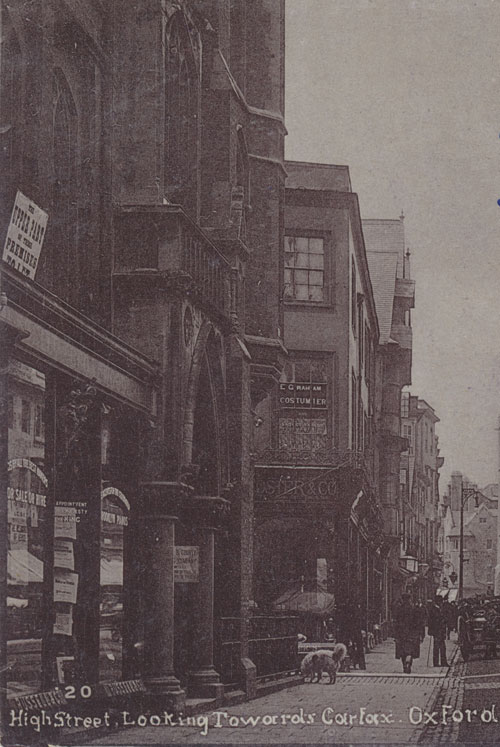
A photograph of James Acott's shop in c.1914 can be seen on the right of this photograph
Right: Russell's music shop at the present No. 120 can be seen to the left of the photograph, with the upstairs premises advertised as being to let
Nos. 121 and 122 (the original bank to the west)
The 1871 census shows the banker Henry Rutherford Smith living here over London & County Bank with his nine-year-old granddaughter plus two bank porters and two domestic servants.
By the time of the 1881 census the manager of the bank was Charles Richard Peake, and he lived over Nos. 121–2 with his wife and three children, a cook, housemaid, and lady’s maid, plus the bank messenger and his wife.
At the time of the 1891 census the bank manager Francis M. Davies (46) was living over Nos. 121 & 122 with the bank porter and the porter's wife plus two servants. He was still here in 1901, when the bank messenger George Augustine Pearce (47) lived in a separate establishment upstairs with his wife Elizabeth and their two children.
At the time of the 1911 census it was the London & County & Westminster Bank and the manager was Walter Cockell (60), and he lived in eleven rooms over Nos. 121 & 122 (described as Bank House) with his wife and two children and their two servants. George Augustine Pearce (57) was still working as the bank's messenger and again lived in a separate part of the upper floors with his wife and two children.
The 1921 census shows the bank manager Thomas William Ridley (51) living in ten rooms over the bank with his wife Annie and two servants. By 1923 it was named the Westminster Bank
Since 1953: Nos. 120, 121, and 122
In about 1953 the Westminster Bank took over the whole building. In 1970 after merging with the National Provincial Bank it was renamed the National Westminster Bank.
In 2013 Lincoln College purchased 120–2 High Street from the Royal Bank of Scotland, and they leased back to the NatWest Bank the parts of the buildings that front the High Street .
This NatWest bank closed in 2017along with the branch on the corner of Cornmarket and George Street and reopened in a smaller building in Cornmarket.
In 2018 Lincoln College was granted planning permission for the following two (very similar) planning applications to convert the building into the Ivy Restaurant:
- 18/00666/FUL: “Alterations to buildings including provision of glazed shopfront to 120, and new entrance to Alfred Street frontage of 121-122, Provision of lift/flue housing to rear. Re-arrangement of ventilation and ducting to the rear. Change of use of ground floor, basement and mezzanine level from bank (A2) to restaurant (A3), and use of upper floors as four apartments (1 x 1-bed, 3 x 3-beds) (C3)”.
- 18/00667/FUL: “Alterations to building including provision of glazed shop front to 120, and new entrance to Alfred Street frontage or 121-122, provision of lift/flue housing to rear. Change of Use of ground floor, basement and mezzanine level from Bank (A2) to restaurant (A3), and use of upper floor as four apartments (1x2 bed, 3x3 bed) (C3)”
Following the college's £5 million redesign the Ivy restaurant now occupies the building, with four apartments on the floors above.
Occupiers of 120, 121,
& 122 High Street |
|||
Date | 120 High Street |
121 High Street | 122 High Street |
1839–1852 |
John Vincent |
James Bowerman Harry
Hitchcock 121A: William Payne |
Blackwell & Evans |
1852–1866 |
James Russell J.
Russell & Co. |
W. Hayward |
Oxford Chronicle (but Mr Blackwell still |
1869–1952 |
London
& County Banking Company Ltd. |
||
1954–2017 |
National Westminster Bank Ltd (later PLC) | ||
2017–2018 |
Vacant |
||
2019–present |
The Ivy Restaurant |
||
