

No. 29: Former Octagonal Chapel
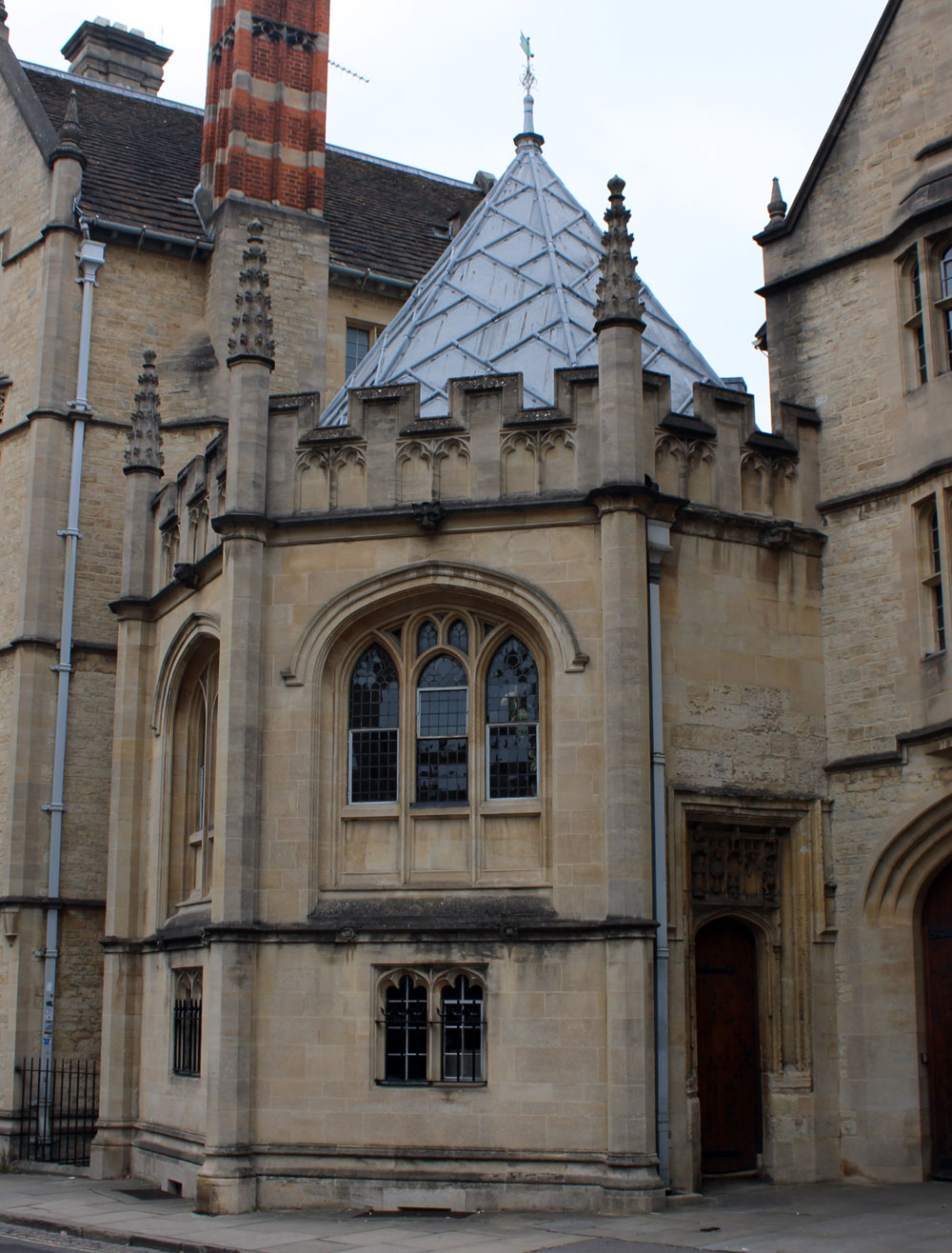
No. 29 Broad Street was originally the chapel of Our Lady at Smith Gate, later known as the Octagonal or Round House, or St Catherine's House. As shown above, it partly survives in the middle of the new part of Hertford College to the north of New College Lane, and is a Grade II listed building (List Entry No. 1369642) and was formerly in St Peter-in-the-East parish.
The first chapel of St Mary at Smith Gate was already in existence by the later fourteenth century. Although technically just to the north of the city wall, it seems to have been part of the defences of the Smith Gate, which stood at the point where Catte Street meets New College Lane. Students used to pray at this chapel before crossing Catte Street for their disputations in the Schools.
The chapel was rebuilt in 1520, but soon fell into disuse, and was deconsecrated and became a private house owned by Oxford City Council in 1582.
In 1583 the city leased it to Henry Toldervey as a dwelling house, together with the land behind, “used for a dunghill”. As tenant, he promised that with two years he would make the decayed house a tenement “with three flowers of good and substanciall tymber and cover the same with good slate or tyle with chymneys fitt for a dwelling house”. He was not allowed to build a house on the ground behind, but could only use it for malthouses. (Henry Toldervey and his mother Alice had in fact already held the tennis court behind the Octagon Chapel since 1562.)
The old building was known as St Catherine's Chapel because she was believed to be represented by the figure over the door, although in March 1844 Mr Rooke of Oriel College told the Oxford Architectural Society that the figure was actually that of the Virgin Mary. And Jackson's Oxford Journal of 11 July 1868 recorded the following note about the chapel under the heading “Local Antiquarian Gatherings”:
OUR LADY'S CHAPEL
It stood within the Wall adjoining on the North of Smith Gate, opposite to Cat Street, a Stone Rotond Edifice. Humphrey Marberry, B.LL., was dispensed some Matter conditionally that he paid xxd. towards the building of it. It is said to have been an Ancient Synagogue of the Jews. This was the most common Opinion of Old. But it has been said to be a Private Oratory, built by a certain Lady, and dedicated by the Name of St. Margaret's Chapel, commonly called the Virgin's Chapel. A faire Wrought neech, on the East Side of this Round Chapel, where stood the Picture of Our Lady, with other Figures, very neatly carved in Stone, and there continued till the Rump Parliament destroyed them.
The city leases on the property were as follows:
- 1583, 1611: Henry Toldervey, yeoman
- 1640: Anne French, widow
- 1651: Thomas French, M.A.
- 1665: Edward Trinder, joiner
- 1689: Paul Trinder of Sarswell Barton and Elizabeth Trinder
of Spelsbury
(in occupation of John Betts, cook) - 1695: Samuel Cornwell, freemason
In 1696 Widow Cornwell paid tax on three windows in this house. - 1708 and 1722: William Jordan, bookbinder
This indicates that by 1708 the old chapel was being used as a shop - 1738: Samuel Hicks, tailor
- 1751: Elizabeth Shilfox, widow (occupied by William Tonge, cordwainer).
On 9 December 1782, Parson Woodforde wrote, “Had my shoes fore-pierced and Heel-pierced
by Tongue the Shoemaker and for which I owe him 0. 1. 8.” - 1765: Elizabeth Longford, widow of Robert Longford, grocer (occupied
by Kat. Tonge, widow)
The 1772 Survey of Oxford shows that No. 29 was still in the occupation of Mrs Tonge,
and its frontage measured 7 yards 0 feet 3 inches. - 1780: John Langford, surgeon, and Elizabeth Langford, widow (occupied by John Bennett, cordwainer)
- 1794, 1808: John Bennett, cordwainer
- 1822: The University
- 1828: The University assigned the lease to thebilliard-table keeper Thomas Betteris,
and he still held it in 1837.
From 1822 the premises formed the entrance to billiard rooms behind (shown on maps to the north-east), and in directories from 1846 to 1872 it is listed simply as “billiard rooms”. Gardner’s Directory for 1852 states: “The entrance to the billiard rooms of Mr T. Betteris, 29, Broad street, is by an ancient doorway, belonging to a chapel, which was formed hexagonally out of one of the bastions of the city wall.”
The chapel was listed as unoccupied (meaning that no one slept there) in the 1841, 1851, 1861, 1871, and 1881 censuses.
In 1867 the University passed a statute by which the category of “unattached student” was created and a Delegacy set up to oversee them. On 2 May 1874 Jackson's Oxford Journal reported:
UNATTACHED STUDENTS' CLUB.—A Club for the use of Unattached Students has recently been opened at No. 29 Broad-street, under the name of the “St. Catherine's Club.” It takes its name from St. Catherine's Chapel, which formerly stood upon the site. About a hundred members have already joined, and every convenience in the shape of reading, dining, and smoking rooms has been provided....
In 1888 St Catherine’s Club moved to new premises in the High Street (in the present Ruskin School of Art Building), then it moved to what is now the Faculty of Music in St Aldate's Street, and eventually the old chapel gave its name to the present St Catherine’s College.
In 1887 the old octagonal chapel became a shop again.
The 1891 census shows the widower Robert S. John, a teacher of Hindustani, living in part of 29 Broad Street with his daughter and their servant.
On 4 May 1895 Jackson's Oxford Journal reported:
PROPERTY AND ESTATES COMMITTEE
The committee recommended that a licence be granted to assign unto F. and H. Bacon, both of No. 29, Broad-street, accountants, the leasehold house and premises, No. 29, Broad-street, and known as St. Catherine's Chapel, held under a lease for a term of forty years from the 25th March, 1878.
Later in 1895 the city council exchanged Nos. 28, 29, and 30 Broad Street with Hertford College.
The 1901 census shows No. 29 as unoccupied, and the photograph below taken by Henry Taunt in 1902 (Historic England CC49/00344) shows it undergoing extensive renovation by Hertford College under the architect Thomas Graham Jackson:
No. 29 is not listed in the 1911 census.
The college initially continued to let out the premises to businesses, and the Holywell Press was the first occupant. The postcard below shows the former octagonal chapel in c.1905:

In c.1907 J. A. Shuffrey painted two views of the Octagon House: OXCMS: 2002.74,5 and 2002.74.6, pictured on pp. 48 NS 49 of Lauren Gilmour and Margaret Shuffrey, J. A. Shuffrey 1859–1939: An Oxford Artist’s Life Remembered.
In 1923, its neighbour to the north was demolished and the section of Broad Street East from New College Lane to the Indian Institute including the Octagonal Chapel was fully incorporated into Hertford College
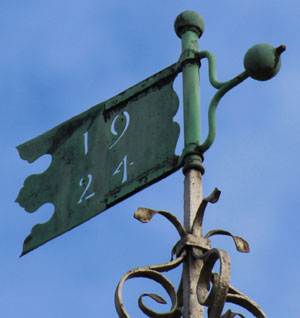
The weather vane at the top of the former octagonal chapel (right) bears the date 1924.
In 1931 the buildingl was altered to create the college’s junior common room, and it is now the middle common room.
|
Occupants of 29 Broad Street listed in directories etc |
|
1846–1872 |
Billiard Rooms: Thomas Betteris (1852); J. W. Dickeson (1861–1872) |
1875–1876 |
The unattached students’ clubhouse |
1887–1894 |
St Catherine’s House: |
1894–5 |
Joseph Bates, Junior florist |
1896 |
T. R. Haycroft, Grocer, Italian warehouseman, fruiterer &c |
1898 |
F. & H. Bacon, Accountants |
1899–1901 |
William Henry Gray, Athletic outfitter |
1903–1916 |
Holywell Press, Publishers & Printers |
1921–1923 |
Octagon House, Cash bookshop |
Since 1924 |
Part of Hertford College |