
South African War Memorial Cottages in Cowley (now demolished)
In 1902 two semi-detached memorial cottages were built in Between Towns Road (then called High Street, Cowley and outside the city of Oxford) to be occupied by disabled soldiers and their families. The architect was Herbert Quinton, and Wooldridge's were the builders. This detail taken from a postcard of about 1907 shows the cottages when they were new, on the right-hand side of the road:
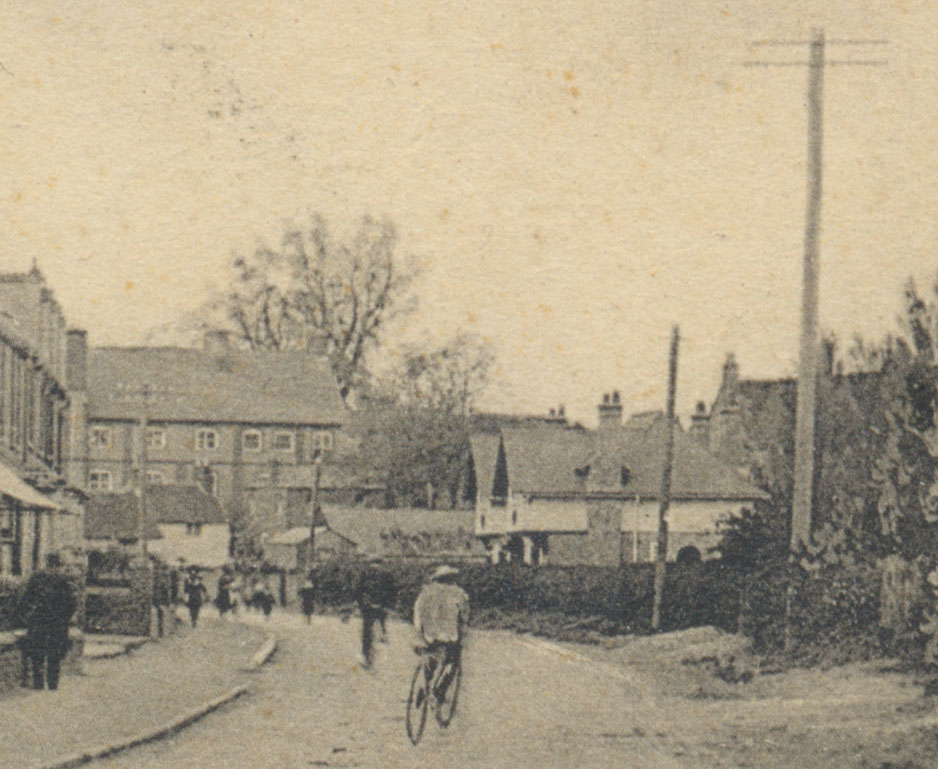
They were numbered 1 & 3 Between Towns Road from the 1930s until 1970, and were then renumbered 13 & 15. They were demolished in 2017 to make way for the student accommodation at Between Towns Court, but they can be seen here in a Google Street View from July 2012:
Imperial War Museum War Memorials register: entry for the Cowley war memorial cottages
Each cottage served as a separate memorial:
- The one on the left remembered Prince Christian Victor of Schleswig-Holstein of the King's Royal Rifles who died of enteric fever in Pretoria at the age of 33 on 29 October 1900. He had been an undergraduate of Magdalen College, and was the grandson of Queen Victoria, who when she heard of his death wrote in her journal:
“I went upstairs, Thora came in & in a faltering voice said “He is gone”. I could not believe it, it seemed too dreadful & heart breaking, & this dear excellent, gallant Boy, beloved by all, such a good, as well as brave & capable officer, gone! To think that he had gone through the Indian campaign, Ashanti, the Soudan & now again in S. Africa had passed through endless hardship, & dangers, without being ill, or getting a scratch, — to fall a victim to this horrid fever, just on the eve of his return home, — oh! it is really too piteous."
The Prince was also remembered in Oxford on the Magdalen College South African War Memorial. - The one on the right remembered the officers and men of the Oxfordshire Light Infantry who fell in the South African campaign (listed here on Oxford's South African War Memorial)
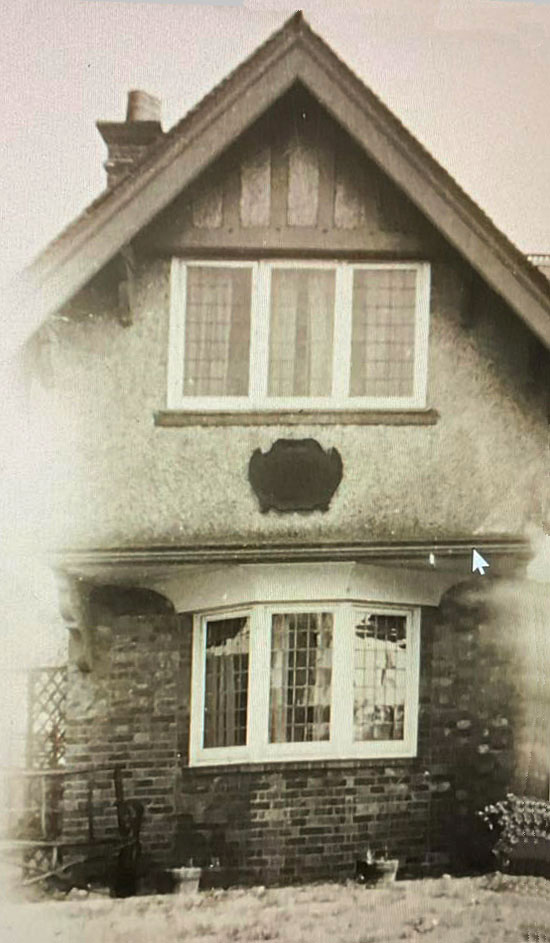
Right: 1 High Street, Cowley (later 13 Between Towns Road) showing its memorial plaque.
This photograph was contributed by Coral Fairbrother (née Aldridge). whose grandfather Sergeant Alfred Aldridge of the Oxfordshire Light Infantry lived here. He had worked at the Co-operative Society Bakery department, and in 1917 was awarded the Distinguished Conduct Medal for “valuable work done and devotion to duty under heavy shell fire”.
He is listed at the cottage in Kelly's Directory for 1930, and remained here until 1936 when the cottage was demolished.
Each cottage had a separate memorial plaque made of wood and measuring about 65cm × 54cm. The one to Prince Christian Victor is shown in its original position in the photograph above and was originally kept at the OBLI Museum at the Slade Barracks, but when those barracks were demolished to make way for housing it was transferred to the Rifleman's Museum in Winchester. It can be viewed in detail here on the Anglo-Boer War Forum in a photograph showing it on display in the Winchester Museum. It reads: “TO THE MEMORY OF / MAJOR HIS HIGHNESS / PRINCE CHRISTIAN VICTOR / OF SCHLESWIG-HOLSTEIN / WHO DIED AT PRETORIA / OCTOBER 29TH 1900”. The current home of the other plaque to the officers and men of the Oxfordshire Light Infantry is uncertain.
The following article about these cottages in Between Towns Road appeared in The Times (of London) on 19 September 1903:
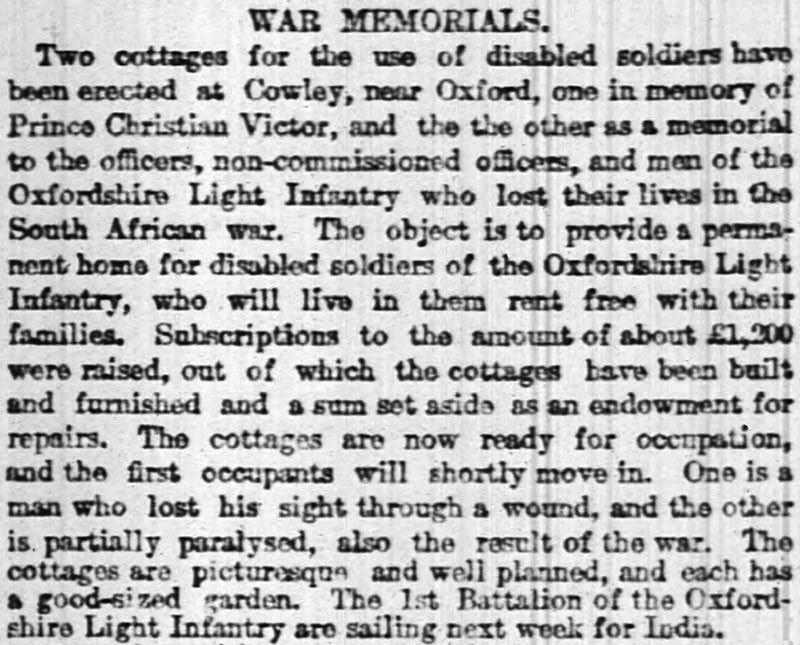
See Ann Spokes Symonds, Oxfordshire People and the Forgotten War: The Anglo-Boer Conflict 1899–1902 (Robert Boyd Publications, 2002), p. 115–16 for a photograph of the first occupants standing outside these two houses, taken from an article in the Oxfordshire Light Infantry Chronicle of 1903.
The following report in the Oxford Times of 10 October 1903 has a drawing of the cottages, each sporting a memorial plaque

The South Bucks Herald of 24 October 1903 names the first two occupants of the cottages: on the left was Private John Frith of Beaconsfield, who was blind, and on the right was Private John Kearley of High Wycombe.
The Oxford Chronicle & Reading Gazette of 15 March 1904 and the Bucks Herald of 26 March 1904 have long reports about the handing over of these disabled soldiers' cottages to the Trustees appointed by the Oxfordshire Light Infantry. The latter details the expenditure, including £704:14:4 to the builder (Mr Wooldridge); £45:12:9 to the architect (Mr Quinton); £59:2:8 to Elliston & Cavell for furniture; £15:12 to Wyatt & Son, ironmongers; £15:1:6 to the gardener; and £4:3 for the removal of the soldiers' furniture. The solicitor Walter Peppercorn waived his fees, but not the stamp duty of £1:12:6.
The 1911 census shows the following people living in the two cottages:
- Left-hand cottage: Avis Annie Tripp, née Tilbury (28) was the head of the household, living here with her four young sons and her 12-year-old niece. She was the wife of the army pensioner Private William James Tripp, who had served with the Oxfordshire & Buckinghamshire Light Infantry in India and Burma in 1891 and 1892, and in South Africa from December 1899 to March 1901. He was admitted to the Littlemore Asylum on 22 February 1907 and was probably there at the time of the 1911 census. He died at the asylum at the age of 45 on 11 February 1917. Five months later on 21 July 1917 at Littlemore Church his widow Avis Tripp (34), who was now living at Littlemore, married married her second husband Philip James Payne (26), who was described as a soldier.
- Right-hand cottage: John Frederick Kearley (38), a disabled army pensioner, still lived here with his wife Rose (née Hudson), who worked at home in this cottage as a laundress, and their four children: the eldest John Frederick Kearley (13) was already at work as a printer's labourer for the Church Army Press. John Frederick Kearley (born 23 December 1873 at High Wycombe) had served in the 1st Battalion of the Oxford Light Infantry and was wounded in the head on 16 February 1900 at Klipdrift in the Transvaal and was invalided home. He had a three-inch plate inserted in his skull, and was initially paralysed down the right-hand side. He received the Queen's South Africa Medal with the "Relief of Kimberley" clasp attached. He remained in the cottage until the 1930s and was buried on 22 February 1941 at Rose Hill Cemetery.
Kelly's Directory for 1914/15 described the cottages as follows, and a similar description appeared in directories up to the end of the 1920s, when Cowley became part of Oxford:
There are two memorial cottages at Temple Cowley for totally disabled soldiers and their wives and families (free of rent and other charges), built in 1902 by subscriptions from the Oxfordshire Light Infantry and many friends of the regiment; one is a memorial to the late Prince Christian (King's Royal Rifles), and the other to the officers and men of the Oxfordshire Light Infantry who fell in the South African campaign. There is an endowment fund amounting to £545 invested for the up-keep of the cottages and payment of rates &c.: Maj. Henry A. Adair of The Cottage, 2 Linton-road, Oxford, is hon. secretary and one of the four trustees.
The 1921 census shows the following people living in the two cottages:
- Left-hand cottage: Newman Victor Young (32), a motor salesman for the Morris Garage at 2 Queen Street, lived here with his family. He had served as a Private (Soldier No. 9217) in the Oxfordshire & Buckinghamshire Light Infantry in the First World War and was discharged as medically unfit: medal card
- Right-hand cottage: John Frederick Kearley (49) still lived here with his wife Rose, who continued to work in this house as a laundress (for Cowley Barracks), with two of their children and his widowed mother-in-law
In 1930 the two cottages were inhabited by Alfred Aldridge and John Frederick Kearley, and they were still here in 1936, but in c.1937 they were converted into shops, and Kelly's Directory for 1938 shows them occupied by the baker A. Butler & Co. Ltd and the ladies' hairdresser Ernest H. Hill-Jones.
The former cottages can be seen viewed from the north in this image dated 25 February 1953: Butler's was still there, but the hairdresser was now John W. Bowen.
On 10 August 2017 planning permission was granted to demolish the Swan Motor Centre along with these two cottages at 13 & 15 Between Towns Road, which were then occupied by a veterinary practice) and replace them with student accommodation comprising 144 study rooms (16/01752/FUL). Stephen Levrant in the accompanying Heritage Statement was quite unaware of their status as memorial cottages, stating: “The site comprises of a car sales area with minimal built form upon it; and a veterinary practice which is in a much altered pair of early 20th century semi-detached houses.... They may have once held some interest but it is extremely doubtful now.” The cottages were demolished shortly afterwards. Then In 2022 further planning permission was granted to demolish Nos. 17, 17A, and 17B together with the Conservative Club next door (21/00300/FUL) and the large site is now occupied by Between Towns Court.
Oxford's South African War Memorial
