
John Obadiah WESTWOOD (1805–1893)
His wife Eliza WESTWOOD, née Richardson (1804–1882)
St Giles (Ss Philip & James) section: Row 37, Grave K36
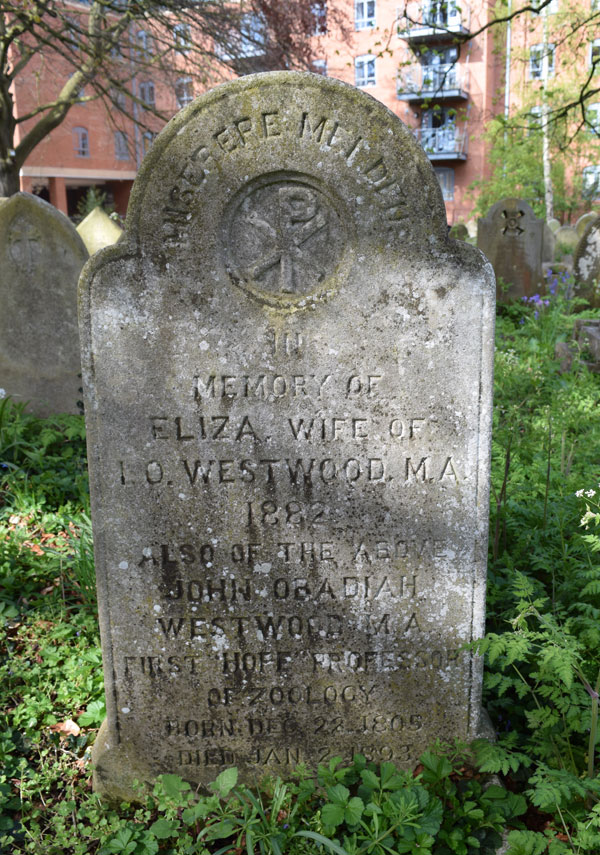
MISERERE MEI DEUS
[Have mercy on me, O God,
Psalm 51]
[Chi Rho symbol]
IN
MEMORY OF
ELIZA, WIFE OF
I. O. WESTWOOD M.A.
1882
ALSO OF THE ABOVE
JOHN OBADIAH
WESTWOOD, M.A.
FIRST HOPE PROFESSOR
OF ZOOLOGY
BORN DEC. 22. 1805
DIED JAN. 2. 1893
.
See also the Oxford Dictionary
of National Biography entry for
John Obadiah Westwood,
entomologist and palaeographer,
Hope Professor of Zoology.
He also has a Wikipedia entry

John Obadiah Westwood was born in Sheffield on 22 December 1805 and baptised at St Peter's Cathedral there on 3 April 1806. He was the son of John Westwood (a medal designer and die-sinker) and Mary Betts.
He was educated at a Friends's School in Sheffield.
In 1819 when John was 13 he moved with his family to Lichfield, where they lived at Parchment Cottage. and then on to Chelsea in London.
John was at first apprenticed as an engraver, but on 14 November 1821 when he was living at Hackney Road in London he was articled Jackson Walton, a London solicitor. By the end of 1828 he was enrolled as an attorney of His Majesty’s Court of King’s Bench at Westminster, an attorney in Common Pleas, and a solicitor in His Majesty’s High Court of Chancery. During this period he also pursued his interest in insects, and in 1824 met the entomologist Frederick William Hope, who became his patron.
On 17 July 1839 at St George’s, Hanover Square in London, John Obadiah Westwood (with his own rank or profession given as “Esquire” and his father's as “Artist”) married Eliza Richardson, who was born at Covent Garden, London in 1804/5 and was the daughter of the gentleman Charles Richard, He was then living in Hammersmith, and Eliza at Bruton Street. They had no children.
At the time of the 1841 census Westwood was living at Brunswick Place, Hammersmith with his wife Eliza, his father John (who again described himself as an artist), and his unmarried aunt Sarah Westwood.
By 1848 Westwood was Secretary to the Entomological Society in Bond Street, London.
In 1851 Westwood (45), described as an “author of Zoological Works”, was living at 5 Brunswick Place with his wife Eliza (46) and his unmarried aunt Eliza Westwood (7), plus their cook and housemaid.
In 1854 Westwood joined Magdalen College, Oxford and on 7 February 1861 he was admitted to the honorary degree of Master of Arts and appointed the University’s first Hope Professor of Zoology.
At the time of the 1861 census John and Eliza Westwood were living at Henley House, Woodstock Road, Oxford with two servants; but in 1865 they became the first leaseholders of a new house at 141 Woodstock Road, which they named “Walton Manor”. (This was originally numbered 71 Woodstock Road.)
In 1871 Eliza was in their Woodstock Road home, but John was paying a visit to William Hewitson, an author on zoology who lived at Walton-on-Thames.
In 1880 Westwood was elected an honorary fellow of Magdalen College.
At the time of the 1881 census he and his wife were living at 141 Woodstock Road, and their niece Miss Emma Swann was also living with them: she was born in Eynsham in 1839, the eldest child of Westwood’s younger sister Eliza and her husband William Swann, who was a paper manufacturer also born in Eynsham. The following year his wife died:
† Mrs Eliza Westwood, née Richardson died at 141 Woodstock Road at the age of 77 on 19 March 1882 and was buried at St Sepulchre’s Cemetery on 22 March (burial recorded in the parish register of St Giles' Church).
Her personal estate came to £1,530 3s. 11d., and her husband was her executor.
At the time of the 1891 census Westwood was still living at 141 Woodstock Road, and his niece Emma Swann was acting as his housekeeper. He also had a cook and a housemaid. Less than two years later, he died:
† John Obadiah Westwood died at 141 Woodstock Road at the age of 87 on 2 January 1893 and was buried at St Sepulchre’s Cemetery on 6 January (burial recorded in the parish registers of both Ss Philip & James’s and St Giles' Church).
The following report on his funeral appeared in Jackson’s Oxford Journal on 14 January 1893:
THE LATE PROFESSOR WESTWOOD
The funeral of Professor John Obadiah Westwood, M.A., Hon. Fellow of Magdalen College, the Hopeian Professor of Zoology … took place at St. Sepulchre’s Cemetery. Walton-street, on Friday the 6th inst., and as a last mark of respect a goodly number of members of the University attended. The funeral cortege left the residence of the deceased shortly after two o’clock, the coffin being covered with a large number of beautiful wreaths and crosses. The mourners were the three nieces of the Professor (Miss Swann, Miss Lucy Swann, and Mrs. E. D. Whitmarsh), the Rev. Dr. Whitmarsh (Vicar of Sandford-on Thames), Mr. C. M. Laing, the Rev. Dr. Yule (of Shipton-on-Cherwell), Mr. C. M. Laing, the Rev. Dr. Yule (of Shipton-on-Cherwell), Mr. H. P. Symonds and Mr. Ritchie (the deceased’s medical advisers). On arrival at the cemetery the coffin was met by the Rev. F. J. Brown, Curate of SS. Philip and James, who read the Burial Service. In front walked the University Marshal and one of the University constables. On either side of the path inside the outer gate of the cemetery stood the members of the University and others who had attended, and as the procession passed they fell in behind and walked to the chapel and afterwards to the graveside. Amongst those present were the President of Trinity, the Provost of Worcester, the Warden of Keble, the Master of Pembroke, the Junior Proctor, Professor Wallace, Dr. Tyler, the Revs. C. H. O Daniel, W. B. Duggan, L. Thomas, and – Treacher, Col. Swinhoe (representing the Entomological Society of London, of which Professor Westwood was a life member), Mr. E. J. Stone (Radcliffe Observer), Mr. Arthur Thompson (of the Department of Human Anatomy at the University Museum), Mr. R. S. Wilson (Brasenose), Mr. F. Madan (Bodleian Library), Mr. M. H. Green (Trinity), Mr. W. W. Fisher (Public Analyst), Mr. G. E. Underbill (Magdalen), Mr. Macdonald, Mr. J. Walker, Mr. Robertson, Mr. H. G. W. Drinkwater, Mr. J. Allin, Mr. W. Shipp (the late Professor’s assistant at the Museum), &c.
The first part of the service was read in the cemetery chapel. The coffin was placed in a plain earth grave, in which the remains of Mrs. Westwood already lay. On a brass plate on the polished elm coffin was the following inscription:—
JOHN OBADIAH WESTWOOD,
Hopeian Professor of Zoology in the
University of Oxford,
Aged 87 years.Amongst those who sent wreaths were the family, Sir Henry Acland, Mrs. Webber and Mrs. Batty, Mr. and Mrs M. Wootten, Mr. C. M. Laing, Miss Maria Slee, Mrs. Dodd, Mr. and Mrs. W. W. Fisher, Mr. E. W. B. Nicholson, Grace, George and Ruth Drinkwater, Mrs. E. and the Misses Slee (Dulwich), Miss E. A. Ormerod (late honorary consulting entomologist to the Royal Agricultural Society), Mr. and Mrs. Edward Stone, Mr. and Mrs. Herbert Druce, Mr. and Mrs. Cuthbert B. Slee and Miss Jessie Slee, Mrs. Yule, the Rev. Dr. Yule, and the Rev. C. Yule.
The funeral arrangements were admirably carried out by Messrs. Elliston and Cavell.
Westwood’s wealth at death was £13,774 15s. 3d.
In 1893 a vestry was erected at St Andrew’s Church, Sandford-on-Thames, in his memory.
The following obituary appeared in Jackson’s Oxford Journal on 7 January 1893 (with paragraphing inserted here):
DEATH OF PROFESSOR WESTWOOD
We regret to announce that Professor Westwood, who has been in failing health during the last year, died at his residence, Walton Manor, Oxford, on Jan. 2. In him Oxford loses the oldest and quite one of the most distinguished and remarkable of her professors.
John Obadiah Westwood was born at Sheffield, on Dec. 22, 1804 [sic: 1805 on gravestone], so that he had just completed his 87th year. He was educated first at Sheffield in a Friends’ school, where he early evinced a strong taste for natural history and a remarkable native gift for drawing, in which he trained himself, without lessons, to a high pitch of skill. Somewhat later his family moved to Lichfield, where they resided in Parchment-cottage, a house formerly lived in by Dr. Johnson. Here the cathedral with its services had a great attraction for him, and helped, perhaps, to lay the foundation of his taste and knowledge in ecclesiastical art.
From Lichfield he went to London and was articled to a solicitor, but though he ultimately became a partner in the firm, he never gave himself to practice, but was more and more drawn off in the direction of science and literature. The subjects in which he achieved a world-wide reputation appear at first sight divergent — entomology and the palaeography of art. He soon became what he remained for many years, one of the first of living entomologists. He was an original member of the Entomological Society, of which he was made a life president, and later he was elected to succeed Humboldt as member of the Entomological Society of Paris. It was this study that brought him to Oxford. In 1858 the late Mr. Hope presented his entomological collection to the University, purchasing and adding to it Westwood’s own, a very valuable one, and made Professor Westwood first keeper and then, in 1861, Hope Professor.
The University made him an M.A., and Dr. Daubeny introduced him to Magdalen College, of which he was, in 1880, elected honorary Fellow. For 30 years he continued to reside in Oxford, discharging the duties of the professorship and retaining his great bodily vigour and freshness up till about a year ago, and his mental power and marvellous skill and command of hand and eye practically to the very last. The list of his works is long and various, reckoning those on entomology alone, and covers a period of 50 years. But he had another side on which he was equally distinguished. He was a specialist in the archaeology and palaeography of art. Books like the “Palaeographia Sacra Pictoria” and “The Facsimiles of the Miniatures and Ornaments of Anglo-Saxon and Irish MSS.” are extraordinary monuments of his combination of knowledge, industry, perception, and skill. In this field, too, he was a pioneer. The value of works like the “Book of Kells” and its place in the history of art are now well known. When Westwood wrote and copied, nearly 50 years ago, this was not so. Allied to this was his knowledge of ivories and of inscribed stones. He was employed to make the catalogue of the ivories at South Kensington. His “Lapidarium Walliae,” one of his later publications, is a monumental work; Professor Westwood was then a patient and minute student alike of nature and of art. In the prosecution of his studies he was indefatigable, travelling through Germany or Russia to copy MSS. and keeping up a correspondence with all parts of the globe on points of entomology. No one probably in Oxford was better known, not only on the Continent, but all over the world, for his work. In Oxford his hearty and honest disposition, his simplicity, his courageous industry and unflagging devotion to science, sustained long after his 80th year, his warm kindliness and courtesy endeared him to old and young. He was fond of relating that when he first came to Oxford some question was raised as to his religious opinion, but all was set at rest by a happy mot of the then Public Orator – that he was not a “sectarian,” but an “insectarian.” He received one of the Royal Society’s gold medals for entomological researches, and was a Fellow of the Linnaean Society and the Society of Antiquaries, and honorary and corresponding member of the Entomological or Zoological Societies of Paris, Holland, Belgium, Berlin, Stettin, Munich, Vienna, Stockholm, St. Petersburgh, Moscow, Quebec, and Boston U.S.A.
We may add that he was married, in 1839, to a Miss Richardson, who died some few years ago, and that his collection of fictile ivories have, to his great satisfaction, been recently purchased by Mr. Fortnum for the University.
A Victorian Renaissance Man: John Obadiah Westwood
Portrait of John Obadiah Westwood in the Ashmolean
Three portraits of Westwood in the National Portrait Gallery
Please email stephanie.jenkins@gmail.com
if you would like to add information
These biographies would not have been possible without the outstanding transcription services
provided by the Oxfordshire Family History Society