

No. 31: Taylor’s Delicatessen
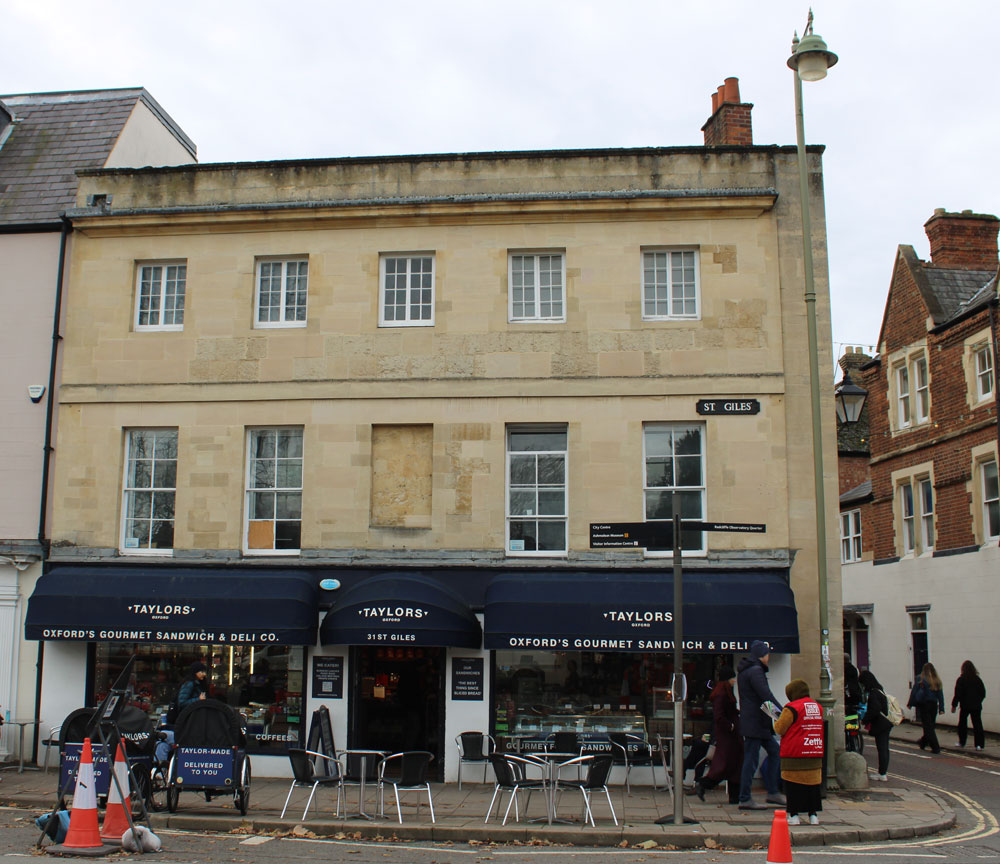
No. 31 on the corner of Little Clarendon Street is a Grade II listed building (List Reference No. 1068551). It lies in St Giles' parish.
On the first floor the rooms have some late eighteenth-century panelling, and in one room the panelling appears to date from the early seventeenth-century. It was originally a much smaller shop, and there was a second building on the corner facing on to Little Clarendon Street.
Until the 1850s, 31 St Giles’ Street was a private house. It does not appear to be listed in the 1841 census, but at the time of the 1851 census it was occupied by a widow of 52, Mrs Louisa Ann Millicent Chase (described as a Landed Proprietor) and her daughters aged 16, 18, and 25 and her nine-year-old son, plus their two servants.
Alfred Scrivener Booth opened a grocer's shop here in 1852, and on 10 October 1853 he obtained a twenty-year lease of the property from St John's College.
On 29 September 1855 the forthcoming auction of this property was advertised with this description in Jackson's Oxford Journal,:
A substantial Stone-built DWELLING HOUSE, containing drawing room, dining room, six bed rooms, with water closet, and suitable domestic offices; also a spacious Grocer's Shop, with plate glass front, two cellars, warehouses, large yard, and garden, in the occupation of Mr. Booth, grocer, at a rental of £68 per annum.
The Booth family were grocers here for thirty years. At the time of the 1861 census Alfred Scrivener Booth was living here over his shop with his wife, nine young children, two apprentice grocers, and three servants. Less than a year later, on 7 February 1862, he died here at the age of 44 and his widow Mrs Sarah Booth continued to run the business, helped by her son John. She can be seen here in the 1871 census with John and five of her other children, plus a grocer's assistant and two domestic servants.
At the time of the 1881 census Mrs Booth's daughter, Miss Sarah E. Booth, was the head of the household here and five of her younger siblings (all unmarried) lived with her. Sarah (30) and her sister Susannah (26) worked as telegraph clerks in the post office which had just opened in the shop. Her brother William (25) was described as the grocer here, employing three men and two boys, while Howard (23) was described as an unemployed grocer. Her sister Mary (29) may have looked after the household, while Annie (22) was described as an unemployed draper's assistant. Also living over the shop were two grocer's assistants and a servant.
Frederick Howard Alden took over No. 31 as a grocery and post office for a brief period in about 1883, but his business then moved to the south end of the Woodstock Road.
The two premises combined, as today
In 1885 Jackson’s Oxford Journal reported that the old No. 31 and the building facing Little Clarendon Street had been “converted into a massive double-fronted shop” by the builder J .C. Curtis for the butcher John Wiblin. The new shop had a balcony with panels from Macfarlane’s foundry, and can be seen in its original splendour in the advertisement below.

John Wiblin did not live over his shop, and in 1881 he was living at Northern House in South Parade with his wife Maria, his three sons, one daughter, a niece, and a general servant, and was described as a butcher, bacon curer, and sausage-maker employing nine men.
In 1886 there was a failed attempt by the joint university and city committee (which ran the covered market) to force the closure of this greatly enlarged shop.
At the time of the 1891 census Charles Tom Alexander Wiblin (30), described as a meat salesman, lived over this shop with his wife Rose and their one-year-old daughter, plus their 15-year-old servant girl.
The 1901 census lists Alfred Wiblin (40), described as a butcher, living here with his wife Edith Amy and their three daughters, plus a general servant. In 1911 he was described as a master butcher & bacon curer, and was still living here over his shop with his wife and their three surviving children, plus a servant. He died in 1917.
At the time of the 1921 census Alexander Henry Steele (44), a police constable based at the station in Blue Boar Street, was living in eight rooms at the butcher's shop with his wife Emily and their six children, plus four boarders.
In the 1920s Reginald Thomas Alden, the dairy farmer at Northern Meadows on the Marston Ferry Road, took the premises over as one of his three Oxford shops, but when he retreated to 205 Banbury Road and 289 Iffley Road in 1934 the shop became John Wiblin Ltd until it ceased to be a butcher’s shop in 1960.
The 1939 Register shows the window cleaner William James Boon and Alice Boon living in the flats over this shop.
The back of the ground floor and top two floors were let out separately from the 1970s to c.1993, with access from Little Clarendon Street:
Photographs of this shop at 31 St Giles' Street:
|
Occupants of 31 St Giles’ Street listed in censuses and directories |
||
1841–1851 |
Captain John Woodford Chase (1841–6)
|
Formerly |
1852–1882 |
Alfred Scrivener Booth (1852–1862) His widow Mrs Sarah Booth (1862–1867) Listed as A. S. Booth again (1869–1882) |
|
1884 |
Frederick Howard Alden |
|
1885–1960 |
John Wiblin, Family butcher, bacon curer and sausage maker Reginald Thomas. Alden, Butcher John Wiblin Ltd, Butcher |
|
1962 only |
Prestcold, Manufacturers of refrigeration equipment |
|
1966–1969 |
Micro Instruments (Oxford) Ltd |
|
1970–1976+ |
A. & J. Antiques Back & upstairs in 1973–1976: Plunkett Foundation for Co-operative Studies |
|
Early 1980s |
? Back & upstairs in 1980: Physiological Society |
|
c.1988–present |
Taylor’s Delicatessen Back & upstairs in 1992–1993+: |
|