

No. 14: Part of St John’s College

No. 14 St Giles was built in about 1800 and is a Grade II listed building (List Entry No. 1369453). It lies in St Giles' parish. It was originally owned by Balliol College but now belongs to St John's.
At the time of the 1772 Survey of Oxford, the former house on this site was occupied by Mrs Whalley, and its frontage was recorded as 8 yards 1 foot.
By 19 October 1813 Sir Francis Burdett, Bart. resided here at 14 St Giles' Street, and it appears that he occupied No. 15 next door as well, as on 23 April 1814 a sale was announced of all the goods “in those two large houses in St. Giles's, lately occupied by Sir Francis Burdett”, and the notice at the end read:
To be LET, and entered on immediately, TWO HANDSOME WELL BUILT HOUSES, well fitted up, and fit for the reception of genteel familes. Enquire of Mr. Halse, Broad-street.
In 1820 Balliol College granted Sir Edward Hitchings a lease of 14 and 15 St Giles' Street for 40 years for a payment of £145 2s 6d., with a rent of 5s. for the former and 20s. for the latter. He moved into this house at No. 14, and lived there for five years until his death in 1825.
By 1835 the Revd Christian William Henry Pauli and his wife Ellen had moved in here, and three of their children were baptised at St Giles' Church. At the time of the 1841 census Christian and his wife Ellen were at home with their seven children, aged between one and twelve.
On 6 January 1842 Richard James Spiers wrote in his record book that he “took possession of 14 St Giles’, sleeping there for 1st time”. The 1851 census shows Spiers (41) living in this house with his wife Elizabeth and their five young children, plus three house servants. He was described as a Town Councillor, and a manufacturer of fancy goods & china employing 28 persons and two apprentices: his shop was at 102 & 103 High Street. His wife died here on 29 October 1858 and the 1861 census shows Spiers here with five of his children and his nephew, plus three servants. He was still here in 1871, now with four children and two servants. During his tenure he virtually doubled the number of rooms, and according to his son (Jackson's Oxford Journal, 18 February 1899) the garden was “looked upon as one of the prettiest private gardens in Oxford, and the grass plot was sufficiently large for the games then in vogue, viz., lawn-billiards, followed by croquet. The mulberry tree, which has now extended its branches over the whole end of the garden, was planted in 1842.”
On 30 November 1872 after thirty years at No. 14 Spiers moved into a smaller house and handed over the keys to Thomas Hill Green.
At the time of the 1881 census only the servants (a cook and housemaid) were at home. On 12 November that year the house was advertised to let from April 1882, and in that year it was occupied by Henry Nottidge Moseley, the Linacre Professor of Zoology. He was one of the six scientific members of staff on board the Challenger Expedition of 1872–6 and wrote Notes by a Naturalist on Board HMS Challenger. He remained here until about 1888.
On 9 February 1889 No. 14 was advertised to be let with immediate possession:
ON THE GROUND FLOOR—Entrance hall, dining room, housekeeper's room, kitchen, scullery, larder, and pantry.
ON THE FIRST FLOOR—Large drawing room and library.
ON THE SECOND FLOOR—Four bed rooms & two dressing rooms, w.c., and housemaid's closet.
ON THE THIRD FLOOR—Four bed rooms and two attics over.
Front and back staircases, cellarage in the basement, garden, and w.c.
At the time of the 1891 census George John Wilson (35), a physician, lived here with his wife Lucy and their daughter and their two servants.
From 1899 Ruskin Hall, the forerunner of Ruskin College, was based here. The line drawing below of the back and the front of this house was published in Jackson's Oxford Journal of 28 January 1899:
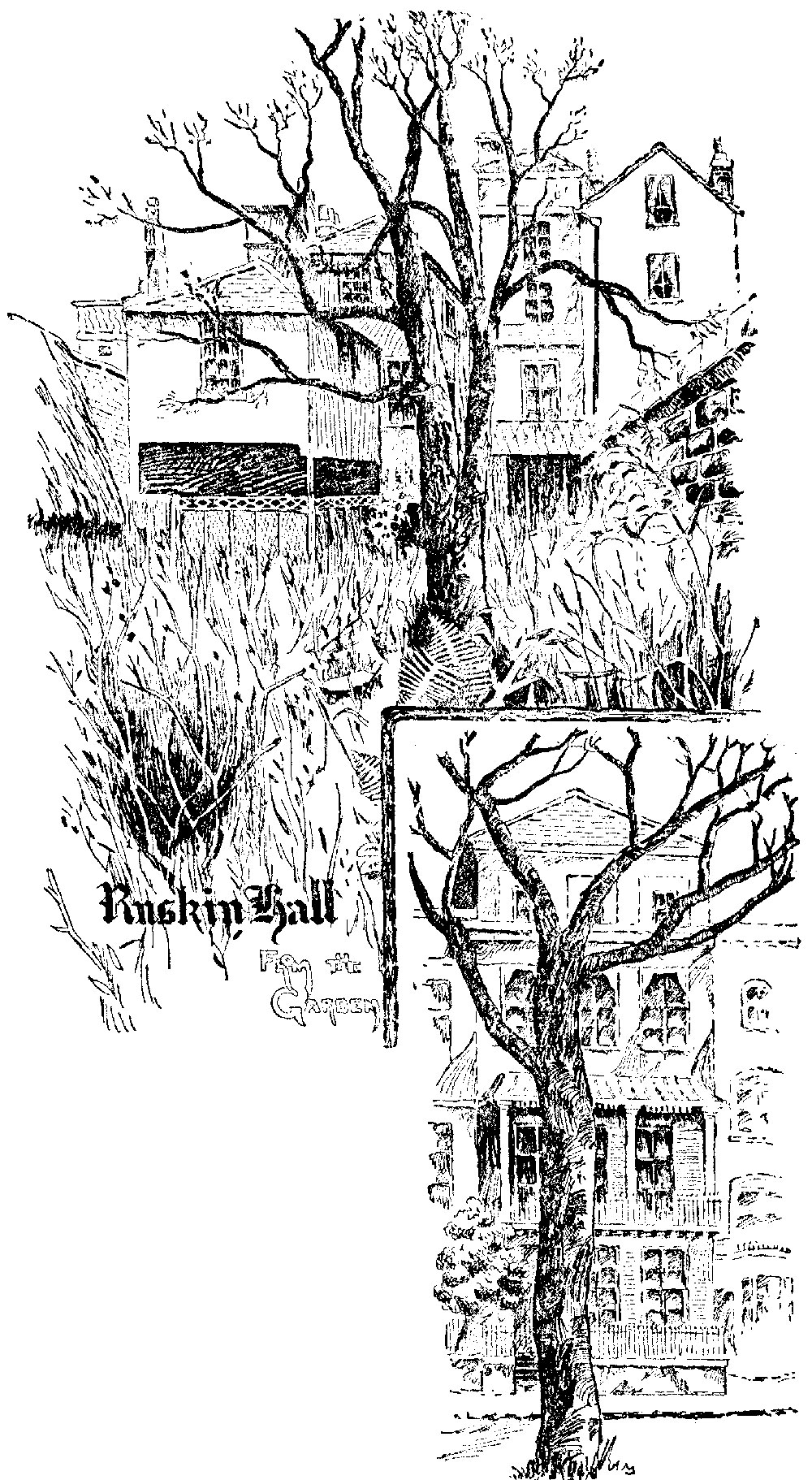
The accompanying report stated:
We publish this week illustrations of the new democratic college which is to be inaugurated under the title of “Ruskin Hall,” at a meeting to be held in the Town Hall on February 22nd. The house depicted is No. 14, St. Giles', formerly occupied by Dr. Wilson. Our artist, in the course of his visit, ascertained that accommodation will be provided for 40 resident students in “Ruskin Hall,” which contains 28 rooms. How this is going to be done our artist was unable to comprehend. The promoters are doing their best to adapt the methods of the Hall to the needs of the prospective students, and in consequence they have determined to hold their principal lectures in the evening. This will give townspeople an opportunity of attending the lectures of the Hall, without infringing on their business hours, and upwards of 50 residents in the city have signified their intention of doing so. So far the promoters have secured the voluntary services of six graduate members of this University to act as lecturers, and Messrs. Vrooman and Beard are at present busily engaged lecturing in different towns on the subject of the Hall. There will certainly be plenty for the students to do when they come up – at least for those who are horticulturally inclined – for the garden (we cannot call them grounds, the whole extent of land attached to the Hall being barely more than 100 feet in length by about 36 feet across) is literally a miniature jungle of overgrown rose-stems, long grass, ferns, neglected fruit trees, ivy, and iris leaves…. The Hall has a splendid outlook on St. Giles', there being eleven windows facing the thoroughfare, with a balcony to the French windows on the second floor. The young scions of the masses who are to be the “undergraduates” of this new college will thus be able to participate in the fun afforded by the great festival of St. Giles in September without risking the dignity of their alma mater by rubbing shoulders with the multitudes which congregate there.
The 1901 census shows Bertram Wilson (30), the Sub-Warden of Ruskin College, living here with ten male boarders aged between 18 and 38, some of the described as students and some by their trades.
In 1903 Ruskin College moved to a new home in Walton Street, and 13 St Giles' Street was purchased by Father John O'Fallon Pope, Master of the predecessor to Campion Hall at 11 St Giles' Street.
At the time of the 1911 census No. 14 was occupied by Hugh Edward Egerton (55), the Beit Professor of Colonial History & Fellow of All Souls College, and his wife Margaret, plus their five servants. He and his wife were still there in 1921 with their daughter Sibyl (32), who was a social science student, and their cook, housemaid, and parlourmaid. Professor Egerton died on 21 May 1927, and his widow remained in the house until 1929.
No. 14 was probably sold to St John's College when Campion Hall moved to Brewer Street in 1936.
The 1939 Register shows the merchant banker Oswald T. Falk living here, with two caretakers in the office premises.
Phaidon Press starting business here in 1947.
In 1999 St John's College was granted planning permission for change of use of 14/15 St Giles' Street for educational use (98/00392/NFH), and since 2000 No. 14 has been used as student accommodation.
Occupants of 14 St Giles’ Street listed in censuses and directories |
|
| Pre-1820 | Thomas Perry |
Richard Buckingham |
|
1820–1825 |
|
1833 |
Lydia Sirman |
1835–1841 |
Christian William Henry Pauli |
1842–1872 |
Alderman Richard James Spiers, J.P. |
1873–1880 |
Thomas Hill Green |
1882–1887 |
Professor Henry Nottidge Moseley |
1890–1896 |
George John Wilson |
1899–1903 |
Ruskin Hall |
1905–1906 |
Miss Frost |
1907–29 |
Hugh Edward Egerton |
1930–1932 |
Arthur W. Allen |
1939 |
St Giles Galleries Ltd |
1941–1947 |
Ernest Henry Tipping Phaidon Press (1947) |
1949–1964 |
Lofts & Warner (later Strutt & Parker Lofts & Warner) |
1968–1990 |
H. Ridge & Partners H.J. Ridge & Partners |
| 1990–present | Student accommodation for St John’s College |