

Jeremy Franklin (1670–1748)
Mayor of Oxford 1728/9 and 1736/7
Jeremy (or Jeremiah) Franklin (or Franckling) was baptised at St Peter-le-Bailey Church in Oxford in 1670. He was the son of William Franklin, who had been appointed City Carpenter in Oxford on 13 January 1688.
Jeremy became a carpenter like his father, taking on his first apprentice, Robert Pratt, in January 1698/9 and his second, William Cantwell, in February the next year. In the latter agreement, Franklin is described as a “house carpenter”, and the terms are spelt out thus: “Master to find meat, drink, washing, lodging & other necessaries but no apparel”.
On 2 July 1699 at St Giles' Church, Jeremy Franklin married Catherine Townesend. Catherine had been baptised at that Church on 20 December 1674, and was the daughter of John Townesend, who was himself to be Mayor in 1720. She was also the sister of William Townesend, an important Oxford builder with whom Franklin was to work throughout his life.
They appear to have set up home in St Michael's parish, and had the following children:
- Elizabeth Franklin (born on 15 August 1701 and baptised at St Michael's Church on 18 August)
- William Franklin (born in 1703 and baptised at St Michael's Church on 26 January 1703/4;
died in 1712 and buried inside the church on 3 June) - John Franklin (born in 1705 and baptised at St Michael's Church on 18 July)
- Catherine Franklin (born on 20 October 1706 and baptised at St Michael's Church on 25 October;
died in 1709 and buried at that church on 11 June)
Jeremy's father William Franklin was buried at St Peter-le-Bailey Church on 15 December 1698, and on 31 May 1700 Jeremy was appointed City Carpenter “in place of his father, deceased”. He appears to have always had two young apprentices working for him, as he regularly took on new boys for a seven-year term: Charles Etty (1703), Thomas Phillips (1705), John Reeve (1710), Thomas Hawkins (1714), John Stiles (1718), Thomas Franklin (son of the late Thomas Franklin, a carpenter of Witney, and probably a relation, 1721), Thomas Garlick (1725), John Lowe (1728/9), Richard Ayres (1731), and John Smith (1736).
On 9 October 1708 Franklin was granted a lease by Balliol College of 65 St Giles' Street for 40 years at a rent of 13s. 4d
In 1708 Franklin leased from the Council Mr Box’s property in Northgate for 40 years for a fine of £39 and 4s. rent p.a. He also leased from them a property in St Peter-le-Bailey.
Franklin had been appointed the Council’s Surveyor of Nuisances on 30 September 1699, a post he held for 49 years until his death in 1748, except for the year 1714/15 (when he served as Senior Bailiff) and for the two years when he was Mayor.
In 1704 Franklin came on to the council as “one of the 24”, and in 1705 he was made a Keykeeper and in 1711 a Gentleman Chamberlain.
In 1709–11 the west range of The Queen’s College was built by Franklin’s brother-in-law William Townesend, and Franklin did the carpentry work.
In 1711 Franklin was elected a Gentleman Chamberlain on the council, and in 1725 Bailiff again.
In 1725 Franklin was chosen as Bailiff again, and then at last on 27 May 1728 was elected one of the eight Assistants and on 20 September the same year was elected Mayor (for 1728/9). He chose John Wilkins as his Child, but his choice for Mayor’s Chamberlain, Sampson Remmett, was rejected by the Commons. In March of his term of office, he proposed that the city should elect a City Plumber. His initials JF appear on the boundary stone on Headington Hill marking the end of the Headington Highway.
Thomas Hearne remarks that on 19 October 1733 houses on the east of the south side of The Queen’s College began to be pulled down in order to erect a new part, and that “The Mason was Mr. Townsend and the Carpenter Mr. Franklin, who are the same that were imployed in the former new Buildings of that College”.
Franklin continued to serve as an Assistant, and in September 1736 was elected Mayor of Oxford a second time (for 1736/7). This time he chose John Gilbert as his Child and William Culley as his Chamberlain.
† Jeremy Franklin died on 10 June 1748 at the age of 77, and was buried inside St Peter-le-Bailey Church on 17 June. His son John Franklin died just three months later on 19 September 1748 at the age of 43.
In April 1749 the city transferred to his widow Catherine Franklin of her husband's tenement in Northgate Street (now Cornmarket), and it was stated that she now occupied that house. Balliol College transferred to her the lease of 65 St Giles' Street. She died four years after her husband, also at the age of 77, on 3 October 1752 and was buried with her husband.
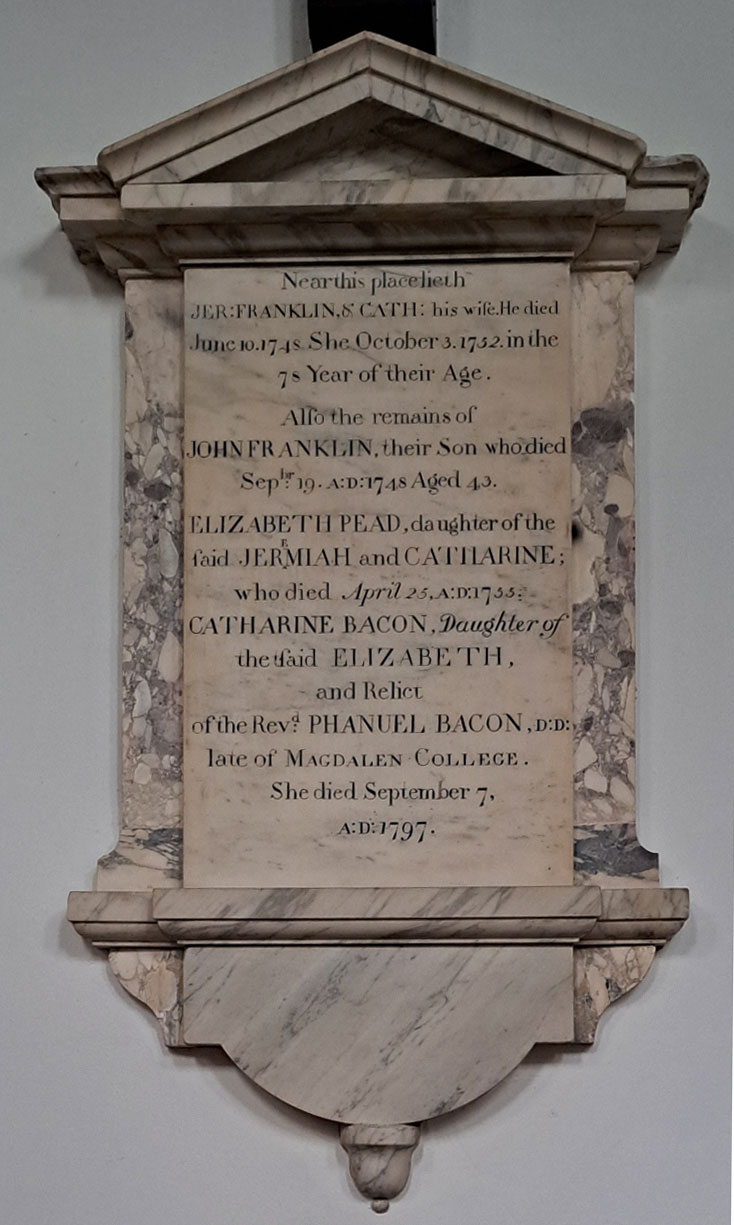
The above memorial (photographed in 2023) was put up on the wall of the original St Peter-le-Bailey Church at the south end of New Inn Hall Street, and when that church was demolished it was moved to the new church further up the street, which now acts as the Chapel of St Peter's College. As well as Jeremiah Franklin, his son John, and his wife Catherine, it remembers the following:
- His daughter Mrs Elizabeth Pead, who died on 25 April 1755
- His granddaughter Mrs Catherine Bacon née Pead who died on 7 September 1797, (She was the widow of the Revd Phanuel Bacon D.D. who had died in 1783)
Franklin’s apprentice
Thomas Phillips, who was Franklin's apprentice in 1705, became an important master-carpenter in London, building the first timber Fulham Bridge (1729/30) and doing the carpentry work in the Treasury Buildings in Whitehall (1733–1737) and in churches such as St Martin-in-the-Fields.
See also:
- Malcolm Graham, Oxford City Apprentices 1697–1800, entries numbered 71, 97, 264, 385, 650, 802, 971, 1093, 1258, 1368, 1456, and 1622
- MS Wills Oxon W. 211.281; 128/2/44
