

William Fletcher (1739–1826)
Mayor of Oxford 1782/3, 1796/7, and 1809/10

Portrait of William Fletcher dated 1798 in the
Council Chamber of Oxford's Town Hall,
The banner on the right reads “Learn to die”
and the text on the left “Æt. suae 57”
William Fletcher was born in Turl Street, Oxford on 28 September 1739 and baptised at St Michael-at-the-Northgate Church on 8 October 1739.
He was the seventh child of James Fletcher senior, a bookseller of the University of Oxford, and his wife Mary King, who were married at St Cross (Holywell) Church on 3 January 1729/30.
Just ten days after his marriage, on 13 January 1729/3, William's father James Fletcher the elder was matriculated at the University of Oxford as a privileged person, and became a bookseller at the north end of Turl Street (in the parish of St Michael-at-the-Northgate).
William and his eleven siblings (of whom only four survived infancy) were baptised at St Michael-at-the-Northgate Church on the dates shown: James Fletcher junior (22 October 1730); the first John Fletcher (14 April 1733 and died aged seven and buried on 13 May 1740); the first Mary Fletcher (25 March 1734, no burial found); the first Rebecca Fletcher (23 July 1735; died aged five and buried on 19 May 1740); the first Richard Fletcher (10 August 1736 and died aged five months and buried on 21 January 1736/7); the second Mary Fletcher (27 January 1737/8); William Fletcher (8 October 1739); the first Ann Fletcher (5 April 1742, wrongly recorded as the daughter of Stephen Fletcher, died the same year and buried on 15 July); the second Rebecca Fletcher (15 July 1743 and died a month later and buried on 22 August 1743); the second John Fletcher (11 March 1744/5); the second Richard Fletcher (27 June 1746, died six weeks later and buried on 11 August 1746); and third Rebecca Fletcher (3 January 1748/9).
William Fletcher was a sickly child, and was sent to Yarnton which was five miles to the north of Oxford to be nursed by the wife of the parish clerk, and he remained there until he was aged 15. He never forgot Yarnton, and not only made benefactions there but also chose to be buried inside its church.
William's older brother James Fletcher the younger was matriculated as a privileged person of the University on 17 February 1756 and took over his father's business.
On 25 March 1755 when William was 15 he was apprenticed for seven years to the Oxford mercer William Wickham (who was himself shortly to become Mayor) in his shop at 34 High Street. He was granted his freedom on 14 June 1765, and went into partnership with Wickham, and the business became known as Wickham & Fletcher.
Fletcher, described as a mercer, was first elected as one of the 24 Oxford councillors on 30 September 1766, and was also appointed cloth-searcher. In 1767 he was chosen as one of the five keykeepers, in July 1769 Isaac Lawrence selected him as Mayor’s Chamberlain, and four years later in 1773 he was elected Junior Bailiff for the forthcoming council year.
On 15 December 1766 William Fletcher's mother Mary Fletcher died and was buried at St Michael-at-the-Northgate Church. The following notice appeared in Jackson's Oxford Journal on 20 December:
On Monday died, of an Apoplexy, Mrs. Fletcher, Wife of Mr. James Fletcher, an eminent Bookseller of this Place; whose Death is justly lamented.—She was a most affectionate Wife, a tender Mother, a sincere Friend, and in every Respect a valuable Woman.
On 16 November 1767 William's younger brother John Fletcher died at the age of 22 (after an illness of four days, according to his death notice in Jackson's Oxford Journal) and was buried in the same vault.
Fletcher had his own business on the south side of the High as well as being the partner of his former master Wickham. The 1772 Survey of Oxford shows Mr Miller, Mr Routledge and Mr Fletcher (probably William) all on the site now occupied by 93 High Street, with Fletcher in the shop on the right with a frontage of 3 yds 2 ft 0 in.
On 11 February 1775 a notice in Jackson’s Oxford Journal announced that the partnership of Wickham & Fletcher Mercers had expired in July 1773, and that the business had been and would in future be carried on by Fletcher alone. Immediately below was an announcement from John Parsons stating that he had “taken to the Shop and Trade of Mr. Fortnom, Mercer, Hatter, Hosier, &c. (who has declined Business in his favour)”: this shop was at 90 High Street.

The four bays on the west side of the Old Bank (left) were In 1775.
Jackson’s Oxford Journal announced on 24 March 1781 that William Fletcher had entered into partnership with another mercer, John Parsons, but that business would initially continue in both shops. Bailey's Western & Midland Directory of 1783 lists Fletcher & Parsons as mercers and the Universal British Directory of 1794/5 lists Fletcher, Parsons, & Co. as linen drapers, but neither gives an address. In the latter directory his fathers business was listed as Fletcher & Hanwell, booksellers.
This Fletcher & Parsons business expanded into 92 High Street to the east, and in the 1790s it changed from mercery to banking.
For over two hundred years 92–93 High Street remained a bank. In its latter days, until 1998, it was called Barclays Old Bank, and the building has been the Old Bank Hotel since 1999.
On 27 May 1776 William's sister Rebecca Fletcher married the Revd Thomas Robinson, Headmaster of Magdalen College School.
By 1780 Fletcher had gone into partnership with John Parsons, and together they established the Old Bank, of which Fletcher remained a partner until his death.
In June 1781 William Fletcher was chosen as one of the Mayor’s eight Assistants, and in September 1782 he was elected Mayor of Oxford (for 1782/3), choosing James Shipton as his Chamberlain and James Adams as his Child.
From 1787 William Fletcher lived at 46 Broad Street and initially his elderly father James Fletcher the Elder lived with him. William was an antiquarian, and had a private museum in his home here that included many Oxford objects. He adorned its corridors with 40 paintings illustrating the Dance of Death, and remained in this house until his death in 1826. (He also owned the house next door, 47 Broad Street, which he let out to tenants.)
In the 1790s four members of William Fletcher's family died, and all except Stephen were buried in the family vault inside St Michael's Church:
On 23 August 1794 William's eldest sister Mary Fletcher died at the age of 56 after a few days' illness
On 12 June 1795 William's father James Fletcher the Elder died at the age of 87 and was buried inside St Michael's Church six days later. Jackson's Oxford Journal stated that he was “formerly an eminent Bookseller, in the Turle in this City, but had retired from Business some Years”.
On 25 September 1796 William's cousin Stephen Fletcher the Younger, described as having been “formerly a bookseller in this city” died aged 81.
Then on 20 May 1798 William's older brother James Fletcher junior, who had taken over the family bookselling business on the corner of Turl Street,, died at the age of 68 and was buried in the family vault five days later: transcript of his will here. It was announced in Jackson's Oxford Journal that “the business will in future be carried on by William Hanwell and Joseph Parker, Partners with the late Mr. James Fletcher”.

There is a memorial tablet to James Fletcher the Younger on the wall of St Michael-at-the-Northgate Church (right) which reads:
In a Vault beneath this Seat
Lyeth the Body of JAMES FLETCHER,
Junior, who died 20 May, 1798
Aged 68 Years.
Also SARAH his second Wife,
who died 3 June, 1778.
Also ELIZABETH his third
Wife who died Octr 27th 1815.

In 1796 William Fletcher was elected Mayor of Oxford a second time (for 1796/7). He chose John Sheard as his Chamberlain and Thomas Henry Taunton as his Child. (The practice of the Mayor choosing a Child was abolished henceforth.)
In April 1798 William Fletcher was elected an Alderman “by scrutiny”. The portrait in the Town Hall shown at the top of this page was painted in that year. From around this time he was usually described as “Esquire” rather than as a mercer.
On 29 March 1803 Alderman William Fletcher and Alderman Edward Lock were elected Commissioners of Sewers.
Left: Bust of William Fletcher
in the Town Hall, Oxford
On 23 November 1804 his sister Rebecca (widow of the Revd T. Robinson) died at his house at the age of 56.
The hand-coloured etching below (National Portrait Gallery D13284) was made and published by Robert Dighton in March 1808. It shows Alderman William Fletcher when he was Father of the Corporation of Oxford and is captioned “Omnibus carus” (“very dear to all”).

In 1809 Alderman Fletcher was elected Mayor of Oxford a third time (for 1809/10), but served much against his will: he wished to stand down on grounds of ill health and pay a fine, but was not allowed to do this. His obituary in Jackson's Oxford Journal states that “though at this period far advance in life and with a constitution never very strong, and now greatly impaired, he discharged the duties of the office, as he had twice before done, with unwearying diligence, with advantage to the City, and with credit to himself”.
In 1817 Alderman Fletcher had the parish clerk’s house and adjoining schoolroom built at the north-west end of Church Lane in Yarnton (drawing), and his arms appear on the south gable.
In 1820 Alderman Fletcher, now aged 80, was excused from attending the Coronation of George IV at Westminster on the grounds of his “great age and infirmity”.
Alderman Fletcher served on the council for over 50 years, from 1766 until his death in 1826, and for some time was senior Alderman and Father of the Corporation. He was described as having kept “the noiseless tenor of his way” through his life and was remembered as one of the last men in Oxford to wear his hair in a pigtail.
† William Fletcher died at his home at 46 Broad Street at the age of 87 on 27 December 1826 and was buried at Yarnton Church on 4 January 1827. His lead coffin was placed inside a massive stone coffin with its original sculptured lid which had been dug up at Yarnton many years before and presented to him by the Earl of Abingdon. The Revd Vaughan Thomas, Vicar of Yarnton, took the funeral service.
The Trustees of his Will sold Alderman Fletcher's property over a number of years, with auctions advertised in Jackson's Oxford Journal on the following dates:
- 25 February 1832: His home in Broad Street
- 23 June 1832: His effects, including old paintings and prints and various curiosities
- 11 February 1837: A house in Broad Street occupied by Mr Reynolds, grocer; a house in Holywell occupied by Mr King; and pieces of freehold meadow land in Osney Mead, occupied by Messrs M. & J. Morrell
- 25 April 1837: The unexpired term of his lease of the Grapes pub at Yarnton; 4½ acres of freehold meadow land called Fire Man's Mouth in Oxney or West Meadow in Yarnton
- 3 July 1854: A leasehold house and premises opposite the Sheldonian Theatre occupied by Mr Perkins, wine merchant; a freehold dwelling house in St Aldate's used as the Blue-Coat Girls' School; a piece of freehold land measuring over three acres in Botley Meadow in the occupation of James Morrell junior; and six shares in the Oxford Canal Company
- 27 November 1858: Readvertisement of the house used as the Blue-Coat Girls' School
Fletcher’s tomb and memorial at Yarnton

Fletcher was buried in a large raised tomb (below) inside Yarnton Church, at the west end.
The top of the tomb has a brass showing an Alderman in his official robes (right).

There are two inscriptions underneath the figure of the Alderman. The first is inscribed:
YARNTON, MY CHILDHOOD’S HOME!
DO THOU RECEIVE
THIS PARTING GIFT –
MY DUST TO THEE I LEAVE.
The second reads:
WILLIAM FLETCHER
OF OXFORD
1826
AGED 87 YEARS
William Fletcher's Will, and his heirs
William Fletcher's Will (PCC Will (PROB 11/1723/198) and transcribed here) was proved on 16 March 1827. It reveals that as well as his home at 46 Broad Street, he owned the following property and land:
- The building in St Ebbe's, Oxford that was then used as a school house
- 47 Broad Street, Oxford (leasehold under the city) occupied by Collis
- 9 & 10 Broad Street (leasehold under the city) occupied by the grocer John Reynolds
- 92 Holywell Street (leasehold under Merton College) occupied by Henley
- A house, probably in Oriel Street, that he bought from John Ireland
- A piece of Ground in Osney Mead near Oxford which he purchased from Mrs Horseman
- Meadow ground late Lydia Seeley's in Osney Meadow
- The pub at Yarnton (leasehold), which was then called The Vine or The Grapes
and is now the Turnpike, which he bought from the Revd Thomas Saunders - Garden ground on the other side of the road from that pub
- A piece of ground in the Lot Meadow, Yarnton
- Two houses in Yarnton (leasehold under Sir Henry Dashwood & others) occupied by Eeley and Lindsey
- Three cottages in Yarnton occupied by Keen, Morris, and Cox.
Fletcher, who never married, left the bulk of his fortune to the three married children of his sister Rebecca Fletcher, who in 1776 had married the Revd Thomas Robinson, Master of Magdalen College School. These were:
- Thomas Robinson (baptised at St Peter-in-the-East Church on 20 June 1780)
In 1817/18 he also served as Mayor of Oxford: see his biography here
He was already a partner in the bank when his uncle died.
He married Margaret Rivington of London in 1803, and their two surviving sons Francis and John were ordained
He died in 1848 - Catharine Frances Robinson (baptised at St Peter-in-the-East Church on 14 May 1778)
She married Thomas Roberts before 8 May 1804 and they had eight surviving children.
She died on 2 October 1830 and her husband on 1 December 1836 - Rebecca Robinson (baptised at St Peter-in-the-East Church on 28 October 1782)
She married the surgeon James West of St Mary-the-Virgin parish at St Mary Magdalen Church on 8 May 1804
They were living in Cheltenham at the time of the 1851 census
She died aged 69 and was buried at Cheltenham on 27 September 1853
William Fletcher’s grateful nephew and two nieces erected this memorial to him in Yarnton Church (see transcription below the image):
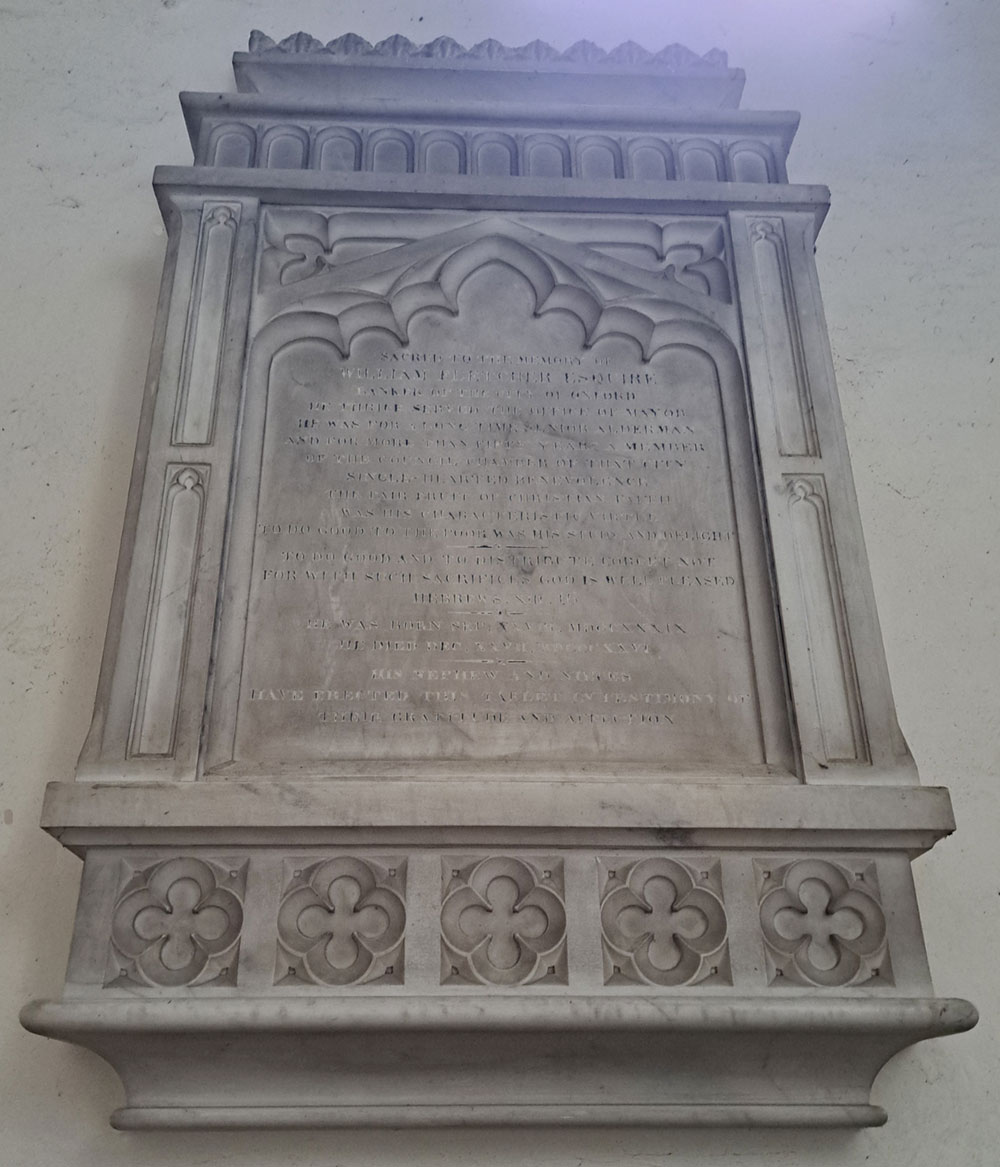
SACRED TO THE MEMORY OF
WILLIAM FLETCHER ESQUIRE
BANKER OF THE CITY OF OXFORD
HE THRICE SERVED THE OFFICE OF MAYOR
HE WAS FOR A LONG TIME SENIOR ALDERMAN
AND FOR MORE THAN FIFTY YEARS A MEMBER
OF THE COUNCIL CHAMBER OF THAT CITY
SINGLE-HEARTED BENEVOLENCE,
THE FAIR TRUTH OF CHRISTIAN FAITH
WAS HIS CHARACTERISTIC VIRTUE
TO DO GOOD TO THE POOR WAS HIS SPUR AND DELIGHT
TO DO GOOD AND TO DISTRIBUTE FORGET NOT
FOR WITH SUCH SACRIFICES GOD IS WELL PLEASED
HEBREWS XIII.16
HE WAS BORN SEP. XXVIII MDCCXXXIX
HE DIED DEC XXVII. MDCCCXXVI
HIS NEPHEW AND NIECES
HAVE ERECTED THIS TABLET IN TESTIMONY OF
THEIR GRATITUDE AND AFFECTION
Obituary
His obituary in the Gentleman's Magazine (reproduced here in The Annual Biography & Obituary for the Year 1828, Vol. 12) read:
FLETCHER, William, Esq. Dec. 27, 1826; at his house, Clarendon [presumably Broad] Street, Oxford, in his 87th year. Mr. Fletcher was senior partner in the Oxford Old Bank, and was a gentleman distinguished in all the relations of life, by the strictest integrity, the soundest judgment, and the most uniform benevolence. The good opinion of his fellow citizens had conferred upon him the Alderman’s gown in 1798, and had placed him three times in the civic chair, in 1782, 1796, and 1809. In his discharge of all these duties, he was at once firm and courteous, combining upon these, as upon all other occasions, the most pacific disposition with the most conscientious adherence to his own principles and opinion; and it is to be remembered, that he had to act in times of great political agitation, and when it was important that a magistrate should be forward to avow, as well as faithful to maintain, the principles of the constitution.
Mr. Fletcher was always among the first to come forward in support of those public measures, which he deemed conducive to the good of his country, and to the stability of its constitution in church and state.
But that which formed the peculiar feature in the character of this upright and amiable member of society, was his benevolence, or rather the considerate nature of his benevolence; to be charitably disposed is one thing, to study how to be charitable in the most serviceable way another: and it was the characteristic of Mr. Fletcher’s charity, to be diligent in finding out what he considered to be the best ways and means of administering to the wants, comforts, and happiness of his fellow creatures. This habit of pondering upon sorrow in its less obvious distresses, and upon poverty in all the little details of its wants, led him to unfrequented paths of kindness, and to modes of charitable donation, which a less studious almoner would never have thought of, and one less strenuous would not have been disposed to undertake and pursue.
But amidst the studies of his benevolence, and the avocations of his business and his duties, Mr. Fletcher found opportunities to pursue, and with considerable success some antiquarian enquiries respecting the counties of Oxford and Berks, having made some interesting collections for the illustration of the topography of those counties. It may be important to add, that they are now in the possession of his nephew, Thomas Robinson, Esq. of the Oxford Old Bank.
The same love of antiquity led him into a line of enquiry which when he entered upon it, was less pursued than it is at present; he made large collections of antient stained, or painted glass, upon a variety of subjects in sacred and profane history, heraldry, and portraiture; and he was as munificent in giving, as he was diligent in collecting and preserving, what had escaped the ravages of time and the fury of fanaticism. Out of these collections, he formed (by a symmetrical arrangement of the several pieces) some large and splendid windows, two of which he presented to the University of Oxford, and placed in the tower of the Picture Gallery; to which, he also contributed original portraits of Mary, Queen of Scots, and Lord Burleigh; other windows he gave to the Curators of the Bodleian; one, entirely composed of the Oseney Abbey glass, to the Dean and Chapter of Christ Church; for which acts of munificence he received the thanks for those learned bodies.
He also presented a suit of windows of painted glass to the church of Yarnton, a village in the vicinity of Oxford, for which, from early recollections, he always felt a strong attachment. It had happened that in his infancy he had been nursed in that village, where he also passed the first year of his childhood, and hence arose that kindness, and those multiplied proofs of it, which that place and its inhabitants ever experience from him. For, besides the gifts of the windows he new pewed and paved, and otherwise improved the church; he also built a substantial stone house for the parish clerk, with a school-room adjoining; every year of his life he used to bestow alms in a variety of ways upon young and old, and he has bequeathed by will several legacies and benefactions to individuals, or for permanent purposes at that place. This force of local attachment and early associations still further showed itself in his desire to be buried there, and in the grave which he had long before prepared for himself in the parish church.
As a man of business, Mr. Fletcher was clear, exact, and punctual. To all within the circle of his acquaintance, friendship, or connection, he was candid, sincere, and kindly affectioned. Mr. Fletcher never having been married, he made his nearest and dearest relations the objects of his paternal regard. But that which completed the character of this Christian philanthropist, was his humility. Wealth, office, high reputation, and universal esteem, were not for a moment able to change the lowliness of his heart; and so precious in his eyes was the garb of humility, that he, who had always worn it so gracefully through life, wished to indicate even after death how much he prized it, by leaving it as his request, that his remains from the hearse to the grave might be borne on the bier, and be covered with the pall of the parish.
Inscriptions remembering Fletcher’s bequests to the poor of Oxford and Yarnton
St Peter-in-the-East Church, Oxford

1827 Alderman Fletcher left 5L annually
to a poor widow of a Freeman of the age of
fifty years or upwards who has resided at
least 12 Months in this Parish previously.
St Bartholomew’s Church, Yarnton
William Fletcher Esqr. Alderman
of the CITY OF OXFORD, by deed Dated Feb. 5
1823, Left a Sum of Money to the Mayor & Cor-
poration of OXFORD for various Purposes,
Amongst others to pay 30L yearly in every Year
on St Thomas’s Day* to the Vicar & Church-
wardens of YARNTON to be by them distrib-
uted every Year as follows.L
10Amongst the Poor Inhabitants in Bread
& Meat on Christmas Day.4
1In Bread of the same
In Cakes for their Children]
]on the 4th of Janry
the day of his Burial.8
To the Parish Clerk for tolling the great
Bell on the 4th of Janry 87 times the num-
ber of Years he lived,2
To the Parish Clerk, as Rent for the
School Room,5
For the Repair of the Clerk’s House if
wanted, if not, for the support of the
School.* St Thomas's Day was 21 December (the shortest day), traditionally a day of charity

See also:
- Jackson’s Oxford Journal, 6 January 1827: Full obituary of Fletcher
- Gentleman’s Magazine, February 1827: obituary of Fletcher by his friend, the Revd Vaughan Thomas of Yarnton
- Annual Biography & Obituary for the Year 1828, Vol. 12, pp. 434–5 (reproducing the article from the Gentleman’s Magazine)
- John Parsons, Mayor in 1788 and 1898 (Fletcher’s banking partner)
- Thomas Robinson, Mayor in 1817 (Fletcher’s nephew and heir)
- L.F. Bradburn, The Old Bank (92 and 93 High Street) Oxford (Oxford, 1977)
- Three portraits of William Fletcher in the National Portrait Gallery entitled “The father of the Corporation of Oxford. Omnibus Carus”. Hand-coloured etchings, published in March 1808 by Robert Dighton (NPG D9446; D13284; and D13448: in archive collection and not on display)
- Brass rubbing (made in 1919) at the Ashmolean Museum of the 1826 monumental brass to William Fletcher at Yarnton Church (ref. Oxfordshire 8/1, not on display)
- Malcolm Graham, Oxford City Apprentices 1697–1800, entry numbered 2093
- Jackson’s Oxford Journal, 30 December 1826, p. 3b: Announcement of Fletcher’s death
- Jackson’s Oxford Journal, 6 January 1827, p. 4b: Obituary of Fletcher
- Museum of Oxford, St Aldate’s: Bust of Fletcher, and three of his “Dance of Death” paintings, showing a skeleton dancing with a lawyer, a physician, and a canon
- Bodleian Library and Yarnton Church for Fletcher’s collection of stained glass
