

The Bear Inn at 123 & 124 High Street
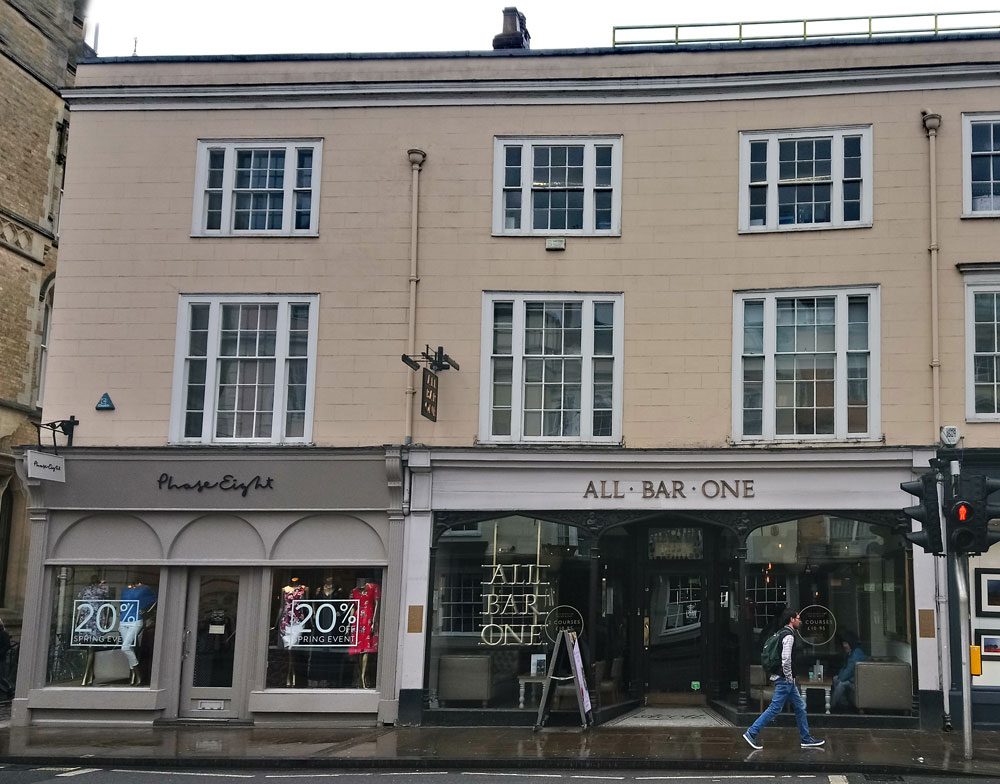
Until 1801 the Bear Inn was at 123 & 124 High Street (above) in All Saints parish on the western corner of Alfred Street: it extended behind for the whole length of that street (which explains why Alfred Street was called Bear Lane in the seventeenth and eighteenth centuries). Coach services via Henley to Holborn in London ran from this inn.
The inn
Brief history of the Bear Inn
Parne Hall originally stood on this site, and was replaced by an inn called Le Tabard in 1421. This was soon renamed the Bear.
By the mid-sixteenth century Royal Commissions and circuit judges regularly met at the Bear Inn.
In 1606 the leaseholder of the Bear Inn was Richard Bryan; in 1623 John Doubey; in 1665 Ralph Flexney; and in 1676 Robert Gilkes.
Anthony Wood records that when the vintner Anthony Hall was elected Mayor in September 1679, he stated in his speech of thanks that “he could not speak French or Spanish, but if they would walk to the Bear they should find that he could speak English” (when ordering his beer).
In 1686 Philip Ashton paid tax on twenty windows at the Bear Inn here at 123/124 High Street. He died in 1697, and the parish burial register for St Michael's Church reads: “Phillip Ashton Inholder att ye Bear In the Parish of Allsaints wass Buryed in this Parish Church Decemr ye 29th.”
In 1703 the innholder was Henry Tash; in 1717 Richard Cobb; and in 1731 Robert Ackerley.
By 1745 the innholder was John Bew. On 28 October 1758 Bew advertised “neat four-wheel'd post chaises and able Horses at nine pence a mile from the Bear Inn to Benson and Nettlebed on the Henley Road to London, and to Tetsworth and Stokenchurch on the Wycombe Road”. Then on 16 February 1760 he advertised Bew's Oxford Machine, which set out from the Bear every Monday, Wednesday, and Friday at 5pm for the Black Bull in Holborn, London, and returned from the latter inn every Tuesday, Thursday, and Saturday at 5pm. Bew still offered post chaises as before, and also to Witney, Burford, Chipping Norton, and Enstone.
By 1765 Bew had given up running the Oxford Machine and Stephen White (who is probably the Stephen White of All Saints parish who married Elizabeth Grimmett at All Saints' Church on 29 February 1772) was running it. As well as providing a regular coach called The Oxford Machine via Henley to London at 6am on three days a week for two shillings, he could also supply a hearse or mourning coach, as this advertisement in Jackson's Oxford Journal of 20 April 1765 shows:

John Bew died in January 1769.
On 3 February 1770 the landlord of the George Inn at Stroud in Gloucestershire advertised the Stroud Water Coach, which offered a twice-weekly service from both Stroud and London to the Bear Inn at Oxford and back.
Stephen White died at the age of 50 on 3 May 1772, and his death notice in the newspaper described him as a coachmaster. His widow Elizabeth White then became the proprietor of his coach service
In 1772 a survey of every house in the city was taken in consequence of the Mileways Act of 1771, and Thomas Brockis then occupied the Bear Inn on the site of 123 and 124 High Street, and its double frontage measured 14 yards 2 feet 4 inches. Elizabeth White (the widow of the previous coachmaster Stephen White) continued to run the coach service from the Bear to London, as this advertisement on 5 August 1780 shows:

On 14 February 1789 Elizabeth White & Co advertised that their post coach with four horses set out from the Bear Inn every morning at 8 o'clock via the Henley Road to the Bull Inn at Holborn (with a return coach leaving the Bull at the same time). The coach stopped at the Old White Horse Cellar in Piccadilly for the convenience of travellers residing in the West End. Mrs White continued to run this coach service from the Bear until early 1794, and she died on 28 October that year.
On 3 January 1784 Thomas Brockis, the landlord of the Bear, announced in Jackson's Oxford Journal that because of ill health he had declined business in favour of his former waiter Thomas Rackstrow.
Rackstrow announced on 9 July 1785 that the inn was “now refitted and new furnished in the most commodious Manner”, and then on 25 July 1789 that he had also enlarged the inn:

On 7 April 1792 Rackstrow went further and said that he had rebuilt the Bear Inn.
On 7 August 1799 Rackstrow inserted the following advertisement, announcing that he had fitted up two rooms in the Bear as a card and dancing assembly:

Rackstrow remained landlord until his retirement in 1800. The following advertisement about the sale of the inn appeared in Jackson's Oxford Journal of 31 May 1800:

The inn did not sell immediately, and the following three auction notices (which give a good picture of this thirty-bedroom coaching inn) appeared in Jackson's Oxford Journal on 28 February 1801:

This time the Bear Inn sold, and it has been divided into two shops (123 and 124 High Street) since 1801. Each is Grade II listed:
- 123 High Street on the left has its own List Entry (1145862)
- 124 High Street has a joint List Entry with the shop to the west, No. 125 (104725)
Although there was a serious fire in these two shops in March 1842, the structure of the inn survives.
The Bear pub
Not to be confused with the Bear Inn above
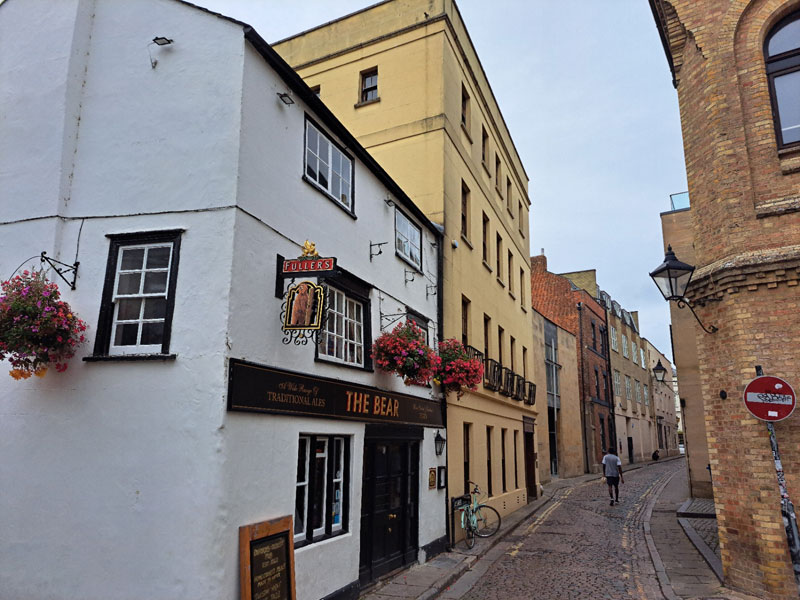
The Bear Public House (above) is at the south end of Alfred Street. This was originally just an ostler's house attached to the back of the Bear Inn at 123/124 High Street. In 1774 it became a pub in its own right called the Jolly Trooper.
It adopted the name of the Bear Inn when the original inn on the High Street closed down in 1801.
It is usually regarded as a pub rather than an inn today, but in the photograph below dating from 1901 (Historic England CC72/02272) it is described as the Bear Inn on the sign:
