

TOUR
141–143 (Carfax House): Black Sheep Coffee

The present large building on the south-east corner of Carfax (above) was erected in 1932 and is owned by Oxford City Council. It is known as Carfax House. It is owned by Oxford City Council, and is included in the list entry for the Grade II* Town Hall (1047153), which states that “the north-west corner of the Town Hall, extending up to the Carfax corner, is an extension of 1932”.

It was built in 1932 as part of a road-widening scheme to round off this busy corner.
It replaced three shops at Nos. 141–143 High Street (plus one at No. 1 St Aldate's street adjoining the Town Hall). These old shops can be seen in the photograph on the left, taken in 1922.
For details of those who leased the former shops at 141 and 142 High Street from 1583 to 1839, see H. E. Salter, Oxford City Properties (Oxford Historical Society, 1926), pp. 141–4.
More old shops on the south-west corner of Carfax were replaced at the same time as part of that road-widening scheme and Marygold House was built on the south-west corner of Carfax.
Following the erection of the large new building, the listings for the High Street in Kelly's Directory stop at No. 140, and Carfax House is listed under the heading of Carfax (along with Marygold House on the south-west corner of the junction).
Former No. 141
At the time of the 1772 Survey of Oxford, No. 141, which had a frontage of eight yards and six inces, was occupied by Mr Cherry.
In the 1820s this shop was occupied by the surgeon & apothecary Stephen Wentworth, who was the medical attendant at both the city and county gaols. He died on 17 December 1831, leaving his widow and nine children unprovided for. His widow took over the business in 1832.
Cruse Horn, “perfumer, hair cutter, manufacturer or ornamental hair in all its devices &c &c” announced in Jackson's Oxford Journal of 8 October 1836 that he had commenced business here in the premises formerly occupied by Mrs Wentworth. In 1839 he was duly listed at No. 141 in Robson's Directory, and the time of the 1841 census he was living upstairs with his wife Elizabeth, their servant, and two lodgers. On 1 January 1842, about five years after opening here, he announced that “in order to lessen his annual expenditure” he had moved to 7 St Aldate's Street.
The chemist Frederick Telfer announced in Jackson's Oxford Journal on 29 November 1845 that he was relocating here from 14 Cornmarket Street.
On 19 June 1847 Mr & Mrs Wells announced that they had moved their Berlin Repository & General Register Office here (from 4 Broad Street), and at the time of the 1851 census the haberdasher Edward Wells (58) and his wife Mary (53) lived upstairs at No. 141 with their two daughters, and a general servant. On 17 July 1858 Edward Wells announced that he had moved from here and was reopening that day at 107 High Street.
The lease of this property was advertised for sale in Jackson’s Oxford Journal of 31 January 1857:
The Central BUSINESS PREMISES,
No.141, HIGH STREET, OXFORD,
(NEAR TO CARFAX CHURCH)
TO BE SOLD BY AUCTION, By Messrs T. MALLAM and SON,At the King’s Arms Inn, Holywell-street, on Tuesday the 10th of February, at Six o’clock,—The PREMISES, No. 141, High-street, one of the best situations in Oxford for business, containing a bow-fronted shop and kitchen on the ground floor, drawing and dining rooms on the first floor, with three bed rooms and two attics above; cellar and offices in the basement.
The Property is held by lease under the City of Oxford for a term of 40 years, from March 25, 1848. Quit Rent, £1 9s.; Land Tax, £2 2s. 2d.; and is now in the occupation of Mr. Wells, Berlin wool dealer, &c.
At the time of the 1861 census this property was occupied by William Denyer, a saddler employing three men and two boys. He died here on 13 December 1869, and in 1871 his widow Susannah was still here. No one lived over this shop at the time of the 1881, 1891, 1901, and 1911 censuses.
Former No. 142
At the time of the 1772 Survey of Oxford, No. 142, which had a frontage of four yards and eleven inches, was occupied by Mr Douglass.
This was a confectioner's shop from at least 1836 to 1890. The Horn family ran it until 1860, and the 1841 census shows the baker Richard Horn living here with an assistant. Richard Horn died in 1844 at the age of 35, and the business was then run jointly by Edward Horn (b.1820) and his mother Catherine Horn, who had another confectioner's shop at 15 Cornmarket. .
At the time of the 1851 census Edward Horn and his mother were still living at 15 Cornmarket, and the shop here at 142 High Street was occupied by Elizabeth Bolton (35), a widowed confectioner, and her two children, plus a general servant, and a lodger.
Edward Horn inserted the following advertisement in Jackson's Oxford Journal on 31 October 1857:
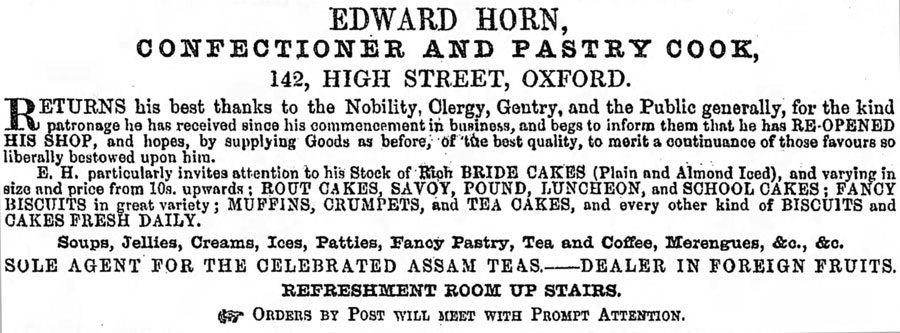
On 9 October 1858 Charles Gee announced in Jackson's Oxford Journal that he supplied Edward Horn with his Oxford sausages, and they could be had cooked here at No.142 or delivered to any part of Oxford at short notice (presumably orders were sent in via the newly-introduced postal service).
At the time of the 1861 census Edward Horn, described as a a confectioner employing two boys, now lived over this shop at No. 142, and he was still listed here at the time of the 1871 census. In 1877 he married Rosetta Deacon, who was 25 years his junior, and he can be seen living here with her in the 1881 and 1891 censuses.
Soon after 1891 the Lion Brewery (Morrell's) opened a town office here where people could place orders for casks or bottled beers (minimum twelve bottles), and it was connected to the brewery by private telephone. The 1901 census shows the premises were occupied by two offices (Morrell's Brewery and the University Typewriting Office, and Joseph J. Giles (32), who was an engine & machine fitter in a brewery, lived here with his wife Bertha. No one lived over the office in 1911.
Former No. 143 (the original and much smaller Carfax House)
At the time of the 1772 Survey of Oxford, No. 143, which had a frontage to the High Steet of eight yards and six inches, was occupied by Mr Dewe.
In an advertisement in Jackson's Oxford Journal on 26 April 1788, Thomas Hardy, mercer, draper, haberdasher, and hosier, advertised his new spring collection as being available “at his Corner Shop, on Carfax”.
In Jackson's Oxford Journal on 5 November 1831 Mr Meadows described the goods he had for sale "at his Warehouse, corner of the High-Street”, including furs, Saxony cloths, meriones, gauze, silks, Welsh flannels, rugs, carpeting, table linen, and hosiery.
Alexander Morison was the linen draper & mercer here by 1836. The 1841 census shows him living here with an assistant and two servants, plus two lodgers.
On 10 May 1845 Castle & Sweetman announced that on the following Wednesday they would be opening a “linen drapery, hosiery, &c.” here at Carfax House, having taken over the business of Mr Morison. They boasted that they obtained their stock from the best London and Manchester markets, and offered “an entire new stock of drapery goods, shawls, dresses, hosiery, gloves, lace, ribbons, flowers, stays, &c. &c.”
The 1851 census shows the draper William Castle living over No. 143 with his sister, three draper’s assistants, and a housemaid.
By the time of the 1861 census another draper, George Fisher, lived here with his family and a draper’s assistant and a draper’s apprentice.
On 27 April 1867 an advertisement for the forthcoming auction of Carfax House in Jackson's Oxford Journal provided the following description:
Lot 1.—“CARFAX HOUSE,” in the occupation of Mr. Fisher, draper, with a street frontage of about 50 feet. The ground floor is occupied as shop and private entrance; on the floors above are eight rooms used as sitting rooms, bed chambers, and ware rooms; in the basement are the servants' offices. This is a corner House, and in one of the most important positions for business in the whole City.
George Fisher continued to occupy Carfax House. At the time of the 1871 census he was away, but his brother James Fisher, who was his assistant, was in the house.
The 1881 census shows the linen draper William Williams living here with his wife, two draper’s assistants, one draper’s apprentice, and a domestic servant. One of these draper's assistants was Frederic Wyatt, who in 1890 had taken over the business, apparently in partnership with someone called Jackson. The 1891 census shows Wyatt (38), described as a draper and an employer, living over his shop with his wife Jessie and four children plus two servants, and boarding with them were three young male draper's assistants.
By 1901 Frederic Wyatt had moved to 197 Iffley Road, and the 1901 census shows Annie Targeth (30), described as a housekeeper, living over his drapery business with two draper's assistants boarding with her, plus a general servant. By the time of the 1911 census the widow Elizabeth Stringer (53) was the housekeeper here, living in six rooms over the shop with two drapery assistants.
Wyatt & Sons continued here until the shop was demolished in 1932, and then took over the brand-new, much larger Carfax House.
Occupiers of 141, 142, & 143 High Street | |||
Date |
141 High Street |
142 High Street |
143 High Street |
Prior to |
Stephen Wentworth,Surgeon & Apothecary, then Mrs Wentworth (1832–1836) Cruse Horn, Hairdresser (1836–1841) |
Richard Horn Edward Horn from 1844 |
Alexander Morison |
1845–1846+ |
Frederick Telfer John Norman Spencer |
Castle & Sweetman | |
By 1851–1857 |
Edward Wells |
William Castle | |
1861–1890 |
William Denyer |
George Fisher | |
1891–1932 |
Henry Andrews (later H. & E. Andrews) Colin Lunn Shoes Limited Lennards Ltd |
Morrell’s (Trustees) Lion Brewery Great Western Railway Co. |
Wyatt & Jackson |
Rebuilt 1932 |
Carfax House |
||
1933–1954 |
Wyatt & Sons, drapers |
||
1956–1980+ |
Chanelle, gowns | ||
1986–2022 |
Edinburgh Woollen Mill | ||
2023– |
Black Sheep Coffee |
||
