

Richard Bradgate, Apothecary (c.1695–1728/9)
Richard Bradgate was born in c.1695. He had an older brother Gervis Bradgate, born in c.1680, who was matriculated at the University of Oxford by Lincoln College on 11 April 1695, and Gervis's matriculation record establishes that the father of Gervis and Richard was Gervis Bradgate senior, a gentleman living at that time in Guilsborough, Northants. Hence Richard is probably Richard Bradgate, the son of Jervis and Ann Bradgate, who was baptised on 23 April 1695 at Peatling Magna, Leicester. He also had a sister, later Mrs Howard.
Richard's brother Gervis Bradgate remained in Oxford after gaining his MA and was awarded the degree of Bachelor of Divinity in 1711. He died in 1713/14, and a transcription of his will is here. He left his “my loveing brother Richard Bradgate and his heires for ever all that my coppyhold Estate of inheritance situate lyeing and being in Bladon”, as well as the bulk of his goods and chattels. He also made Richard his sole executor, but with trustees appointed to take on this task if his death took place before Richard reached the age of 25 (which it did). He allowed Richard £15 a year until he had served his apprenticeship, which would have ended in about 1715, and then £300 to set him up in a trade or profession.
On 29 January 1716/17 at St Bartholomew-by-the-Exchange Church in the city of London, Richard Bradgate of the parish of St Peter-in-the-East in Oxford married Elizabeth Matthews of the parish of St Mary the Virgin in Oxford, and they evidently returned to Oxford.
Bradgate had to be matriculated as a privileged person in order to be allowed to work in the city of Oxford as an apothecary for the University, and Alumni Oxonienses shows this duly took place on 17 March 1717/18.
His daughter Elizabeth Bradgate was baptised at St Peter-in-the-East Church on 2 January 1718/19.
He did not remain an apothecary for long, however, as on 14 May 1719 he was matriculated again, this time as a vinter, and he took over the Three Tuns Tavern, which was owned by University College and stood at the extreme west end of that college, opposite All Souls College. The drawing below by William Turner of Oxford (Historic England HT00106) shows the Three Tuns tavern (which was latterly a shop) shortly before it was demolished by University College in 1842:
There is more information about the Three Tuns Tavern and the building it occupied here. A photograph of an onion bottle with Richard Bradgate’s seal (from the Alan Blakeman catalogue) can be seen here on Traci Muller Rylands’ Facebook blog.
Richard and his wife Elizabeth had two children baptised in St Mary the Virgin Church: Richard Bradgate junior on 31 July 1722 and Ann Bradgate on 14 April 1724. They had another son, Charles Bradgate, who was born in about 1725 but no baptism can be found. He died on 8 August 1728 at the age of three and was buried at St Mary the Virgin Church the next day.
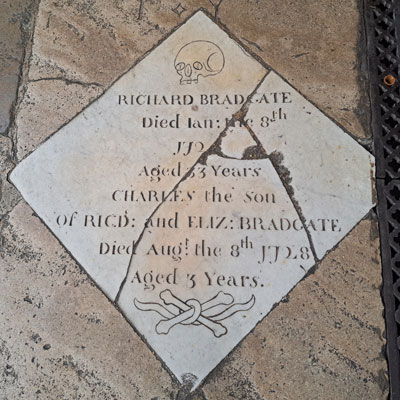
Richard Bradgate himself died at the age of 33 on 8 January 1728/9 and was buried inside the Church of St Mary the Virgin two days later.
He had signed his Will nearly ten years earlier on 23 May 1719, when he still described himself as an apothecary. It was proved in Chancellor’s Court on 15 January 1729 and is available from the National Archives (PROB 11/627/305), and a transcription is here.
He left of the estate at Bladon that he had inherited from his brother to his wife, and the other half to any children they might have. He also left his wife the leasehold messuage or tenement that he held from Magdalen College in the parish of St Peter-in-the-East.
Thomas Hearne wrote in his diary on 9 January 1729: “Yesterday morning ... died suddenly Mr. Bradgate, keeper of the Three Tuns Tavern in High St., Oxford, a man of about 37 years of age, who hath had the tavern about 10 years.” He went on to say that Bradgate “was by trade an apothecary, but leaving off that business, he took the said Tavern, having married one Mrs. Elizabeth Matthews, who is now about 30 years of age”, and that she was “a fine, stately, beautifull, large young Woman, but very proud & empty of sense, as her husband also was, and a great Company Keeper”.
Richard Bradgate's widow and surviving son
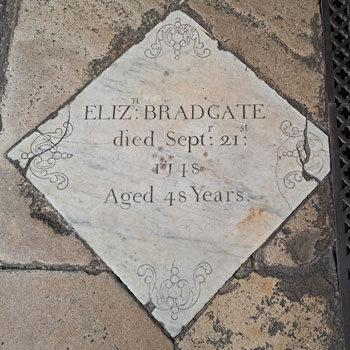
Elizabeth Bradgate continued to run the Three Tuns Tavern for 19 years until she died on 21 September 1748 at the age of 48. She was buried inside St Mary the Virgin Church three days later.
Their son Richard Bradgate junior (born 1722) then took over the tavern. He was admitted free and appointed City Solicitor in April 1748 and City Coroner in October 1748, coming on to the city council as Chamberlain in 1749.
He was described as being of St Peter-in-the-East parish when on 31 March 1752 he married Elizabeth King at St John the Baptist (Merton College) Church. They had two children baptised at St Peter-in-the-East Church: Anne Bradgate on 13 June 1753 and Richard King Bradgate on 23 September 1755.
Richard Bradgate junior continued to run the tavern for 16 years until he died on 26 September 1764. He was buried at St Mary the Virgin Church on 29 September, and on that day Jackson's Oxford Journal announced:
On Wednesday Morning last died here, of a Dropsical Disorder, Mr. Richard Bradgate, Attorney at Law; by whose Death the Offices of Sollicitor and Coroner for this City are become vacant.