

University and City coats of arms and mottoes
The coat of arms of the University (with the motto “Dominus illuminatio mea") and of the City (with the motto “Fortis est veritas”) can be seen in numerous places throughout Oxford, so (apart from the city arms which appear on all boundary stones set up by the city) only one example of each has been given on this website, namely:
- The city arms at Headington Hill Park
- The university arms on the Clarendon Press Institute in Walton Street.
This page only shows examples of the two coats of arms where they appear together.
Carfax Conduit (1617)
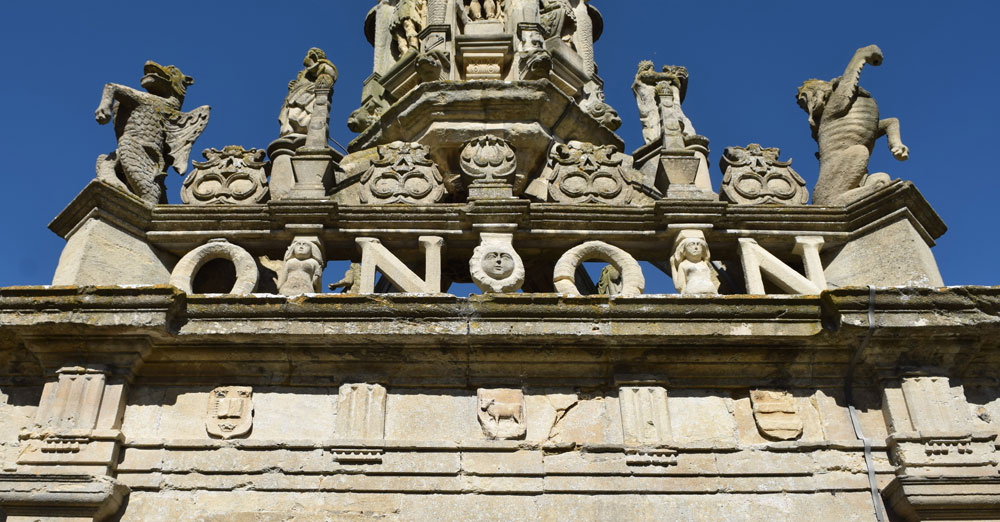
The water conduit that stood at Carfax from 1617 to 1787 bears three coats of arms, shown above: those of the University of Oxford, the City of Oxford, and Otho Nicholson. (Nicholson was a graduate of Christ Church who had the idea for the conduit and paid for it, and his initials O N can also be see repeated above.)
It was a joint town and gown venture: the conduit belonged to the University, but the City allowed as much space for it at Carfax as could be spared, for which the University paid a fee of a shilling a year.
The upper part of the pipe from the cistern on Hinksey Hill supplied various colleges, and the lower part the city
The conduit was moved out of the way to Nuneham Courtenay in 1787 to make more room for traffic at Carfax. A full history of the conduit can be seen here.
Oxford Local Board (under the jurisdiction of both town and gown): 1865–1889
In 1865 the Local Board of Health succeeded the earlier Paving Commission that had been set up in 1771. This new board included members of both the University and the City, and supervised the paving, cleansing, lighting, and general improvement of the city, with the result that even lampposts started to sport the university and city coats of arms side by side.
The Public Health Act of 1875 amended the membership of the Board thus:
Constitution of local board of the Oxford district
The local government district of Oxford shall be subject to the jurisdiction of a local board consisting of the vice-chancellor of the University of Oxford and the mayor of Oxford for the time being, of forty-five other members, fifteen to be elected by the university of Oxford, sixteen by the town council of Oxford, and fourteen by the ratepayers of the parishes situated within the area formerly within the jurisdiction of the commissioners, for amending certain mileways leading to Oxford, and making improvements in the university and city of Oxford, the suburbs thereof and the adjoining parish of Saint Clement, and of the members for any parishes or parts of parishes which may have been or may hereafter be added to the Oxford district.
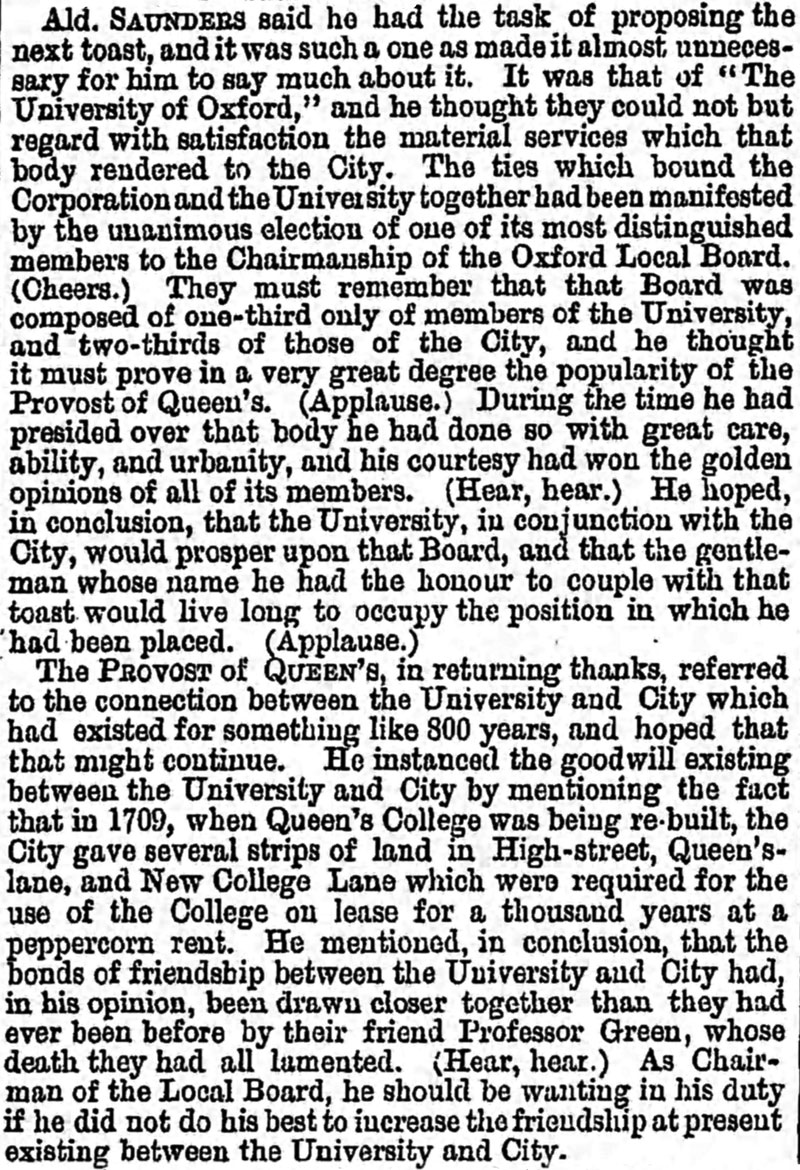
This speech by Alderman Jason Saunders published in Jackson's Oxford Journal on 21 October 1882 shows how the Local Board helped the co-operation of Town and Gown:
In 1882–3 the Oxford Local Board widened Magdalen Bridge by 20 feet on the south-west side and rebuilt both parapets (see inscription on the side of the bridge).
This Boundary map of the City of Oxford in 1883 produced by the Local Board shows that in the south-east of the city their jurisdiction extended beyond the city boundary, which is marked in sepia. The pink line marks the end of their jurisdiction, so although streets like Bullingdon Road and Magdalen Road were outside the city in 1883, they still came under the Local Board.
In 1885 it replaced the level crossing at Port Meadow with a bridge spanning the railway (described in Jackson's Oxford Journal of 17 October 1885).
The Board was abolished in 1889 when Oxford became a county borough and its powers were transferred to the corporation.
Lampposts (1860s–1889)
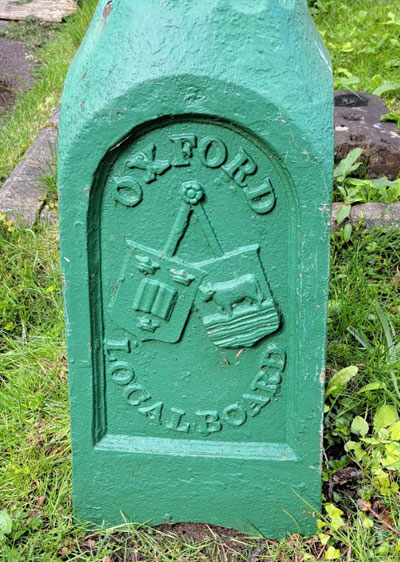
Some of the earlier Oxford lampposts dating from 1865 to 1889 have the university arms on the left and the city arms on the right. They were made by Dean & Son of Oxford and are inscribed OXFORD LOCAL BOARD,
The example shown here is in St Clement's churchyard.
Old Headington has a number of these Local Board lampposts, but they are recent imports, as prior to 1929 Headington was outside the city and was hence not under the jurisdiction of the Local Board.
Most old lampposts in the city of Oxford (such as the ones on Magdalen Bridge) bear only the city arms, which means that they date from after 1889.
.Oxford Boys' High School, George Street (1881)

This school, which opened in 1881, was a joint venture by town and gown, promoted by Professor Thomas Hill Green, White's Professor of Moral Philosophy and the first university member to serve on Oxford City Council. Hence the mottoes DOMINUS ILLUMINATIO MEA on one side of this window, and FORTIS EST VERITAS on the other, but not the actual coats of arms.
Wilberforce Temperance Hotel, 33, 34, and 35 Queen Street (1888)
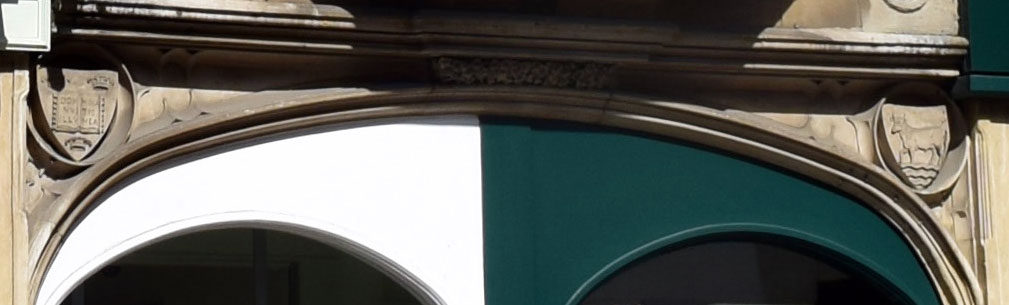
The arms of the University and the City appear over the central entrance on the ground floor and again on the left and right gables at the top: see whole building here.
Osney Bridge (1888)
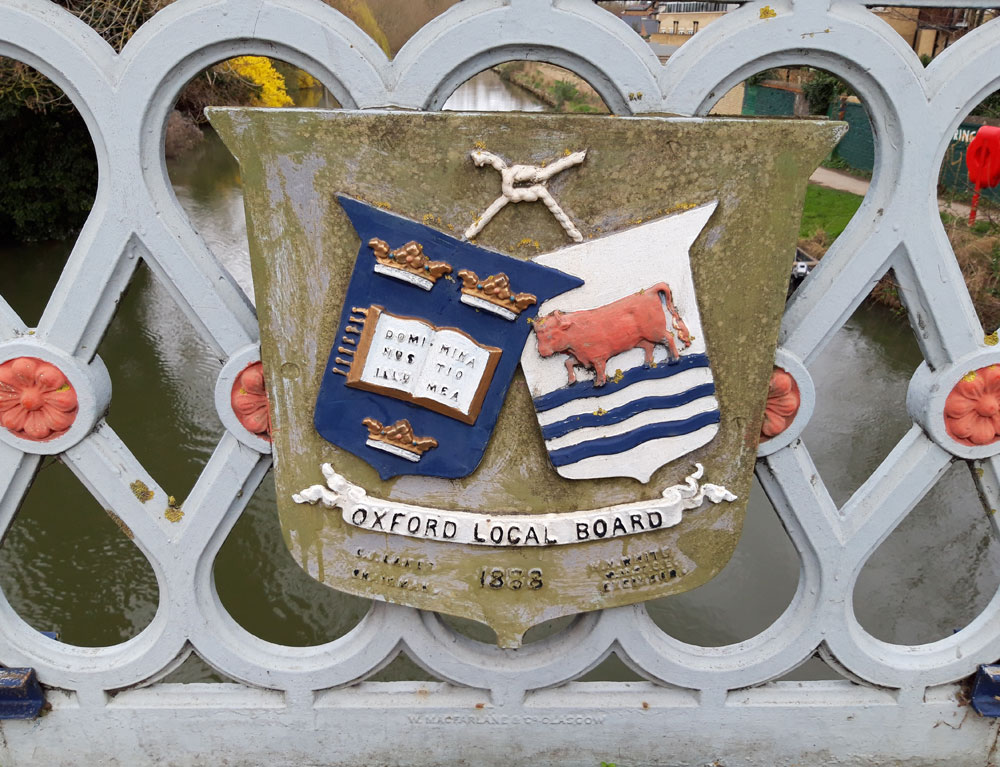
Osney Bridge bears the arms of the University and the City above the words OXFORD LOCAL BOARD. Beneath that is the date 1888 with C. J. LAKER / CHAIRMAN to the left and W. H. WHITE / M.INST.C.E. / ENGINEER to the right. (Charles J. Laker was a wine & spirit merchant at 69 High Street, and William H. White, who lived at 8 St Margaret's Road, was the City Engineer.)
This important bridge carries the Botley Road over the River Thames just to the east of Osney Island. A large portion of the central arch of the original old turnpike bridge collapsed on 2 December 1885 (see Jackson's Oxford Journal of 5 December 1885). Initially coaches and carts to and from Botley had to do a huge detour via Wolvercote.
It was unclear who was responsible for replacing the bridge, and the Oxford Local Board sought the Opinion of Counsel and were advised in June 1886 that the County of Oxford, and not the City or Local Board, was liable for the bridge A legal dispute dragged on for the next two years, and a temporary bridge was provided between East Street and Russell Street in Osney.
In the end the Oxford Local Board gave in and erected the bridge, which cost about £4,000. Its ironwork was built by the Horseley Ironworks Company of Tipton, Staffordshire. It was officially opened in January 1889, just over three years after the collapse of the previous bridge. Later that year Oxford was to become a county borough.
For a detailed description of this bridge, see Jackson's Oxford Journal of 12 January 1889. It is the lowest of the 76 bridges on the non-tidal section of the River Thames, with a height (headway) of only 2.28m (7'5").
Oxford War Memorial, St Giles (1921)
The war memorial in St Giles was erected in 1921 by Oxford City Council on a piece of land in front of St Giles's Church that was donated by St John's College. It remembers all those from the City and University who died.

This memorial has the arms of the City on the side of the octagon to the left of the main inscription, and those of the University to the right.

Town buildings that are now Gown
On the right is the tower of the Central Girls' School in New Inn Hall Street, showing the weather vane that can be seen on the plans of 1900.

The school was erected by the Oxford School Board, so the city emblem of an ox crossing a ford was very appropriate. Today, however, the former school is part of St Peter's College and is now Gown rather than Town.
Firms which use both city and university arms
It has always been in the interests of businesses and organizations to court both town and gown. In the 1920s the Oxford Varsity & City company produced postcards bearing both the university and city coats of arms (below):


Hoggar's map of Oxford of 1850, whose cover is shown on the right, is dedicated “To the Chancellor, Masters & Scholars of the University and the Mayor, Aldermen and Citizens of the City of Oxford”.
The Town & Gown restaurant operated from 135 High Street from the 1920s to the 1970s. There was also a firm called Town & Gown Lettings.
Today we have the Town & Gown fun run each year.
St Frideswide is the patron saint of the City, University, and Diocese of Oxford