

Oxford Inscriptions: Boyle & Hooke

In a house on this site
between 1655 and 1668 lived
ROBERT BOYLE
Here he discovered BOYLE’S LAW
and made experiments with an
AIR PUMP designed by his assistant
ROBERT HOOKE
Inventor Scientist and Architect
who made a MICROSCOPE
and thereby first identified
the LIVING CELL
This plaque is on the wall that joins the old part of University College on the left to the new part on the right. The Shelley Memorial now stands on the site of Boyle's house.
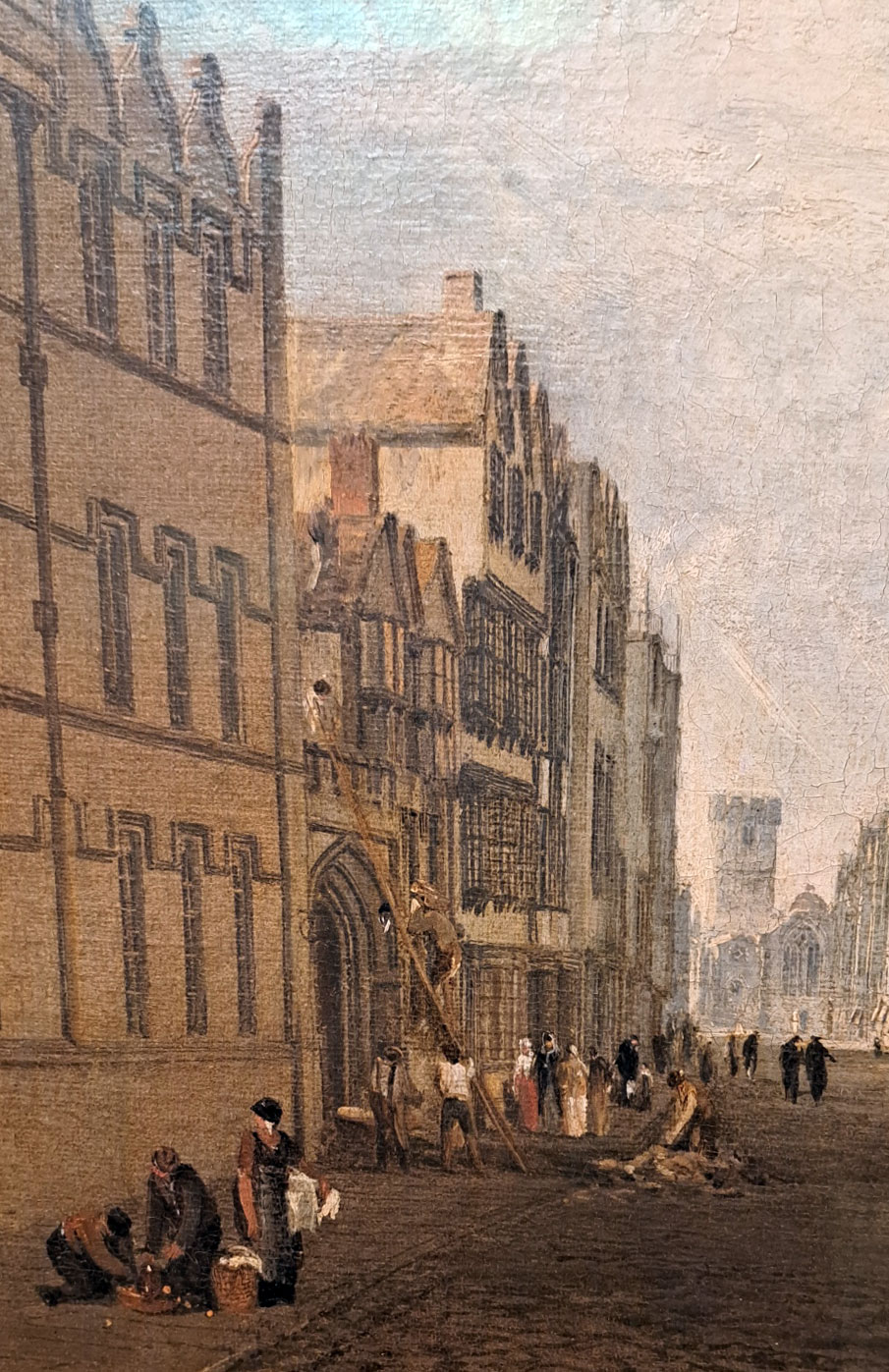
The detail below from J. M. W. Turner's painting of Oxford's High Street in 1809/10 shows workmen preparing to demolish Deep Hall where Boyle had his home and laboratory:
Anthony Wood wrote:
1659: The Royall Societie at Oxon, and of Chemistry. They did in Clerk's house, an apothecary in St. Marie's parish [John Clerk or Clarke, at 106/107 High Street], exercise themselves in some chimicall extracts, which were carried on and much improved before the king's restauration [1660], in so much that severall scholars had privat elaboratories and did performe those things which the memory of man could not reach. But the one man that did publickly teach it to the scholars was one Peter Sthael, borne at Strasburgh in Royall Prussia, brought to Oxon by that eminent scholar Mr. Robert Boyle a sojourner in the University anno 1659, and by him setled in the same house wherin he lived viz. in that house (owned then by an apothecary) next on the west side of University coll. somtimes known by the name of Deep hall.
On 23 April 1663 Wood repeated that Sthael was brought to Oxford by Robert Boyle in 1659, and that “he began to take to him scholars in the house of John Cross, next, on the west side, to University Coll. [Deep Hall].... After he had taken in another class of six there, he translated himself to the house of Arthur Tylliard, an apothecary, the next dore to that of John Cross, saving one (which is a taverne); where he continued teaching till the latter end of 1662.”
In 1662 Boyle discovered what became known as Boyle's Law on this site. He also experimented with an air pump (vacuum chamber) designed by his assistant Robert Hooke and showed how it was possible to create a vacuum. On 8 September 1665 he was created a Doctor of Physic by the University. He moved to London in 1668.
A famous painting of the High by J. M. W. Turner dating from 1809/10 shows Deep Hall being demolished. The part of University College on its site now houses the Shelley Memorial.
See the lecture by Dr Alessia Pannese: “Intravenous anaesthesia on Turner's High Street”
Wikipedia: Robert Boyle and Robert Hooke
T. D. Whittet: “Some Oxford apothecaries”, Journal of the Royal Society of Medicine, Vol. 72 (December 1979)