


Below: the houses each side of Mansfield Road in 1900 (Historic England CC72/01916):
The present Mansfield Road is on the site of a pair of attached houses at Nos. 22 and 23 Holywell Street and also swallowed Brazier's Yard to the west and Park Place to the east. These two houses on Holywell Street had no back gardens and the first houses of Brazier's Yard and Park Place were attached to them at the back.
Photograph showing the entrance to Park Place in 1885
The site of Mansfield Road, looking south in 1890
(Park Place is not the same as Park Passage, which also ran off the north side of Holywell Street,
although sometimes Park Place was confusingly described as Park Passage.)
An advertisement for the forthcoming auction of 23 Holywell Street was published in Jackson's Oxford Journal on 19 August 1837:
A very desirable MESSUAGE or DWELLING HOUSE, situate on the north side of Holywell-street, Oxford, (No. 23), now in the occupation of Mr. Glibbery, last-maker, with a large garden at the back part thereof, and an entrance thereto from the public foot path leading to the Parks. Also a piece of Garden Ground, lying on the other side of the foot path, now occupied by Mr. Stone; and a Right of Common in Holywell Field.—This lot is held by lease under the Warden and Scholars of Merton College, in Oxford, for the term of 40 years, commencing on the 5th of April, 1837.
In 1841 Park Place was known as Pinfold’s Yard and presumably belonged to John Pinfold, the Holywell butcher. Pinfold was still farming in Holywell as late as 1840.
Hunt's Directory of 1846 lists Park Place between Nos. 21 & 22 Holywell Street and the only occupant was the carpenter T. Henneford Gilder.
On 27 August 1864 a sale was announced of a forthcoming auction of property in Oxford by the Trustees of Mr William Fletcher, deceased that included “Eight cottages and Four Gardens in Holywell-street, known as Park Place”.
The extract below from the 1876 Street Plan of Oxford shows the area that was soon to be obliterated by Mansfield Road.

On 21 December 1885 the Spring Hill Nonconformist Theological College in Birmingham, which had decided to relocate to Oxford, agreed to pay Merton College £3,000 for the site of their new hall (the present Mansfield College), plus £300 for the cost of building a road through the site leading from South Parks Road to Holywell Street.
Love Lane ran westwards from the present St Cross Road and then turned north up to the University Parks. It was also possible to turn southwards and reach Holywell Street via Park Place. This lane was lost and altered by the creation of Mansfield Road:
Work on the present Mansfield College began in April 1887, and while waiting for their new premises to be built, the theological hall, which had now been renamed Mansfield College, operated in two rooms in 90 High Street from 1886 to 1888, but the five graduate students studying there had to find their own accommodation..
On 10 July 1886 Jackson's Oxford Journal reported:
The [General Purposes] Committee recommend that the new road leading from South Parks Road to Holywell be named “Mansfield Road,” as suggested by Merton College, the owners.
Kerbing and channelling were complete by October 1886, and substantial progress towards completion of the north part of Mansfield Road had been made by October 1887. This provided access from South Parks Road for for the erection of the main new building n 1887–7.
Jackson’s Oxford Journal of 11 October 1890 reported:
The College has purchased from Merton College land between Holywell-street and the field road known as Love-lane, but which is presently to be laid out as a wide street. The projected Mansfield-road from Holywell-street past the Mansfield College Estate gives frontage to the new buildings.
In 1893 Manchester New College (now Harris Manchester College) moved to its present site in more new buildings on Mansfield Road. By that year the road had been extended south to Holywell Street, which necessitated some demolition there, running from east to west as follows:
- The wide entrance to Park Place that ran to the west of the present 20 Holywell Street,
and its eight houses - Nos 22 & 23 Holywell Street (the latter also known as 1 Park Place)
- The narrow passageway called Brazier's Yard that ran between Nos. 23 and 24 Holywell Street, and the houses on the east side of Brazier's Yard (behind 23 Holywell Street and back-to-back with the houses on the west side of Park Place).
On 14 October 1893 Jackson's Oxford Journal reported :
The southern end of Mansfield-road has been made, thus completing the new thoroughfare from South Parks-road to Holywell-street. The first portion of Savile-road, on the line of the old footpath known as Love-lane, from Mansfield-road towards Wadham Gardens has been made.
The southern part of Mansfield Road provided also access to a second new college, Manchester College (now Harris Manchester College), which was built in 1891–3 on vacant land behind 24 and 28 Holywell Street .
The development of Savile Road and the demolition of Park Place (now part of Mansfield Road) were opposed by the ratepayers of Holywell, who denied that Savile Road was needed. At a Vestry meeting on 26 January 1894 the following “memorial” was drawn up for presentation to the city council:
We, the ratepayers of the Parish of Holywell in Vestry … beg leave to submit as follows…. That the said footpath (Love Lane) affords a short and convenient means of access to Church Street [now St Cross Road] and Long Wall Street, from the north end of the Parish…. That the proposed new carriage road is not really needed for public purposes … the improvement would be dearly purchased if it entailed the removal from the Parish of several of its poorer families…. We believe that the unconditional assent of the Council to the closing of Park Passage [i.e. Park Place] would favour the further demolition of buildings and the removal of their occupants to distant parts of Oxford…. We therefore respectfully urge that the assent of the Council should be given conditionally as follows:— … The closing of Park Passage (if at all) to take place subject to a provision for the erection at or near that spot of dwellings suitable to the means of working class tenants….
The modified scheme was approved by the council on 7 March 1894, and Jackson’s Oxford Journal reported:
As to the improvement itself no-one, we think, can entertain any doubt; it will substitute a wide well planted and handsome road in the place of Love Lane, which is only eight feet wide, unlighted and bordered by a hideous wire palisade….
The full Order for “the Closing and Stopping-up of a certain Highway or Lane known as LOVE LANE, and of a portion of a certain Highway or Passage known as PARK PASSAGE, both situate in the Parish of Holywell, in the City of Oxford” can be seen in Jackson's Oxford Journal on 14 April 1894 (p. 1).
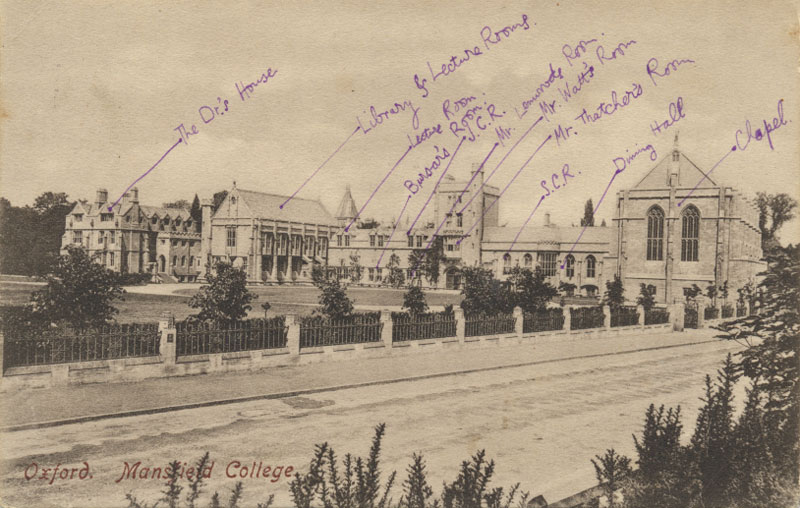 Postcard showing Mansfield College, after which Mansfield Road was named,
annotated by and sent by Reginald (Rex) Frost to his sister on 22 October 1906
No. 22
1841
The 1841 census for Holywell does not give house numbers, but it is possible to deduce where people listed that year lived by examining directory entries between 1839 and 1842 and later censuses
William Pratley (40), a college servant who worked as a groom, lived here with Mary (35) and William (4), Elizabeth (5), Mary (2), and Catherine (two months). The family had two lodgers.
1851
The house is described as “Holywell Street No. 22 or Park Place No. 1, suggesting that its entrance was at the side. It was occupied by Elizabeth Molyneux (40), the wife of John Molyneux, porter at Brasenose College, and their children John (19), Arthur (16), Elizabeth (14), William (12), Matthew (10), Mary Ann (6), and Louisa (4).
1861
John Molyneux (58) still lived here with his wife Elizabeth (50) and their children William (21) and Matthew (20), who were both hosier’s assistants, and Mary (16) and Louisa (14), who were respectively a dressmaker and a scholar. He died here on 9 June 1862, after being a servant of Brasenose College for over 40 years.
1871
[The house normally numbered 21A is recorded as 22 Holywell Street in this census]
1881
William Price (65), a boot closer, lived here with his wife Eliza (49) and his daughter Eliza (19). They had four lodgers: a dressmaker, a college bedmaker, a college butler’s assistant, and a cordwainer.
1891
Charles Stapleton (57), a bootmaker, lived here with his wife Ann (53) and their children Kate (20), Albert (15), who was a bootmaker's apprentice, and Eva (12). Lodging in one room in the house were John Rogers (41), a gardener, George Roberts (21), a plumber, and Arthur Payne (17), a groom.
No. 22 Holywell Street was demolished soon after the 1891 census to make way for Mansfield Road
Park Place
Sometimes houses appear to be treated as one, and sometimes as two, and hence six, seven, or eight houses were listed here between 1841 and 1891:
1841 (then known as Pinfold’s Yard)
Mary Baker (65), a laundress, is listed first with George Baker (25), who was a carver & gilder; Elizabeth Baker (25), who was a laundress; and Mary Ann Baker (20).
Possibly 3 Park Place (see 1851):
Henry Osborne (30), a painter, lived here with his wife Sarah (25) and daughter Sarah (3). A shoemaker called William Price (who was at 2 Park Place in 1851) lodged with them.Sarah Poole (65), a laundress, lived here with Eliza Poole (16) and one female servant.
Elizabeth Molyneaux (30), who is described as a college servant (but this may refer to her absent husband, John, who was a servant at Brasenose College) lived here with John (9), Arthur (7), Elizabeth (4), William (2), and Matthew (four months). A lodger and a 13-year-old servant girl lived with them. (This may in fact be 22 Holywell Street: see above.)
Possibly 4 Park Place (see 1851):
Ann Hutton (40) lived here with her 13-year-old servant girl Rowena Poole.Thomas Hanneford Gilder (60), a carpenter, lived here with what appears to be his four grown-up children: Richard (25), who was a printer; Edwin (20), who was a joiner; Margaret (20), who was a dressmaker; and Thirsa (15). Gilder, who had set up business in Holywell in 1809, was the only person listed in Park Place in Hunt’s 1846 directory.
Possibly 7 Park Place (see 1851):
Thomas Kinch (40), an agricultural labourer, lived here with Susannah (40), Jane (8), Edward (3), and Ellen (6 months).
George George (20), a male servant, appears to be listed in the same house as the Kinches. He was here with Ann (20), and a second family: Sarah Hedges (50) with Rachael (20), John (15), Thomas (13), and Rosetta (11).
1851: Park Place
No. 1: See No. 22 Holywell Street above.
No. 2: William Price (35), a boot closer, lived here with his wife Mary (32), who was a laundress, and their daughter Sylvia (10 months). Also living with them were his niece Mary (21) and widowed mother Mary Baker (77), both of whom were also laundresses.
No. 3: Henry Osborne (43), a painter, lived here with his wife Sarah (39), who was a laundress, and their children Sarah (13), Jane (11), Martha (8), Henry (6), and Harriet (4).
No. 4: Ann Hutton (51), a widowed laundress, lived here with her servant.
No. 5: Susannah Pool (51), a widowed laundress, lived here with her daughter Susannah (14). In the same house was Benjamin Whitlock (47), who was a coachman, his wife Rebecca (45), and his nephew William Wellington (4).
No. 6: William Gawthorn (57), a widowed tailor, lived here with his daughter Emily (16) and his unmarried sister-in-law Mary Hounslow (57), who was a schoolmistress.
No. 7: Thomas Kench (50), a gardener’s labourer, lived here with his wife Susan (50) and their children Jane (18), George (15), Edward (11), and Helen (9). There were two other households in this dwelling: James Blay (30), an unmarried college servant, and his sister Elizabeth (34), a cook; and Henry Cox (69), an annuitant.
No. 8: George Jones (38), a college servant at The Queen's College, lived here with his wife Ursula (43) and their children George (10), William (8), John (6), Charles (4), and Ellen (2), and their niece Martha Osborne (13).
1861: Park Place
No. 1: Jane Burrows (45), a widowed mangler, lived here with her children Jane (12) and Joseph (9), her aunt Mary Hurley (a widow of 83) and two lodgers (a college servant and a house painter).
No. 2: Henry Osborne (53), a house painter, lived here with his wife Sarah (49) and daughters Sarah (22) and Martha (18), all of whom were laundresses; his son Henry 16, who was a printer compositor; his three younger children Harriet (14), William (9), and Eliza (6), who were all at school; and his granddaughter Emma Osborne (1).
No. 3: Ann Fletcher (63), a widowed laundress, lived here with her servant Martha Hunt (31).
No. 4: Susannah Poole (a widow of 60) lived here with her daughter Susan (24): both were laundresses.
No. 5: Jane Norton (40), a widowed seamstress, lived here with her son George (13), who was at school.
No. 6: John James (52), a servant, lived here with his wife Christina (42) and his children Thomas (17), who was a printer compositor, and Amanda (13) and William (8), who were at school. (John James was described as a coachman of 7 Park Place in the announcement of his death on 4 February 1870, and his son lived at No. 7 in 1870
No. 7: George Jones (48), a college servant, lived here with his wife Ursula (53) and his children George (19), who was a servant; William (17), who was a printer compositor; John (15), who was a servant; and Ursula (11), who was at school.
1871: Park Place
No. 1: Miss Martha Hunt (49), a laundress, lived here with two lodgers.
No. 2: Miss Mary Ann Reynolds (73), a retired domestic servant, lived here on her own.
No. 3: Mrs Mary Ann Tarran (39) lived here with her children Robert (6), Mary (3), and Emily (1).
Nos 4 and 5 may have been numbered the wrong way around in either 1861 or 1871,
unless Mrs Norton and Mrs Poole swapped housesNo. 4: Mrs Jane Norton (50), a widowed and now a servant at the Museum, still lived here with her son Harry (18), who was a grocer's apprentice, and a lodger
No. 5: Mrs Susannah Poole (70), still worked here as a laundress and had a lodger.
No. 6: George Buckell (32), a college servant, lived here with his wife Maria (32) and their son Edwin (2), plus four young lodgers.
No. 7: Thomas James (27), a printer and compositor, lived here with his wife Marianne (28) and their children John (5), Walter (3), and David (1), plus their lodger.
No. 8: Sarah Osborne (59) lived here with her daughter Sarah Carter (22) (both widowed laundresses) and other her children Henry (21), who was a printer, William (19), who was a tailor, and Elizabeth (16), who was a dressmaker, plus her grandchildren Sarah Carter (4) and Martha Soane (3). They had one servant.
1881: Park Place
No. 1: Three separate households lived here: (1) Anthony Woods (31), a cabman, and his wife Kate (21); (2) George Robinson (64), a fly driver and his wife Ann and their children Ernest (13) and Mary (22), and (3) two widowed lodgers: Charlotte Butler (69) and Mary Tims (67), who were both nurses.
No. 2: James Farrant (62), a gardener, lived here with his wife Lucy (60). Lucy died at 2 Park Place at the age of 64 on 6 January 1884.
No. 3: George W. Wernham (46), a college bedmaker, lived here with his wife Esther and his children Ada (17), who was a governess, Alice (14), and Rosa (7). They had a butler lodging with them.
No. 4: Ann Day (69), a lodging-house keeper, lived here with three lodgers: a college bedmaker and his wife, and a 68-year-old widow.
No. 5: Christina James (68) still lived here, and was now a widow and described a lodging-house keeper: her lodgers were a city missionary and a grocer’s assistant. When she died on 31 March 1885 her address was given as 4 Park Place, showing the the numbers were still fluid.
No. 6: George Greening (42), a coachman, lived here with his wife Emma (44) and his children William (15), who was a groom, George (12), Ellen (10), Alfred (7), and Evelyn (4).
No. 7: Jane Cater (58), a widowed dressmaker, lived here with three lodgers: a retired publican, a tailor, and a hairdresser’s assistant. (Charles Cater was described as living at Park Place on on 16 January 1875, but died later that year at the age of 67; and James Cater had four fowls stolen from No. 7 in September 1876.)
1891: Park Place
No. 1: Thomas Allsop (51), a widower and butler, lived here with his daughter Catherine (26), who was a domestic nurse, Thomas (22), who was a college servant, and Ethel (14).
Lodging in two rooms in the house were the widows Charlotte Butler (79) and Elizabeth Calcott (53), and Dorothy Calcott (14), a dressmaker.No. 2: James A. Farrant (73), Parish Clerk and Sexton, lived here with his daughter Grace (31), who acted as his housekeeper, and a boarder.
No. 3: Edward Hines (43), a builder, lived here with his wife Maria (46) and their children Edward (15), Horace (12), Norman (11), Gladys (9), Nora (6), Rhoda (3), and George (1).
No. 4: Henry Chamberlain (45), a general labourer, lived here with his wife Annie (40), who was a laundress, and their children Florence (9), Beatrice (7), Harry (5), Annie (3), and Emily (1). They also had an elderly lodger listed as an afterthought later on in the census.
No. 5: William Cambray (33), a painter, lived here with his wife Charlotte (27) and their children Emily (5), William (4), Lottie (2), and Annie (three months), and William's half-sister Fanny Dorsett (11).
No. 6: Recorded as having already been pulled down.
No. 7: Harry Turner (39), a journeyman tailor, lived here with his wife Sarah (42) and their children Harry (14), who was an errand boy, Rosina (12), Arthur (10), William (6), Frederic (4), Mary (2), and Gertrude (two months).
Park Place was obliterated shortly after this census to make way for Mansfield Road
No. 23
1841
The 1841 census for Holywell does not give house numbers, but it is possible to deduce where people listed that year lived by examining directory entries between 1839 and 1842 and later censuses
John Simms (30), a shoe maker, lived here with Clara (30) and George (11), James (9), Elizabeth (8), Maria (6), Louisa (4), and Arthur (1). The family had one female servant.
John Prior (45), a college servant, appears also to have lived here with Esther (40) and Sarah (20), James (20), Esther (15), John (15), and George (14). They had two young servant girls, and probably a lodger.
1851
Joseph Merritt (31), an unmarried tailor occasionally employing another man, lived here with his sister Mary (18). There was a second household in the same dwelling: John Lovegrove (49), a college servant, and his wife Maria (39) and their son Charles (13),
1861
George Lively (32), a sawyer, lived here with his wife Ann and sons Thomas (3) and John (10 months). They had a tailoress as a lodger (listed at the end of the street).
1871
William Price (25), a boot closer, lived here with his wife Eliza (29), who was a college servant, and their children Elizabeth (16), who was an apprentice dressmaker, and Harry (12). They also had four lodgers.
1881
John Herbert (49), a cabinet maker employing two men, three apprentices, and one boy, lived here with his wife Mary (51) and his unmarried sister Elizabeth (56), who was a college servant.
1891
John Herbert (59), an upholsterer & cabinet maker, lived here with his wife Elizabeth (58) and his unmarried sister Elizabeth (66).
No. 23 was demolished soon after the 1891 census to make way for Mansfield Road
Brazier’s Yard
1841
The 1841 census for Holywell does not give house numbers, but it is possible to deduce where people listed that year lived by examining directory entries between 1839 and 1842 and later censuses
Sarah Such (70), “poor”.
Sarah Beesley (30), a laundress, with an independent lady of 55 and a child of 4.
Mary Yateman (70), “poor”.
George Hounslow (60), plasterer, with George (30), Philip (25) and William (25), all shoemakers.
Robert Burden (30), a servant, with Ann (30), Mary Ann (6), William (4), and Jane (1).
(Jane Burden was born the previous year in St Helen's Passage in St Peter-in-the-East parish, where she is remembered by a blue plaque. Her family was here at Brazier's Yard in 1841, but by the time of the 1851 census they had moved to King's Head Passage on the same side of Holywell Street, a little to the east.
1851
No. 1
William Thomas (73), a farm labourer, lived here with his wife Sarah (65), who was a washerwoman. They had a lodger aged 85 who was a mangle woman.No. 2
Eliza Fletcher (42), a widowed charwoman, lived here with her son Charles (14), who was a scholar.No. 3
Martha Brewster (35), a widowed needlewoman, lived here with her children William (12) and Martha (7).No. 4
George Hounslow (73), a widowed journeyman plasterer, lived here with his unmarried son Philip (39), who was an unmarried cordwainer, and his married son William (35): both were cordwainers. Also in the house were William’s wife Caroline (30) and his daughters Amelia (2) and Louisa (1).
1861
Richard Minchen (48), a widowed labourer, lived here alone.
William Parker (52), a carpenter, lived here with his wife Elizabeth (5) and his children Tom (15), who was a shopboy and Selena (9), who was at school.
Joseph Coombs (58), a stableman, lived here with his wife Emma (70), who was a charwoman.
Jane Adams (66), a widow, lived here with her unmarried daughter Jane (30).
Sarah Newman (45), a widowed laundress, lived here with her children Frances (15), William (13), Thomas (10), George (8), Henry (6), Charles (4), Edward (3), and Robert (1).
1871
No. 1: John Gardner (59), a carpenter, lived here with his wife Rebecca (58) and their son Thomas (32), who was a painter.
No. 2: Elizabeth Parker (63), now a widowed laundress, lived here with her son Charles (25), who was a gardener.
No. 3: Thomas Jones (31), a groom, lived here with his wife Lucy (20). They had a lodger who lived in a separate part of the building.
1881
No. 1: There were three small households in this dwelling: (1) George Cox (87), a bell-founder; (2) Harriet Webb (63), a laundress; and (3) Joseph Coombs (80), an unemployed stableman, and his wife Emma (82).
No. 2: Samuel Barnett (68), a stonemason, lived here with his wife Sarah (75).
No. 3: Elizabeth Fortescue (33), a widowed charwoman, lived here with her daughters Fanny (8) and Grace (6).
No. 4: Isaac Richards (62), a footman, lived here with his wife Charlotte (60), a tailoress.
Brazier's Yard was obliterated shortly after the 1891 census to make way for Mansfield Road
Occupants of the houses at the former 22–23 Holywell Street listed in directories etc. |
||||
| B R A Z I E R S Y A R D |
Former No. 23 (left) |
former No. 22 (right) |
PARK PLACE |
|
1772 |
Mr Brooks |
Mrs Jackson |
Gateway: (also in 1758) |
|
1839 |
John Simms |
No listing, but was Mr Glibbery, last-maker, in 1837 |
||
1841 |
William Pratley |
|||
1846 |
Joseph Merrit |
|||
1851 |
John Molineux |
|||
1861 |
Census: George Lively, sawyer |
|||
1866–1876 |
John Herbert |
William Rivill Price |
||
1881 |
||||
1884–1887 |
C. Stapleton |
|||
Since 1891 |
Mansfield Road |
|||
Oxford Directory of 1871:
Park Place (between 21 and 22)
2. Mrs Osborne
3. George Farrant
4. Miss Hunt
William Ellard
5. Mrs Poole
6. Mrs Norton
7. Mrs James
8. George E. Buckett
Brazier’s Yard (between 23 and 24)
1. Mrs Parker
2. Mrs Jones
3. John Gardener