

Magpie Lane (formerly Grove Street/Grope Lane)


Magpie Lane runs south from the High Street to Merton Street, becoming wider at the far end. It is bounded to the east by the Quod Restaurant and to the west by the side of the Oriel College Rhodes Building and then part of the college itself.
The houses and shops on the east side of the street straddled two parishes as follows (running north to south):
- St Mary-the-Virgin parish (Nos. 1, 2, 3, 4, & 5)
- St John-the-Baptist parish (Nos. 6, 7, 8, 9. 10, 11, 12, & 13)
This lane has had a number of different names:
- It had a reputation for prostitution in the thirteenth century, when it was known as Gropecunt Lane
- Anthony Wood refers to it as Grope Lane in 1682
- It was renamed Magpie Lane in the seventeenth century after the sign of a magpie on an alehouse in the lane. (The Magpie was renamed the Talbot by 1682.)
- In the Council Acts of 22 May 1828 it was named Grope Lane again.
- At some point between 1 November 1835 and 8 April 1839 (see burial registers of St John-the-Baptist Church) it was renamed Grove Street. In the baptismal registers of that church, however, the name Magpie Lane persisted until 1840. The name was presumably chosen because it led down to Merton College Grove.
- By1927 the name of Magpie Lane had been reinstated, probably to avoid confusion with Grove Street in Summertown.
See Helen Kavanagh: “The secrets of Magpie Lane: prostitution in Oxford in the fourteenth and fifteenth centuries”
(Oxfordshire Local History Association Bulletin, Vol. 10, No. 2 (Summer 2018). E. G. Bruton, however, gave a different derivation for the name “Grope Lane” in his article on Oxford in the sixteenth century published in Jackson's Oxford Journal on 27 October 1888:
Great Lion Hall we find at the corner and the lesser within Grope-lane, so named after W. de Krop, alias Grope, alias Crope. We are informed it has also been called Winkin-lane, from its being the residence of a printer of that name; and later Magpie-lane, from the sign of the Magpie on the west side of it. Now it is called Grove-street, as leading to Merton-grove.
Above: The entrance to Magpie Lane (then named Grove Street) in 1909, just before the shops to the right were demolished by Oriel College to make way for their Rhodes Building (Historic England HT11048)
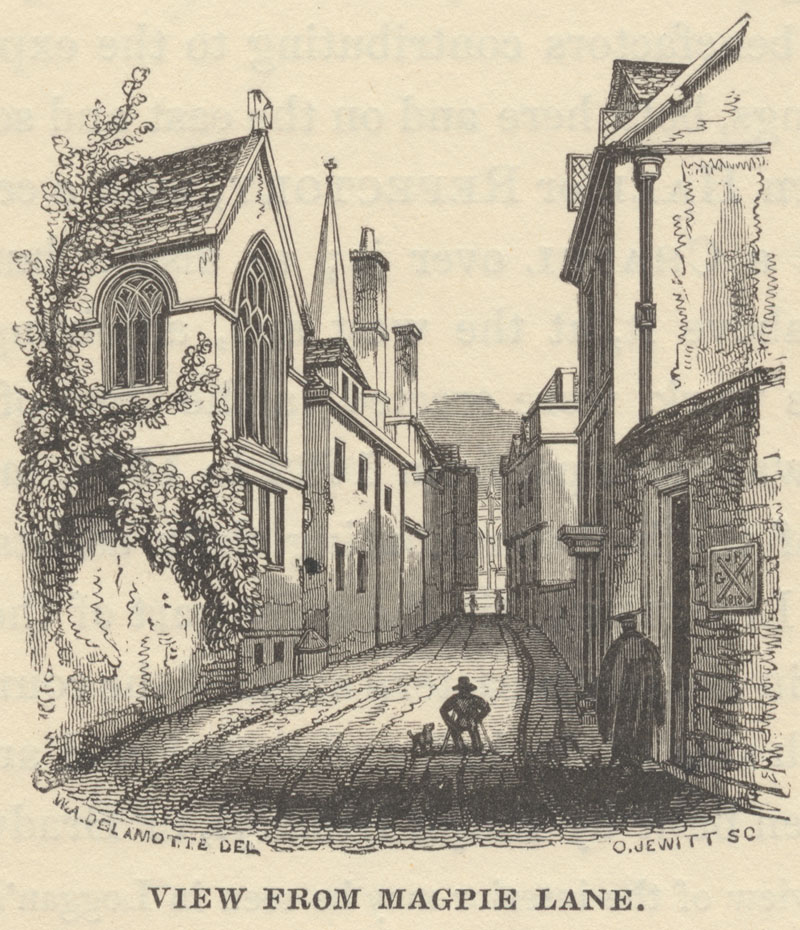
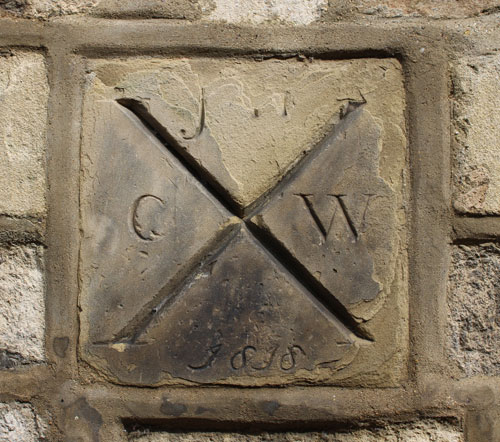
Above: Engraving by Orlando Jewitt shows Magpie Lane in the 1840s, looking north, with the spire of St Mary-the-Virgin Church in the background and Oriel College on the left. On the wall on the right is a square block dated 1818 with the St Andrew's Cross used by St Mary-the-Virgin Church to mark its parish boundaries, in this case with that of St John the Baptist (whose parish church also served as Merton College Chapel)
This parish boundary mark can still be found on the wall of 7 Magpie Lane (right).
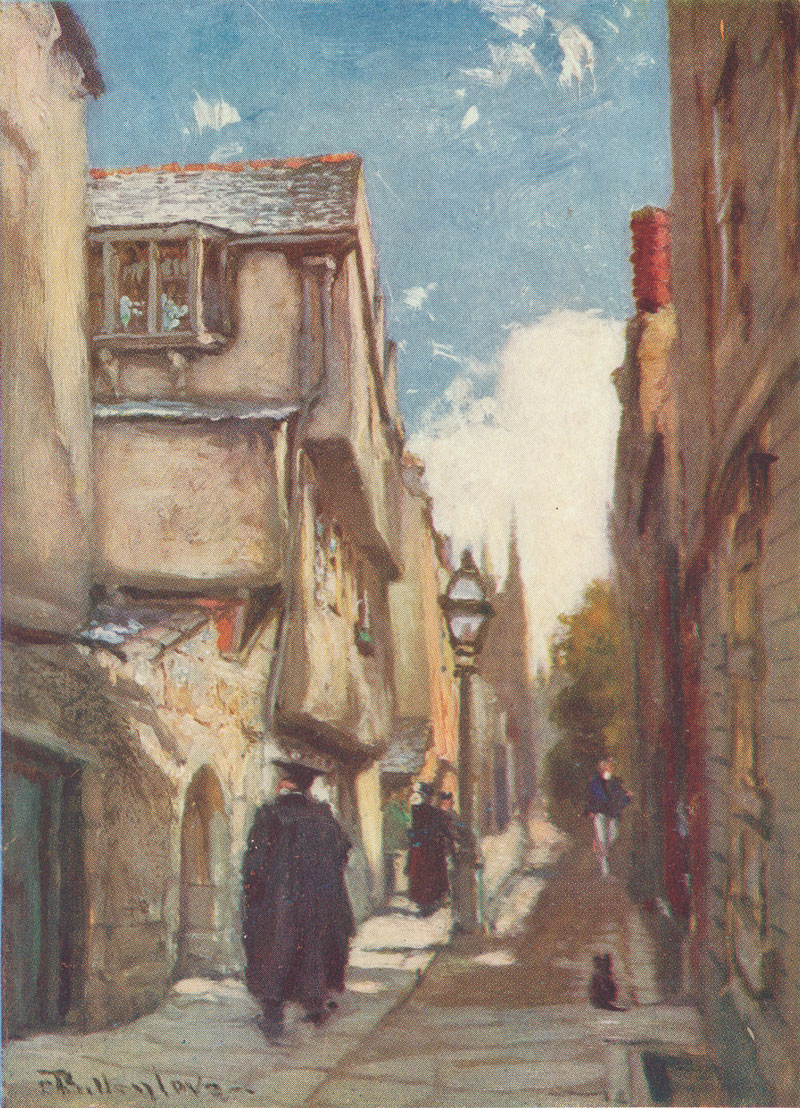
The painting below by John Fulleylove (1845–1908) shows a similar scene to the one in the postcard at the top right, with Merton College at the far end.
The street numbering of Magpie Lane and the surviving houses
The east side of Magpie Lane north of Kybald Street (formerly Grove Place) has nine houses (numbered 1–9). The next four houses between Kybald Street and Merton Street (10, 11, 12, and 13 Magpie Lane) were demolished in the 1960s by Corpus Christi College to make way for modern student accommodation.
The pictures shown below of the nine surviving houses and the Corpus building on the east side of Magpie Lane were taken in May 2006.

1 and 2 Magpie Lane

3 Magpie Lane

4 Magpie Lane

5 Magpie Lane
 6, 7, 8, and 9 Magpie Lane from south
 6, 7, 8, and 9 Magpie Lane looking towards Merton Street
 Corpus Christi College accommodation replaces 10, 11, 12, and 13 Magpie Lane
There is a crime novel named after this lane: Lucy Atkins, Magpie Lane (2021).
Businesses in Magpie Lane in the nineteenth century
The following businesses are listed under Grove Street (Magpie Lane) in Pigot’s Directory for 1823/4:
- Book Binders J. L. WHEELER
- Gun & Pistol makers James FORREST
- Whitesmiths, &c Charles STEVENS
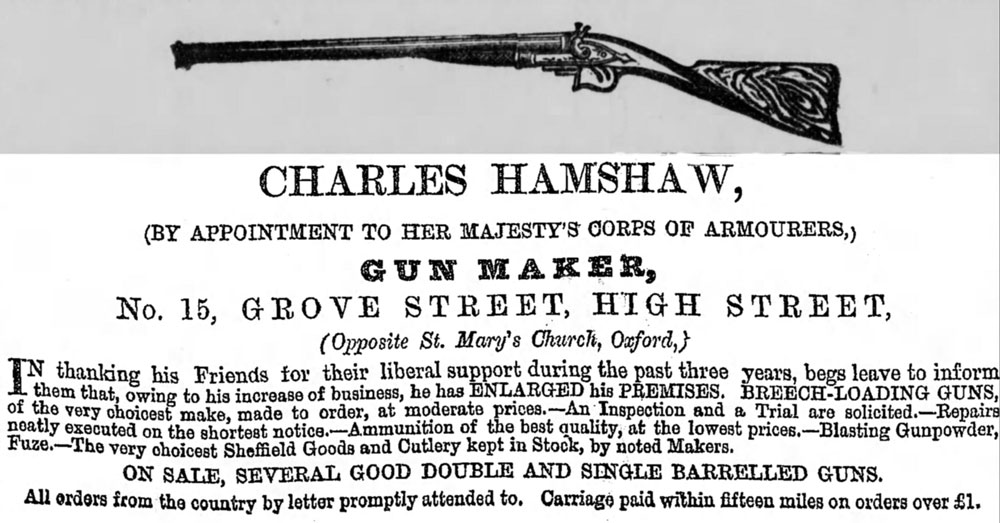
The advertisement below for a gunsmith called Charles Hamshaw whose business was at 15 Grove Street (Magpie Lane) appeared in Jackson's Oxford Journal on 24 August 1872:
Grove Street (Magpie Lane) in the 1851 census
St Mary-the-Virgin parish
1: Joanna Slatter, a widowed grocer, and her two daughters
2: Mary Norman, a widow of 60, and her two nieces
3. Mary Burton, a widow of 33 who was a milliner & dressmaker, and her two infant children, plus two servants;
with Thomas Wilkinson (23), an Oxford Bachelor of Arts, listed as a separate household
4: James Patey (22), a solicitor's general clerk, and his wife and two-year-old son
5. John Betteris (47) a law stationer employing two apprentices, with his wife and four children, plus two general servants
St John-the-Baptist parish
6. Richard Pauling, College servant, and his wife and their servant girl
7: Andrew Paul, surgeon, a widower with his two children, plus a cook and a nursemaid
8: Walter Green, College servant, and his wife and baby daughter, plus their servant
9: Ann Wilkinson, College servant (a widow of 73), and her servant
10: Joseph Cullam, College servant, and his wife and their servant
11: William Green, College servant, and his wife and baby daughter, plus their servant; plus Arthur Marshall (24),
an Oxford undergraduate, and J. H. Dangerfield (25), a student, listed as two other households
12: Emma Martin, a widow with three young children, plus her widower father and their servant; and Charlotte Lane,
a widow of 62, and William C. Gainer, a Bachelor of Arts aged 23, listed as two other households
13: Edward Haynes, College servant, and his wife and four children, plus their servant; and
two Bachelors of Arts,
Almeric Rumsey (25) and Adolphus Hackman (24) listed as two other households
Grove Street (Magpie Lane) in the 1901 census
St Mary-the-Virgin parish
1: Tobacconist's shop
2: Not in occupation
3: William G. Wilkins, College servant, and his wife
4: Samuel Crozier, Accountant, and his wife
5: Miss Emma Collins, University lodging house, with her sister and brother, a servant, and two visitors
St John-the-Baptist parish
6. Children of the lodging house keeper George Shrimpton
7. Henry Horsley, Common room man, and his two grown-up children
8. Caroline Cuddeford, Lodging house keeper, and her two unmarried daughters
9.
Maria Field, a widow of 57, with her sister, and her three employed children,
plus Alexander Hamilton, a private tutor, who lived in a separate household in the building
10: Elizabeth Bevan, a widowed lodging house keeper, and her servant girl
11: Tom Taunt (61), a widowed compositor and University lodging house keeper, and his widowed
sister-in-law Anne Taunt (72), who kept house for him and managed the lodgings
12: Frank Woodford (38), a college servant (bedmaker) and his wife and three children
13: William Bunce, a college servant, and his wife, plus their 14-year-old servant girl
Listed buildings in Magpie Lane (linked to their list entries) |
|
East side, running north to south |
West side, running south to north |
Kybald Street
This cul-de-sac leading off the east side of Magpie Lane, which was in the parish of St John the Baptist, originally continued on to Logic Lane. In the nineteenth century it was often considered to be part of Grove Street, although it was sometimes described as Grove Place. It has now reverted to its ancient name of Kybald Street.
The Black Lion inn was here. John Wilmot was the landlord here in the 1790s. James Slatter was the landlord here from at least 1846 until his death at the age of 68 on 23 December 1848. Charles Maltby was here in 1851 & 1852, and Sarah Maltby his daughter died here on 26 October 1884. Auctions and inquests were held here. Its licence was adjourned until September 1893, and no more is heard of it after that date, and it was listed as unoccupied in the 1901 census.
Jackson’s Oxford Journal on 13 February 1886 reported on a lecture about Oxford in the fourteenth century by J. Gilbert, who stated that this lane was “known as Kybald Twychen, from the circumstances of its connecting to two parishes of St. Mary the Virgin and St. Peter in the East”. A twychen is a narrow lane or alley, and is still remembered today in the name of the sixteenth-century house there called Kybald Twychen that belongs to Corpus Christi College.
Anthony Wood (Life & Times, iii.20) describes it as “antiently called Kibald's Street” and says that at the time he was writing (1662) it was “where the Universitie carrier's stables are”.
- Parson's Almshouses at 4 & 5 Kybald Street
- The Oxford Sausage, 16 November 2025: “Kybald Twychen”
