

133: Oxford Illusion Museum
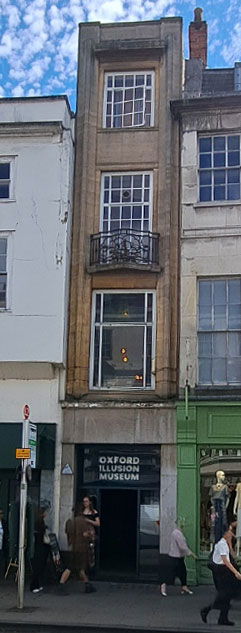
No. 133 was rebuilt in 1937, and with a frontage of 6ft 6in (1.98m) it must be the narrowest shop in Oxford. It was in the parish of All Saints until that church closed in 1971, and is now in the parish of St Michael-at-the-Northgate Church.
There is little today on the ground floor, but the offices upstairs spread over to 134 next door.
The building on this site has been owned by Oxford City Council since about 1420.
The pub on this site (by 1731 to 1905)
For details of those who leased the former building here from 1593 to 1831, see H. E. Salter, Oxford City Properties (Oxford Historical Society, 1926), pp. 137–8.
In 1772 a survey of every house in the city was taken in consequence of the Mileways Act of 1771. No. 133 was then in the occupation of a Mrs Green, and its frontage measured 2 yards 2 feet 10 inches: two feet wider than it is today.
The former very narrow building on this site was a pub for many years. The Split Cow was here from 1731, and in 1810 was renamed the Vine (although it is marked on some maps as The Grapes).
Coaches leaving the Vine Tavern or Inn in the 1830s & 1840s
On 1 March 1834 the Tollit brothers started to run the Oxford Age coach between the Vine Tavern here at 133 High Street in Oxford to London, and on 3 May 1834 a different company advertised The Rapid coach to London through Henley.
Vincent's Directory of 1835 advertised the Echo coach as leaving this inn at 10am and the Age coach at 11am on every day except Sunday
On 8 August 1840 there was a notice that the Defiance would henceforth run to London from the Vine Tavern instead of the Mitre.
The tavern was still listed as still having a coach office in an 1846 directory.
At the time of the 1841 census the victualler Sarah Stephens was living at the old inn here with Elizabeth Stephens and Rosa Stephens (probably her daughter and granddaughter), plus two lodgers, the coachman Joseph Tollit who ran the coach from this tavern , and two female servants. A University Wine Licence was granted to her for 1843/4.
The 1851 census shows George Baker, the tavern's landlord, living here with his wife Mary Anne and their baby daughter plus an 11-year-old servant girl.
In Jackson's Oxford Journal of 2 June 1860 the Vine Tavern was advertised to let, and was described as “a snug little inn”.
The 1861 census shows the inn occupied by Joseph King (39) and his wife Hester and his sister-in-law Jane Bowen.
At the time of the 1871 census the publican living here was Charles Bruton, a widower with a young son.
The 1881 census shows the publican Edward Elson as living here with his wife and daughter and a boarder.
The Oxford Chronicle of 11 October 1884 (p. 7e) reported that a new oak front, designed by H. J. Tollit and with the work carried out by J. Ward, was fitted to the Vine.
By the time of the 1891 census the publican here was the Irish-born Robert Gould (38), and he lived here with his wife Jane, his brother-in-law Alfred Tarbolton, three lodgers, and a servant. The Vine was bought by Halls in 1888, and the 1901 census shows that Gould was still here as the landlord.
The Vine Inn closed in 1905, and this building was unoccupied at the time of the 1911 census.
After two short tenancies, the photographic business Will R. Rose Ltd had the premises here from 1916 to 1936, when the old Vine Inn was demolished. (Since 1908 this firm had also had the upstairs of the shop next door, No. 134, and continued to operate from both premises.)
Present building at No. 133 (from 1937)
William R. Rose Ltd took over the new shop when it was rebuilt in 1937, and his name can be seen on the railings of the second-floor balcony (below).
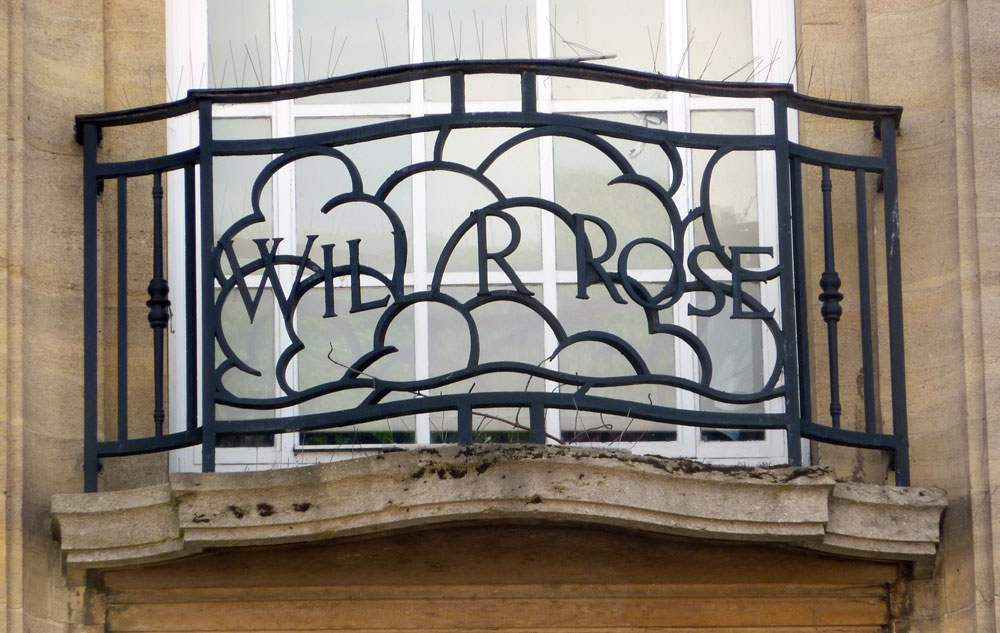
William R. Rose Ltd remained at both 133 & 134 High Street until 1964.
This shop was then taken over by the Automobile Association. In 1981 permission was granted to the AA to turn this shop into an office and combine it with No. 134 next door, but in 1998 the AA retreated back and No. 133 became a separate office.
No. 133 at ground-floor level today is the entrance leading upstairs to the Oxford Illusion Museum, which occupies 22 rooms above both No. 133 and the much larger listed building at 134 next door.
Occupiers of 133 High
Street | |
1810–1904 |
The Vine Inn or Tavern Richard Smith (1801–1817) |
1905–1907 |
Oxford Geographical Institute (William Stanford & Co. Ltd.) |
1908–1915 |
Sherratt T. Scott, Auctioneer & estate agent & valuer |
1916–1964 |
Will R. Rose Ltd., Photographers (also at 134): old building to 1937 |
Will R. Rose Ltd., Photographers (also at 134): new building from 1937 |
|
1967–1998 |
Automobile Association (with 134 next door by 1979) Guardian Royal Exchange |
1998–2022 |
Hay’s Accountancy Personnel |
2023–2025 |
Vacant |
2025– |
Entrance to Oxford Illusion Museum (upstairs here at No. 133 and also over No. 134) |
