

Horse-drawn trams in Oxford, 1881–1915
Horse-drawn trams
Before 1913, the only form of public transport within the city of Oxford was the horse-drawn tram. In 1881 two lines opened:
- East–west: From the Magdalen Road cricket grounds to the Park End Street railway stations,\
via Cowley Road, The Plain, Magdalen Bridge, High Street, Carfax, Queen Street, and New Road - North–south: From Rackham's Lane (now St Margaret's Road) to the bottom of St Aldate's,
via Banbury Road, St Giles', Cornmarket, and Carfax.
PictureOxon: Photograph of a horse-drawn tram at the Magdalen Road terminus
As can be seen in the postcard below dating from 1905, there was a single set of tramlines in the middle of the High Street that split into two to allow passing. Hansom cabs for private hire are waiting for customers outside The Queen's College.
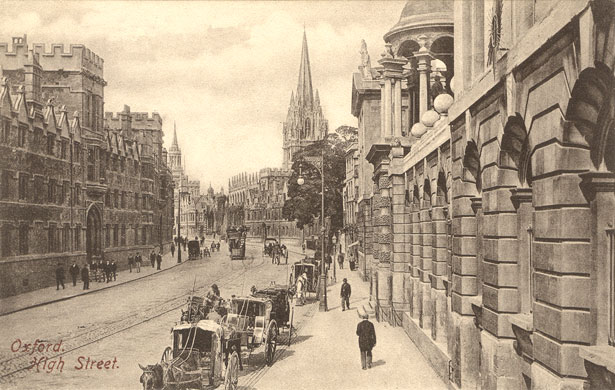
Francis Frith & Co postcard No. 45181
The postcard below entitled “A bit of Old Oxford” was posted in November 1903, and shows a horse-drawn tram carrying weary policemen coming home from their shift after pounding the streets. The sender wrote on the back, “I am sending you this to show you how they take the policemen off when they go off duty, how they fill up the trams.”
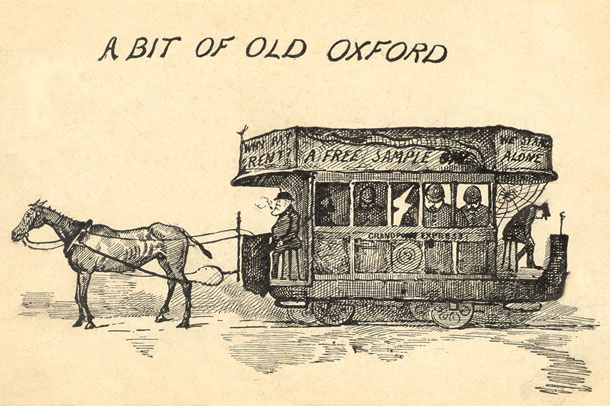
The first tramway in Oxford, from the Oxford railway station via the Rewley Road station, along Queen Street and over Carfax to the High Street and thence along the Cowley Road, was opened on 28 November 1881: see full report in Jackson's Oxford Journal of 3 December 1881. The route was single-track with passing loops, and there were no fixed stops: drivers and conductors had to look out for passengers.
This was followed by trams running south from Carfax down St Aldate's Street and north along Cornmarket and then splitting between the Banbury Road and Kingston Road (via Beaumont Street and Walton Street). On 5 May 1894 Jackson's Oxford Journal reported that it would be running an omnibus service to Summertown (which was becoming a residential locality following the laying-out into building sites of the Diamond Farm estate) in connection to the tramway service in order to test the traffic before laying more lines, This postcard shows the extended lines in about 1905.
By 1895 the City of Oxford and District Tramways Company had a fleet of sixteen single-decker trams, and by 1910 nineteen double-decker trams with 150 horses, with its depot and stables off Leopold Street in east Oxford. There was also a horse-bus network for those parts of Oxford that had no tramways.
The Oxford Tramways (Extension) Order of 1898 led to early trams for workers from 19 June 1899. Henceforth from the Cowley Terminus a tram ran to Kingston Road at 4.55am, to Hinksey at 5am, to the railway station at 5.10am, and Summertown at 5.30am.
Failed proposal for electric trams
The people of Oxford dreamed of motor-buses, but the Corporation considered these vehicles too dangerous and dirty, preferring the cleaner electric tram. The University, needless to say, wanted no change, but considered particularly unthinkable the prospect of overhead power lines in the High.
In 1905 Oxford Corporation put forward a proposal to take over the (horse) Tramways Company and to introduce electric trams.

The postcard above, published by Davis’s of 2 Cornmarket Street (probably in 1906), shows the University’s horror at the idea of an electric tram. The don on the left, Dr James Bright (Master of University College) is saying “Johnnie, I shall have to build another bridge”, referring to the controversial bridge that his college had just built over Logic Lane to link the Durham Building to the older parts of the college.
The tram is packed with members of Oxford Corporation: the gentleman second from the left is probably Alderman Walter Gray, leader of the Conservative group, and top right at the head of the stairs Alderman Robert Buckell, leader of the Liberal group.
This Historic England photograph (CC73/01178) of c.1905 shows two trams using the passing-point in the High:
The postcard below, also produced by Davis's, is dated 1906, but it is hard to understand what the function of the loop near Queen's Lane would have been. The electric tram that is upside-down in the loop is advertising Davis's Oxford souvenirs:

Another Davis postcard, below, shows that trams were no more welcome in St Giles. Here the heads of members of the city council can be seen rising out of an explosion beside an electric tram just north of the Martyrs' Memorial:
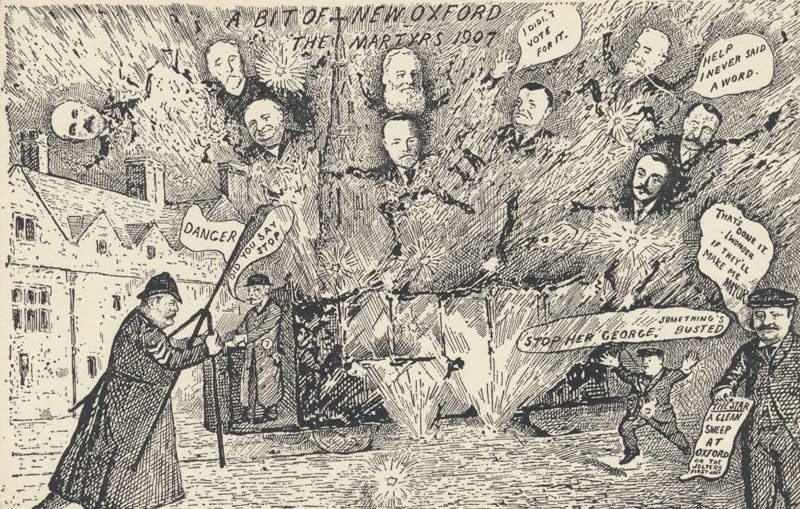
Below is a photograph of a horse-drawn tram in Cornmarket Street dating from about 1907 (Historic England HT10434):
Horse-drawn trams, however, were not without problems and could themselves be quite dangerous, as the following photographs published in the Oxford Journal Illustrated indicate:
- Tram collision in Cornmarket (24 July 1912)
- Broken-down tram at the west end of Queen Street (16 October 1912)
- Tram accident in St Aldate's, when one horse slipped and both became trapped under the tram (11 June 1913).
In the event, escalating costs meant that the electric trams never materialized, and the horse-drawn trams continued to operate. In March 1913 there was a strike by employees of the Oxford Tramways Company, and there are photographs of their procession from the Independent Labour Party's headquarters in Gloucester Street, a strikers' picked outside the depot, and trams being guarded by police in the Oxford Journal Illustrated of 26 March 1913.
- More about the Oxford Tramways on the Culham Ticket Office website
- Harold W. Hart: “The Horse-Trams of Oxford, 1881–1914” (Oxoniensia, 1972)
The Motor bus
In late 1913 William Morris (later Lord Nuffield), manager of the new Oxford Motor Omnibus Company, applied to the City Council for licences to run motor omnibuses. They were slow to respond, and Morris dramatically broke through the impasse when he brought a dozen motor buses from London overnight in November 1913. On 10 December 1913 The Times (of London) reported:
Owing to a misunderstanding considerable delay arose in answering the application, and consequently the company are running a service of motor-omnibuses, tickets being issued to passengers in advance at some of the principal shops in the city. The experiment is being watched by the citizens with much interest, and the service has proved extremely popular. Up to last night no legal proceedings had been taken against the company.
On 8 January 1914 The Times reported that Oxford City Council had on the previous day agreed that twelve licences should be granted to the two competing companies.
The last tram ran on 14 August 1914, and buses are still dominating the High today.
The tramlines were soon removed: the Oxford Journal Illustrated reported on 16 December 1914 that the tram rails were being taken up in the Cowley Road as far as the tramway stables in Leopold Street, and by the time they published this photograph on 10 February 1915 the workers had reached Cornmarket Street.
The postcard below shows an early open-topped motorbus travelling east past All Souls College:
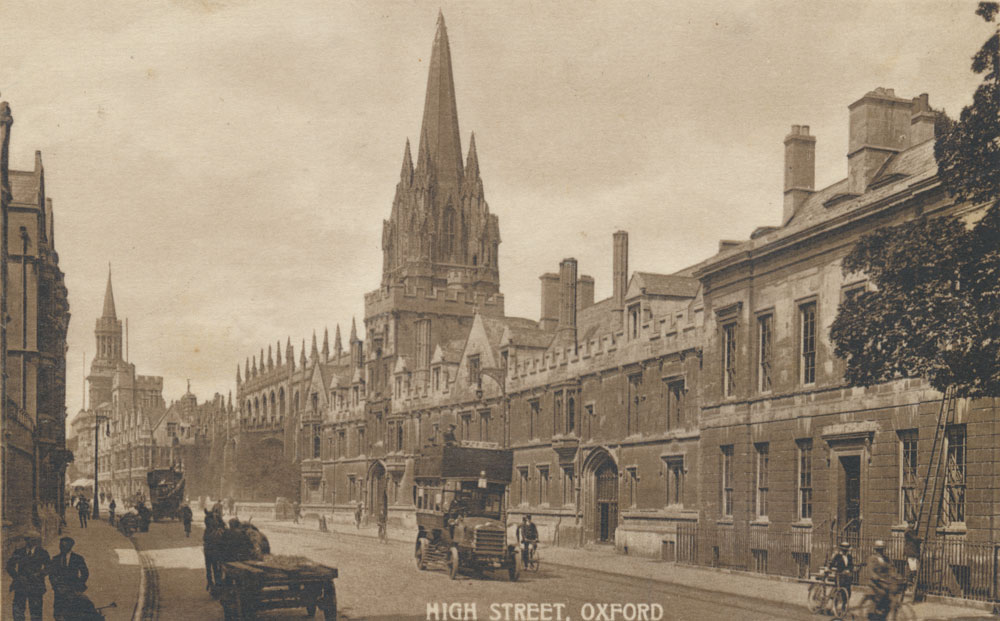
Poem about this new Motor bus by the Public Orator of the University of Oxford
A. D. Godley (1856–1925), Public Orator at the University of Oxford from 1910 to 1920, wrote the following macaronic poem in 1914 when the new bus service started. (The word “Bus” is treated as a Latin second declension noun, and the word “Motor” as a third declension increasing noun, and they appear in ten of the twelve possible case variations.) Further explanation here
MOTOR BUS
What is this that roareth thus?
Can it be a Motor Bus? [nominative singular]
Yes, the smell and hideous hum
Indicat Motorem Bum! [accusative singular]
Implet in the Corn and High
Terror me Motoris Bi: [genitive singular]
Bo Motori clamitabo [dative singular]
Ne Motore caedar a Bo – [ablative singular]
Dative be or Ablative
So thou only let us live:
Whither shall thy victims flee?
Spare us, spare us, Motor Be! [vocative singular]
Thus I sang; and still anigh
Came in hordes Motores Bi, [nominative plural]
Et complebat omne forum
Copia Motorum Borum. [genitive plural]
How shall wretches live like us
Cincti Bis Motoribus? [ablative plural];
Domine, defende nos
Contra hos Motores Bos! [accusative plural]
With thanks to Dr Malcolm Graham, former Head of Oxfordshire Studies, for additional information
