

William Lukyn (1789–1863), dentist
William Lukyn (or Lukin) was born in the City of London on 4 December 1789 and baptised at St Mary Woolnoth Church on 5 March 1790. He was the son of Paul Lukyn and his wife Elizabeth. His father was a stationer and manufacturer of ruled paper and account books, based at 144 Cheapside in 1784; Mansion House Street in 1790; and at 48 St. Paul’s Churchyard 1792–1799 (trading alone 1784–1795, and as Lukyn, Winbolt and Co. 1796–1799).
On 23 September 1812 at St Mary's Church in Lambeth, Surrey, William Lukyn married Sarah Morgan, and they had the following children:
- William Lukyn junior (born in London on 2 October 1814 and baptised at St Mary's Church, Newington Butts with his younger brother John on 14 May 1817)
- John Lukyn (born at Mansion House, George Street, London on 19 July 1816 and baptised at St Mary's Church, Newington Butts with his older brother William on 14 May 1817)
- Edward Lukyn (born in London on 23 May 1818 and baptised at St Mary's, Newington Butts on 14 June 1818)*
- Henry Lukyn (born at Manor Place, Newington, London in early 1820: only survived three weeks and buried at St Mary's Church, Newington Butts on 21 March 1820)
- Elizabeth Lukyn (born in c.1821, probably in London or Devon); died in Oxford aged twelve in 1833
- Christopher Lukyn (born in Plymouth on 19 December 1822)*
- Thomas Lukyn (born on 10 May 1825 and baptised at Heavitree, Exeter on 24 May or 3 June 1825)*
- Anna Maria Lukyn (born on 13 April 1827 and baptised at Bruton, Somerset on 1 or 3 May 1827)*
- Fanny Lukyn (born in Oxford and privately baptised by St Clement’s Church on 31 July 1831 and admitted to the church on the same day).
* On 4 July 1830 Edward, Christopher, Thomas, and Anna Maria Lukyn were all admitted
to St Clement's Church, but only their youngest child, Fanny, was actually baptised there.
While in Newington Butts, London William Lukyn was working as a stationer like his father. He appears to have moved to Plymouth in about 1822, and when he moved to Exeter in about 1823 he was practising as a dentist. He and his family moved a number of times in the next six years, and in 1829 he became an “insolvent debtor” (until 1861 only those who bought and sold goods to make a living could be made bankrupt). He was summoned to appear in the Southampton Court House on 25 July 1829, he was listed in the London Gazette as having been at the following addresses:
William Lukyn, formerly of Black Boy Turnpike Road, City of Exeter, afterwards of Gittisham, near Honiton, Devonshire, afterwards of Wyke, near Castle Cary, Somersetshire, afterwards of Ansford, near Castle Cary aforesaid, and late of the Town and County of the Town of Southampton, Dentist.
Near the end of 1829 William Lukyn moved with his family to practise in Oxford, and was the only dentist listed in the city in Pigot's Directory for 1830. His first surgery in the city was at his home in London Place, St Clement’s: he may have chosen to live and work there because at that time only freemen and matriculated tradesmen could work within the city of Oxford, and St Clements did not become part of the city until 1835.
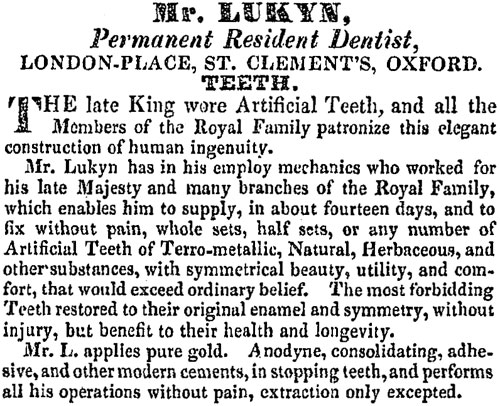
Lukyn’s career can easily be followed in the extravagant advertisements he regularly placed in Jackson’s Oxford Journal. In this early advertisement published on 28 May 1831 he implied a royal connection:
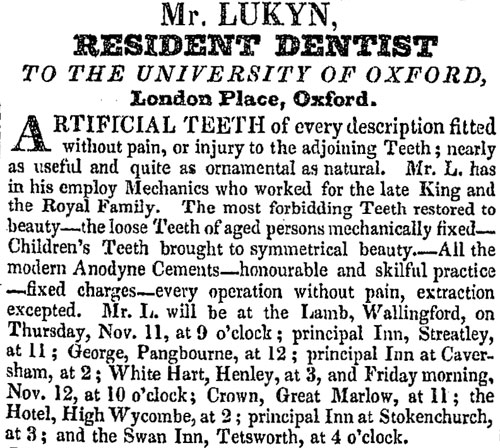
In Jackson's Oxford Journal of 5 November 1831, despite not yet being matriculated as an Oxford tradesman, he described himself as “Resident Dentist to the University of Oxford”:
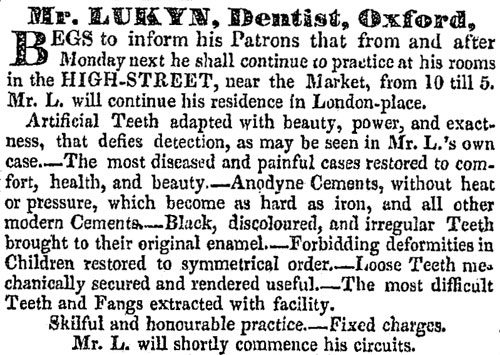
Shortly before 31 March 1832 when the following advertisement was published, Lukyn opened a surgery in the High Street near the Covered Market while continuing to reside at London Place. He invited people in that advertisement to admire the false teeth that he himself wore:
Lukyn was matriculated by the University as a “chirurgus” (surgeon) on 4 December 1832 after attending to the teeth of the current Vice-Chancellor (presumably George Rowley, who held the post from 1832 to 1836). G. V. Cox in Recollections of Oxford wrote:
An Oxford dentist, named Lukyn, about this time [1833] having had the good luck to operate successfully upon a Vice-Chancellor’s erkos odonton [quotation from Homer meaning “barrier of teeth”], asked and obtained the privilege of being matriculated. The consequence was, that wherever he could, in newspapers and by printed circulars, he was ever before one’s eyes as “Lukyn, the Matriculated Dentist”, accompanied in smaller type, by a reprint of the Vice-Chancellor’s acknowledgment of “having been benefitted by his skill”.
The following advertisement appeared in Jackson’s Oxford Journal on 5 January 1833:

Within seven months Lukyn had moved his practice to Cowley House in Cowley Place. His daughter Elizabeth died there on 25 August 1833 at the age of 12 years and 3 months and was buried in St Clement’s churchyard.
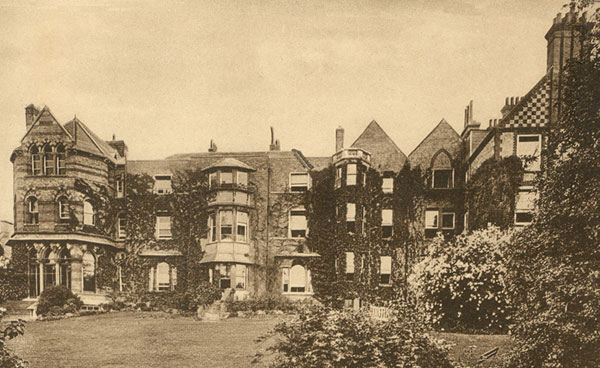
Cowley House (now the Hall building of St Hilda’s College) was at this time owned by an upholsterer called Cooke, and Lukyn would only have rented part of it. The postcard below shows the back of the house, which faces the River Cherwell.
The following advertisement appeared in Jackson’s Oxford Journal on 18 October 1834. Lukyn now specifically boasted that he had been matriculated by the Vice-Chancellor of the University:
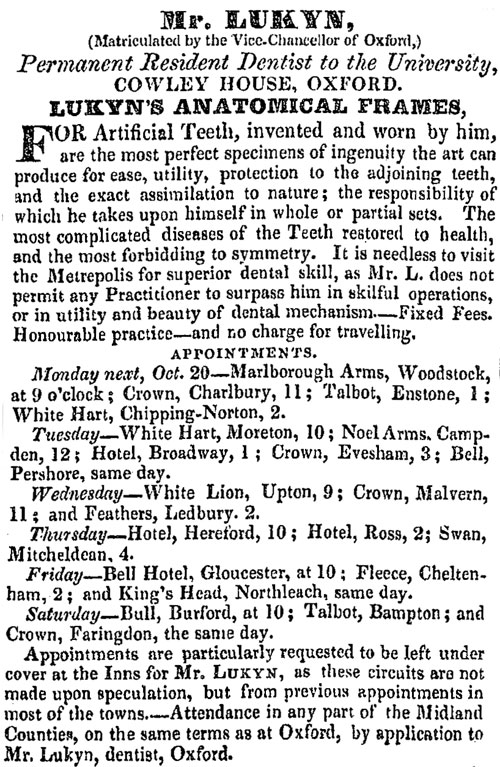
The following notice on 11 July 1835 shows that Lukyn soon took on assistant dentists at Cowley House:
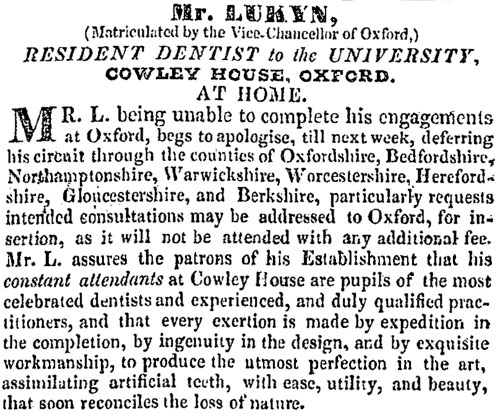
On 3 September 1836 Lukyn advertised that he was willing to travel to perform dentistry not only in Oxfordshire but in Buckinghamshire, Bedfordshire, Northamptonshire, Warwickshire, Worcestershire, Herefordshire, Monmouthshire, Gloucestershire, Berkshire, Wiltshire, Hampshire, and the borders of the neighbouring counties:
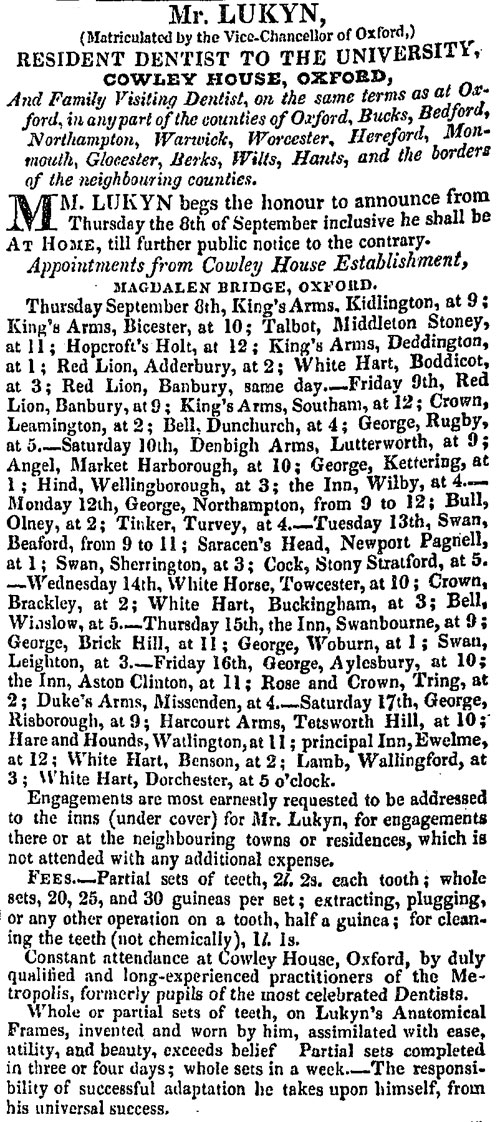
Here, on 11 February 1837, Lukyn advertises for a new assistant:
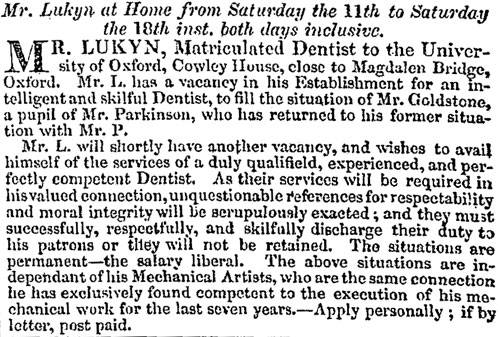
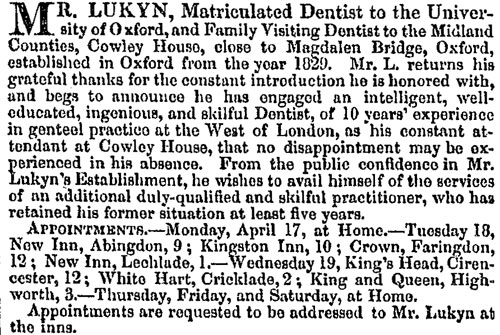
On 15 April 1837, the arrival of the lucky assistant was announced:
A rival dentist, Edward King, whose practice was at 2 High Street was obviously very jealous of Lukyn and tried unsuccessfully to get himself matriculated too. He inserted a notice in Jackson’s Oxford Journal on 18 November 1837 stating that Lukyn was using an “absurd title of an office which does not exist”, and quoting a letter written on 21 October 1837 from the Vice-Chancellor and Principal of Brasenose, Ashhurst Turner Gilbert, confirming that no dentist “more than another, has any testimony from the University to his skill, or any peculiar claim to be employed by its members”. Lukyn evidently took no notice whatsoverr.
In Robson’s Commercial Directory of 1839, Lukyn (stretching a point as to his matriculation, which was actually in 1832) advertises himself as follows:
Lukyn, Wm. Cowley House (& at 24 Spring Gardens, London), Patentee Dentist, & Matriculated Dentist to the University from 1829.
At the beginning of 1839, Lukyn took out a patent on his method of attaching teeth:
William Lukyn, of Lower Cowley House, Oxford, dentist, for certain improvements in applying, and attaching original and natural teeth. January 29; six months.
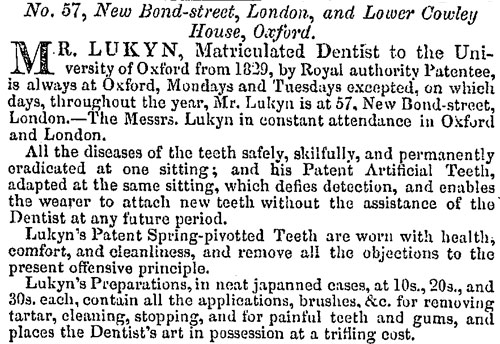
The advertisement below, dating from 1 February 1840, shows that Lukyn had moved the London side of his practice to New Bond Street:
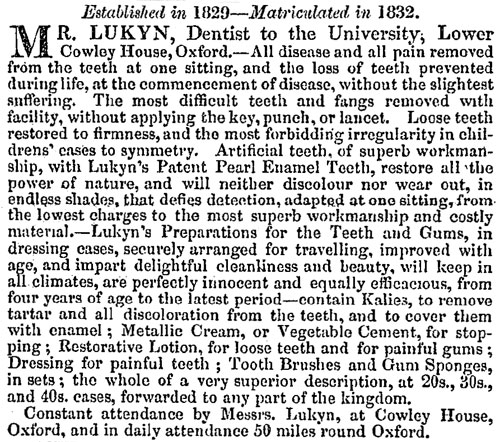
Lukyn’s last advertisement in Jackson’s Oxford Journal was on 9 May 1840:
Less than five months later, on 3 October 1840, the dentist Edmund Bevers inserted a notice in Jackson’s Oxford Journal to say that he had succeeded to Lukyn’s practice. Two weeks later Bevers distanced himself from him in another advertisement stating that “In consequence of the unfounded reports, Mr Beavers takes this opportunity of informing his friends there is no connection whatsoever existing between him and Mr Lukyn, who formerly resided at Cowley House”.
Meanwhile Lukyn himself was once again an “insolvent debtor” and had been sent to a debtors' prison. Described in the London Gazette as a prisoner, he was ordered to be brought up before the Court for Relief of Insolvent Debtors at the Court House in Portugal Street on 22 March 1842 with his numerous addresses in both Oxford and London repetitively recorded:
William Lukyn the elder (sued and committed as William Lukyn), formerly of London-place, Saint Clement's, Oxford, and of High-street, Oxford, then of Cowley House, Cowley, near Oxford, Oxfordshire, also of High-street, Oxford, and also of No. 24 Spring-gardens, Charing-cross, Middlesex, Dentist,
then of Lower Cowley-house, Cowley aforesaid, also of High-street, Saint Clement's aforesaid, also of No. 24, Spring-gardens aforesaid, Dentist,
then of Lower Cowley-house aforesaid, also of No. 57, New Bond-street, and of Lancaster-court, New Bond-street aforesaid, both in Middlesex, having also a Store-room in Cantel's-lane, at the back of Lower Cowley-house aforesaid, Dentist,
then of No. 5 A, Sloane-street, Chelsea, also having a Store-room at York-street, Han's-place, Knightsbridge, both in Middlesex, afterwards of No. 15, Great Surrey-street, Blackfriars-road, Surrey, and of Cantel's-lane, and having a Store-room at York-street aforesaid, then of No. 3, South-crescent, Bedford-square, Tottenham-court-road, Middlesex, and of Cantel's-lane aforesaid, having a store-room at York-street aforesaid, and late of No. 9 South-crescent aforesaid also having a Store-room at York-street aforesaid, Dentist.
It was reported in The Times on 5 April 1849 that William Lukyn was heard at the Court for the Relief of Insolvent Debtors on 19 February 1849 and would appear again on 23 April to apply for orders of protection and discharge.
At the time of the 1851 census William Lukyn (62) was practising as a dentist in Nottingham and living at St James Street there with his wife Sarah (57) and their daughter Fanny (19).
On 19 October 1852 he was living at Broad Street in Nottingham when he was granted a patent on “a liquid draught detector, or self-measuring tube, with a union conveyance tap and its stock and time table”.
In December 1856 William Lukyn, described as a dentist of Nottingham, submitted a patent for a “buffer brake for railway carriages or trucks attached to locomotive engines, whether one or more engines for the conveyance of goods or passengers”.
On 29 April 1858 Lukyn placed an advertisement in the Nottinghamshire Guardian for artificial teeth at much lower prices than he charged at Oxford: a single tooth cost 15 shillings in Nottingham but had been two guineas in Oxford back in 1836.
Lukyn's wife Sarah died in the Radford registration district of Nottinghamshire near the beginning of 1859.
On 20 April 1860 William Lukyn, now of Broad Street, Radford House, Ilkeston Road, Nottingham, took out a patent for “A method of attaching artificial or natural teeth on expanded or contracted frames”.
The 1861 census shows William Lukyn as a widower, living at Radford House in Radford, Nottinghamshire with a servant and Hannah Spurr, a widow aged 46 described as an “Operative Dentist”.
William Lukyn died in Nottingham on 15 January 1863. His effects came to under £450, and Hannah Spurr was his executor.
Lukyn’s sons
There was a pair of dentist brothers with the surname Lukyn working in New Bond Street, London at the same time as William Lukyn was based in Oxford and London, who were probably his sons. On 4 April 1846 Edward Lukyn put an advertisement in The Times, saying that he was formerly with a Mr Bell, but had moved from Cheapside to 35 New Bond-Street. This gentleman later added that he was “sole dentist to the ex-Queen and King of the French”. His brother, Thomas Lukyn, worked with him for ten years and then opened his own practice at 3 Wyndham Place.