

No. 52: White Horse
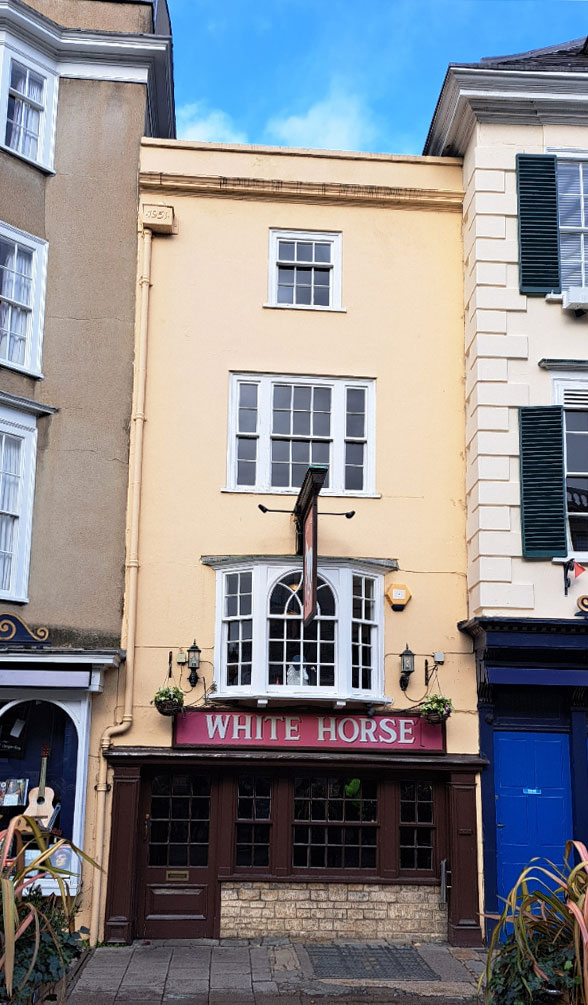
This tiny pub is squeezed between Blackwell’s main shop and its newer small shop to the west. The building dates from the sixteenth century, although its stuccoed timber-framed fronting probably dates from the eighteenth. Its front was rebuilt in 1951, when a painted wall was revealed on the first floor.
It is a Grade II listed building (List Entry No. 1185470), and is in St Mary Magdalen parish. It belonged to the city from 1629 to 1773, and was then owned by Exeter College up until 1980, when it was taken over by the brewery which owned the pub. It was formerly a Hall’s pub, but was taken over by Mitchell’s & Butler in May 2006.

The names of this pub at 52 Broad Street
This is one of Oxford’s oldest pubs and has had four names:
- The Mermaid when the whitebaker Roger Scott was given a licence for it in 1591. It was later known as the White Mermaid
- The Jolly Volunteer
- The White Horse
- The Elephant: when the Elephant to its east closed down in 1820, this pub appears to have adopted that name for the next fifteen years.
- From the late 1830s the pub is listed consistently in directories as the White Horse.
John Norris was the landlord here from 1748. In 1772 a survey of every house in the city was taken in consequence of the Mileways Act of 1771, and No. 52 was then in the occupation of his widow Mrs Norris, and its frontage measured 4 yards 1 feet 9 inches. Later that year the building was sold by the city to Robert Curtis, a cook.
By the time of the 1841 census James King was the victualler at the White Horse, and he lived here with his wife Ann and their children George (21), who was a cook, Alfred (17), who was an apprentice harness maker, Mary Ann (11), and Emma (9), plus five male servants.
Their daughter Emma died at the White Horse at the age of 16 in 1850, and the 1851 census shows James & Ann King still living on the premises with their son Thomas. The latter is described as a “coach porter”, which suggests that the building may already have become a cab office, as it certainly was in the 1860s when John Jones was landlord.
James King died at the pub at the age of 65 on 28 January 1858, and the 1861 census shows his widow Ann King as the publican, living here alone with one servant. She died near the end of 1865.
John Jones had taken over the pub by 1866 and was also a cab proprietor. The 1871 census shows him as a widower of 47 living over the pub with his three young children, a general servant, and two boarders.
The 1881 and 1891 censuses shows the licensed victualler John Harper living at the pub with his wife Jessie and their four children. John died at the age of 55 near the beginning of 1900, and the 1901 census shows his widow Jessie Harper living here as the landlord with her daughter Mary.
Albert Charles Rawlins took the pub over in 1908, and at the time of the 1911 census he was living in the six rooms of accommodation with his wife Rosa and their three children.
The 1921 census shows Richard G. W. Wilkins (46), a painter for Salter Brothers, living in five rooms over the pub with his wife Harriet and their two children. He died near the beginning of 1935, and his wife Harriet took over the licence. The 1939 Register shows Harriet living here with a young woman called Joan Patterson who undertook unpaid domestic duties.
From 1957 to 1978, the sign at this pub showed a mounted policeman on a white horse holding back the crowds when they broke the barriers at the Cup Final between West Ham and Bolton at Wembley in 1923.
In 1980 a fire in the kitchen badly damaged the White Horse, but it was carefully rebuilt and reopened in 1981. It appeared several times in the Inspector Morse television series.
|
Occupants of 52 Broad Street listed in directories |
Elephant 1823: B. Clarke |
| White Horse 1839: Richard Preston |